
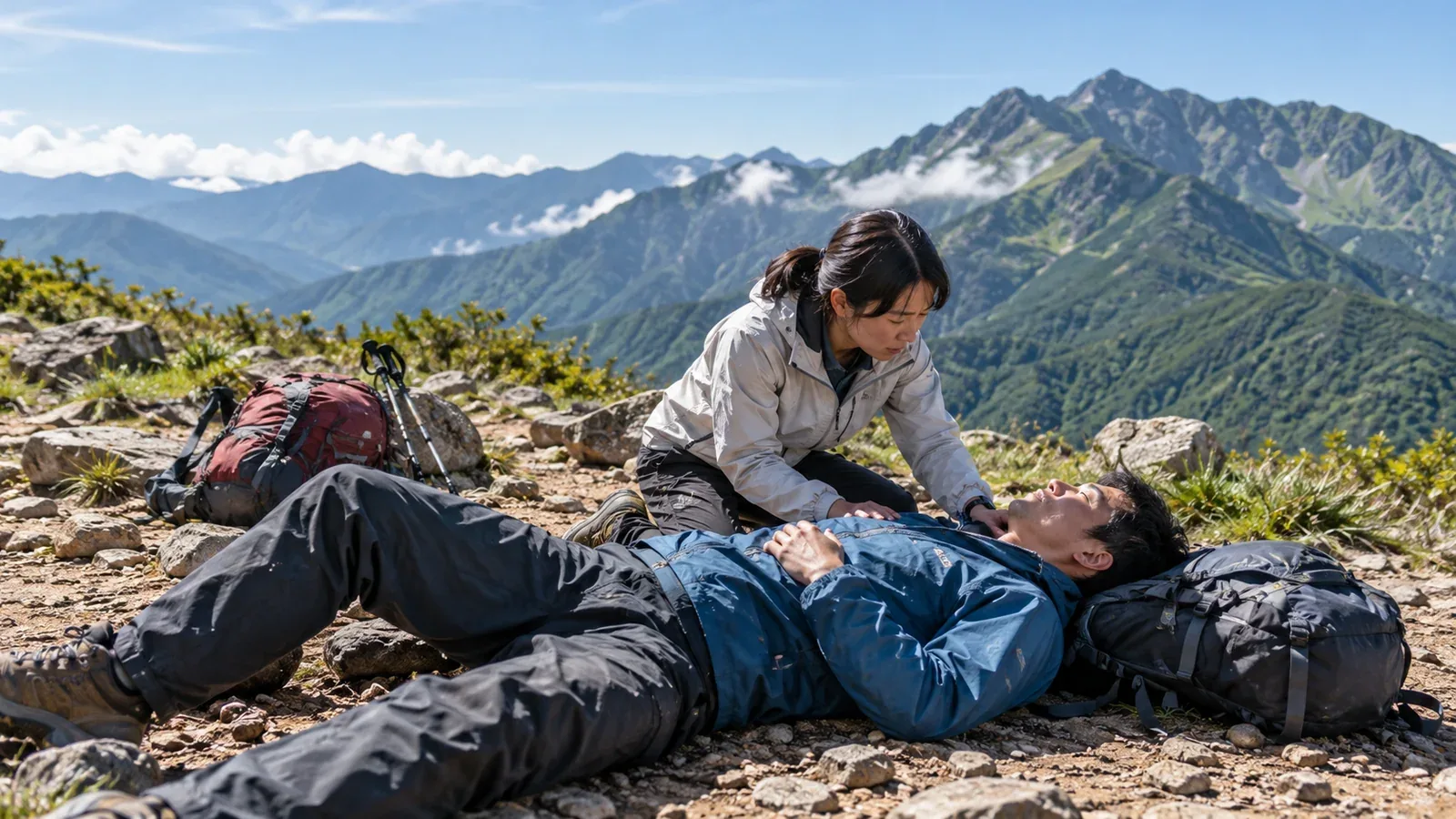
If a companion suddenly collapses or develops new chest pressure, trouble speaking or weakness on one side, stop immediately and call 119 in Japan. A medical emergency on the trail may require rescuers to reach you on foot or arrange another way to get you to care.
Heart attacks and strokes can cause lasting damage. Early treatment matters, and the time it takes to reach a trail makes an early call especially important. Give the dispatcher your location and tell them what happened.
The signs below can help you recognize an emergency, give first aid and make decisions while waiting for help.
Possible heart attack: take chest symptoms seriously
Why exertion matters
Steep climbing, cold and altitude can increase the strain of a hike. Pay attention to new or unusual symptoms, even if the person has hiked the route before or has no known heart condition.
Warning signs to recognize
A heart attack can start with one or more of these symptoms.
- Pressure, squeezing or pain in the chest: Some people describe heaviness or tightness in the middle of the chest. The sensation can vary.
- Pain or discomfort elsewhere: It can spread to either arm, the shoulder, jaw or back. Some people have little or no chest pain.
- Cold sweat, nausea or unusual fatigue: These may appear with shortness of breath or chest discomfort.
- Palpitations or an irregular heartbeat: A racing or irregular pulse with faintness, chest discomfort or shortness of breath also warrants urgent help.
Stop exertion and call 119 promptly for suspected heart attack. Symptoms can ease or return. Avoid making the person walk to see whether they improve.
Cardiac arrest: CPR and an AED
Check that the scene is safe. If the person is unresponsive, get help and check for normal breathing for no more than 10 seconds. Occasional gasps are not normal breathing. Follow the dispatcher’s directions.
- Call for help and have someone bring an automated external defibrillator (AED) if available.
- Call 119 and explain that the person is unresponsive. Give your location and use speakerphone if possible.
- Start chest compressions if the person is not breathing normally. For an adult, press on the center of the chest at 100–120 compressions per minute, about 5 cm deep and no more than 6 cm. Let the chest rise fully between compressions and switch with a companion if possible.
- Use the AED as soon as it arrives. Follow its voice instructions and the dispatcher. Some trailheads and huts have an AED.
The Japanese Red Cross Society and local fire departments offer hands-on CPR and AED courses. A course lets you practice compressions and switching with another rescuer.
Possible stroke: recognize the signs with FAST
What a stroke is
A stroke occurs when a blood vessel in the brain is blocked or ruptures. The sooner the person reaches medical care, the sooner clinicians can assess treatment options. On a remote trail, calling early gives responders time to reach you.
FAST: a quick stroke check
FAST is an easy way to remember three common warning signs and the need to act quickly.
- Face: Ask the person to smile. Does one side of the face droop?
- Arms: Ask them to raise both arms. Does one arm drift down?
- Speech: Ask them to repeat a simple phrase. Is speech slurred, difficult or absent?
- Time: Call 119 immediately if you see any of these signs.
Other sudden symptoms include a severe headache, loss or blurring of vision, weakness or numbness on one side, and trouble walking or keeping balance. Call 119 for possible stroke even if all three FAST checks seem normal.
What to do while help is on the way
- Stop and make the area safe. Have the person rest in a comfortable position. Move them only as needed to escape immediate danger or as directed.
- Call 119 immediately. Give GPS coordinates or a landmark, symptoms, group size and any access difficulties.
- Watch their breathing and response. If unresponsive and breathing normally, place them on their side if safe and follow the dispatcher’s guidance. If breathing is absent or abnormal, start CPR and use an AED when available.
- Keep them warm and give nothing by mouth. Swallowing may be impaired.
- Note when symptoms started. If you don’t know, report the last time the person was known to be free of symptoms.
When to call from the trail
If you suspect a heart attack or stroke, call from where you can do so safely. Let the dispatcher decide what kind of help is needed.
Call 119 immediately for any of these signs
- Reduced awareness or loss of consciousness
- Unresponsiveness with absent or abnormal breathing
- Any FAST sign or another sudden stroke symptom
- New chest pressure or pain suggesting a heart problem, even if it subsides
- Sudden severe trouble breathing, walking or staying upright
Wait for guidance on whether to move
- Even if symptoms resolve, report the signs and when they occurred.
- Share any known condition and what the person was doing when symptoms began.
- Describe the terrain and possible ways to reach you, and follow the dispatcher’s instructions.
Stroke symptoms can resolve during a transient ischemic attack (TIA). A TIA still needs urgent evaluation. Call 119 even if facial droop, speech difficulty or weakness has passed.
Prepare before you leave
Your group can do several things in advance to make it easier to help in an emergency.
- Review health conditions and medication: If you have heart disease, hypertension or diabetes, discuss the route with your clinician and carry any prescribed medication. Tell a trusted companion what responders may need to know.
- Share the route and a contact: File a hiking plan where applicable and tell someone when you expect to return.
- Check your insurance: Review whether private search and evacuation costs are covered and which areas and activities the policy includes.
- Plan how to call: Check local advice about mobile coverage and compatible satellite equipment. Save the route for offline use.
- Practice CPR and AED use: Take a first aid course with a local fire department or the Japanese Red Cross Society.
Before your next hike
Share your plan, identify where you can call and make sure your companions know the warning signs. If you have an existing condition, bring your proposed route to your clinician. Nordwand can help you find a guide familiar with the route.
Sources
- Japan Ministry of Health, Labour and Welfare: when to call 119
- National Cerebral and Cardiovascular Center: acute myocardial infarction
- National Cerebral and Cardiovascular Center: stroke and when to seek care
- Fire and Disaster Management Agency: adult CPR and AED use
- Japanese Red Cross Society: first aid training
References and sources
- Japan Ministry of Health, Labour and Welfare — When to call 119
- National Cerebral and Cardiovascular Center — Acute myocardial infarction
- National Cerebral and Cardiovascular Center — When to seek emergency care
- National Cerebral and Cardiovascular Center — Stroke
- Fire and Disaster Management Agency — CPR and AED
- Japanese Red Cross Society — First aid courses