
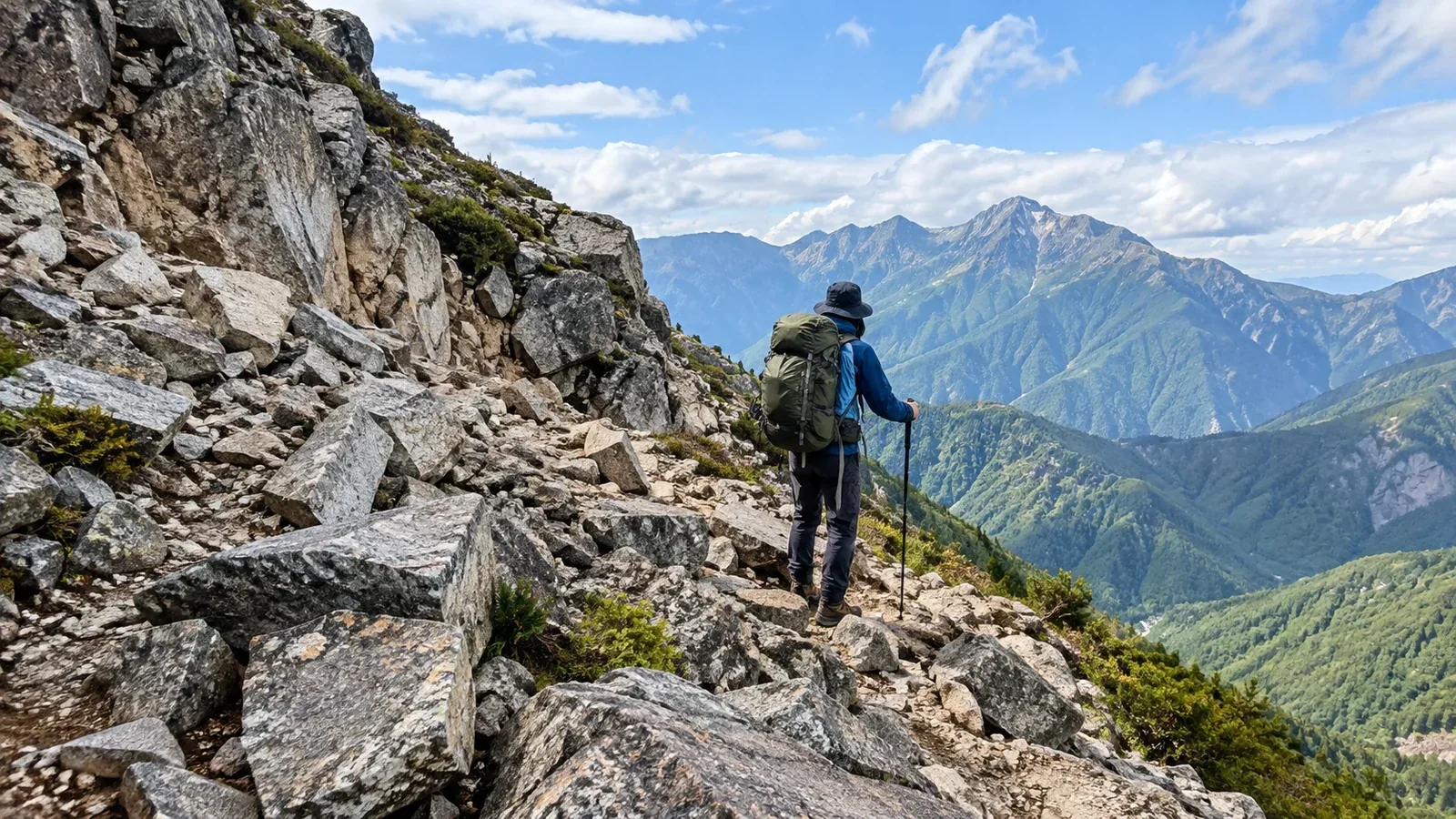
If you feel strong shaking on a mountain, first protect yourself from falls and falling rocks. After it stops, cliffs can still collapse, and a trail you just used may be impassable.
Here’s what you can do during the shaking and what to check afterward, whether you’re on a ridge, beside a stream, on rock, or inside a mountain hut.
What shaking can do to slopes and trails
Japan’s Fire and Disaster Management Agency advises hikers to protect themselves from falling rocks during strong shaking and to stay away from cliffs and steep slopes.
Rockfall and rock collapse. Shaking can dislodge rock and send it down a slope. Beneath a cliff or a scree slope, pay attention to where rocks could fall or roll.
Landslides and moving debris. Material loosened by shaking can move into a stream channel. Stay away from unstable slopes and gullies after the shaking too.
Trail damage. A trail edge can give way, and bridges and steps can be damaged. Check whether the route is passable, even if you plan to go back the way you came.
What to do when you feel shaking
Call out to people nearby and protect yourself from losing your footing or being struck by falling objects. During strong shaking, avoid running any distance or staying exposed to read your phone.
How to protect yourself in different places
On a ridge. Move away from a drop or an unstable edge as far as you can safely manage. Get low on firm ground and protect your head.
Beside a stream or in a valley bottom. Watch your footing and what’s overhead. Look for a safe way away from the base of cliffs and flowing water. If a debris flow is approaching, move out of its path to the side and get to higher ground you can reach safely.
On rock or a chain-assisted section. Keep your footing and balance, and watch for falling rocks. Avoid jumping or rushing up or down during strong shaking. Move to a safer place when you can do so steadily.
In a mountain hut or shelter. Move away from windows and shelves that could fall. If a sturdy table is close by, get under it and protect your head. Stay clear of the exit while the ground is shaking and follow hut staff instructions afterward. Deal with stoves or flames when you can do so safely.
What to check after the shaking
Once the shaking stops, check whether hazards are still present and how the people with you are doing.
- Check for injuries. Check responsiveness, breathing, and heavy bleeding. If someone is badly hurt or unable to walk, call for rescue. Avoid moving them unless there is immediate danger or you must do so to save a life. Follow the dispatcher’s instructions.
- Look up and check the slope. Stay away from places where you hear falling rocks or see dust or a collapsing slope. Think about whether you could protect yourself where you are if the shaking starts again.
- Reassess where you are. If you’re below a cliff or in a stream channel, check your footing and move to stable ground nearby.
- Call from a safe place. If a phone or satellite device works, give your location and the condition of your group. Stay clear of damaged trails and dangerous slopes when looking for a signal.
- Decide whether to descend or wait. Consider trail access, injuries, further shaking, the time until dark, the weather, and your equipment.
When to descend and when to wait in a safe place
Moving out of immediate danger to a nearby safe spot is a separate decision from making a long descent. If someone can’t move independently or the trail is gone, prioritize rescue.
Consider descending if
- Local notices or what you can see from a safe position confirm the descent route is passable.
- Everyone in the group can walk safely.
- You have a margin for darkness, visibility, weather, and the equipment you have.
- You can avoid places with a high risk of rockfall or debris, such as cliff bases or gullies.
Prioritize waiting or calling for rescue if
- The trail has collapsed, you can’t confirm whether it is passable, or there is no safe detour.
- Further shaking or rockfall makes moving more dangerous.
- Darkness or bad weather makes it hard to see your footing.
- Injury or another problem prevents you from descending without help, and you have a nearby place to wait away from falling rocks and unstable slopes.
If you need rescue in Japan, call 110 for police or 119 for fire and emergency medical services early. Give the mountain name, route, trail junction or coordinates, group size, and injuries. Follow instructions. If you move after calling, tell the dispatcher where you’re going if possible.
What to prepare before entering the mountains
Check information for your destination and agree with your group on where you could stop if the trail became impassable.
Earthquake and volcano information. Check the Japan Meteorological Agency and trail notices from local authorities and mountain huts.
Hiking plan. Find out where and how to file it. Share the planned route and return time with family or another trusted person.
Mountaineering helmet. Wear one on rocky routes where a fall or falling rocks could injure your head.
Equipment for waiting. Pack warm layers, an emergency sheet or shelter, a headlamp, water, extra food, and first-aid supplies suited to the season and route.
Before your next hike
On the map, locate cliffs, gullies, and rocky passages. Think about where you could stop safely and which landmarks would help you report your location. Check for trail notices at the trailhead or from mountain huts before setting out.
Sources
- What to do when you receive an earthquake early warning (Japan Meteorological Agency)
- Earthquake guidance for hikers (Japan Fire and Disaster Management Agency)
- Earthquake-induced rockfall and landslides, and escaping a debris flow (U.S. Geological Survey and Japan Ministry of Land, Infrastructure, Transport and Tourism)
- Mountain rescue and calling 119 (Nagano Prefecture and Japan Fire and Disaster Management Agency)
- Hiking plans, helmets, and earthquake and volcano information (Nagano Prefecture and Japan Meteorological Agency)
References and sources
- Japan Meteorological Agency: What to do when you receive an earthquake early warning
- Japan Fire and Disaster Management Agency: Earthquake guidance for people in the mountains
- U.S. Geological Survey: What are the effects of earthquakes?
- Japan Ministry of Land, Infrastructure, Transport and Tourism: Preparing for landslides and debris flows
- Nagano Prefecture: What happens from the call for help through mountain rescue
- Japan Fire and Disaster Management Agency: Calling 119 in an emergency
- Nagano Prefecture: Filing a hiking plan
- Nagano Prefecture: Mountain areas where helmets are recommended
- Japan Meteorological Agency: Earthquake information
- Japan Meteorological Agency: Volcano data and information