
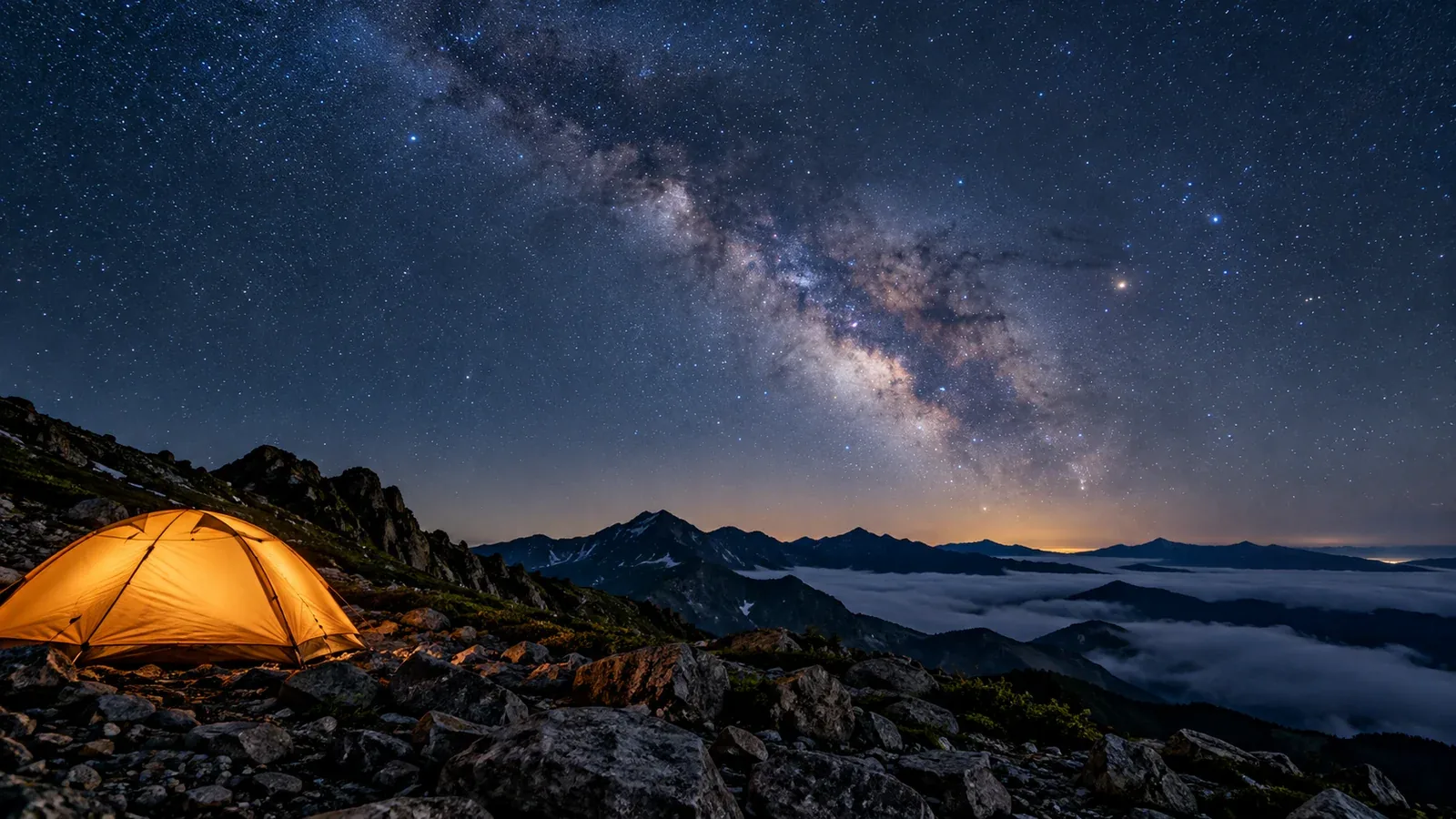
Step outside a mountain hut and you may see stars you couldn’t see in town. Elevation affects the atmosphere above you, while artificial lighting, the Moon, clouds, and haze also affect what you see.
Here’s what changes at higher elevations, how to find a dark sky, and how to prepare for a safe night of stargazing in the mountains.
What happens to starlight at higher elevations?
Some of the light from stars is scattered or absorbed as it passes through the atmosphere. Air molecules, tiny particles, and clouds affect how much light reaches your eyes.
For the same viewing direction, there is generally less atmosphere above you at higher elevations. Airmass describes how much atmosphere you are looking through. Light near the horizon travels a longer, slanted path than light from directly overhead, so stars there are more likely to look dimmer.
Artificial lights affect sky brightness too. Light from the ground scatters in the atmosphere, and parts of the horizon can glow even far from town. Consider where nearby and distant lights are as well as your elevation.
Four conditions that affect what you can see
When choosing a viewing spot, consider elevation, transparency, atmospheric turbulence, the Moon, and how much of the sky is open to view.
Sky transparency
Faint stars are easier to see when there’s little cloud, fog, or haze. Seasonal patterns offer some clues, but a ridge can be clouded over even when the rest of the area is clear. Check the regional weather forecast and local reports from mountain huts or other sources.
Seeing: How steady the air is
Atmospheric turbulence can make stars appear to wobble or blur in a telescope. Astronomers call the atmospheric conditions that affect image steadiness and sharpness seeing. A clear night with faint stars visible can still offer poor views of fine detail through a telescope.
Moonlight, moonrise, and moonset
With the Moon above the horizon, its light can make faint stars and the Milky Way hard to see. Check moonrise and moonset at the viewing spot as well as the Moon’s phase. Also check when the sky will get dark enough after sunset.
How much of the sky can you see?
Trees can hide the sky near the horizon. Choose a place with firm footing and a clear view in the direction you want to look, such as a designated hut terrace or a viewpoint open at night.
How faint a star can you see without a telescope?
The brightness of the faintest star you can see with the unaided eye is called the limiting magnitude. Higher numbers mean fainter stars. The National Astronomical Observatory of Japan gives magnitude 6 as an approximate naked-eye limit under an ideally dark sky.
Even at the same site, moonlight, haze, nearby lights, and how well your eyes have adjusted to the dark affect which stars you can see. Compare the faintest star you saw in a constellation with a chart to record that night’s visibility.
How clearly the Milky Way appears also depends on sky darkness, clouds, and how high it is above the horizon. If you’re comparing star counts or views of the Milky Way, note the direction and time.
Preparing to stargaze in the mountains
Check the viewing spot and the route there and back in daylight, and confirm that you can use it at night. Choose a spot where you won’t need to look for a path or find your footing after dark.
Lighting and night vision. Check your headlamp and pack spare power. Once you’ve stopped somewhere safe, give your eyes time to adjust and use a dim red light if needed. When walking, use enough light to see your footing.
Staying warm. You won’t move much while watching the sky, and wind can chill you. Check nighttime temperatures and wind, and bring warm layers, a windproof layer, and gloves.
Footing and where to go. Choose a spot that keeps you away from steep rock and cliff edges at night. At an open mountain hut or a designated campsite, keep pathways clear while you watch.
Changes in the weather. Wrap up early if clouds gather, the wind strengthens, or fog makes the return route hard to see. Check the weather before leaving and again on site.
Seasonal sights in Japan’s night sky
The constellations you can see depend on the time and latitude. These are some features to look for on Japanese nights in each season.
- Autumn. Look for the Great Square of Pegasus. From a dark site, look for the Andromeda Galaxy too. The Orionid meteor shower is active in October.
- Winter. Look for Orion, the Winter Triangle, and the Pleiades. Choose a spot open at night and prepare for the cold and icy footing.
- Summer. Use the Summer Triangle to find the Milky Way. With a clear view south, you may see the brighter part of the Milky Way toward Sagittarius.
- Spring. Look for Leo, Virgo, and the Spring Triangle. The region of sky toward Virgo is a good place to observe galaxies through a telescope.
Meteor showers recur at roughly the same time each year, but the best viewing hours and moonlight change. Check that year’s information from the National Astronomical Observatory of Japan or another observatory.
Before your next night out
Choose a place open at night where you can check the footing during the day. Check the Moon’s position, clouds, wind, and your way back for the planned time, then bring working lights and warm layers.
Sources
- Atmospheric extinction, seeing, and naked-eye magnitude (European Southern Observatory and National Astronomical Observatory of Japan)
- Moonrise, moonset, seasonal constellations, and meteors (National Astronomical Observatory of Japan)
- Choosing a viewing site, lighting, and weather (National Astronomical Observatory of Japan, U.S. National Park Service, and Japan Meteorological Agency)
References and sources
- European Southern Observatory: Photometry and atmospheric extinction
- European Southern Observatory: Definitions of observing conditions
- National Astronomical Observatory of Japan: Where is a good place to observe the sky?
- National Astronomical Observatory of Japan: Night-sky brightness and magnitude
- National Astronomical Observatory of Japan: Astronomical calendar calculations
- National Astronomical Observatory of Japan: Choosing a viewing spot and adapting to the dark
- National Astronomical Observatory of Japan: Constellations by season
- National Astronomical Observatory of Japan: When can I see meteors?
- U.S. National Park Service: Stargazing basics
- Japan Meteorological Agency: Weather information