
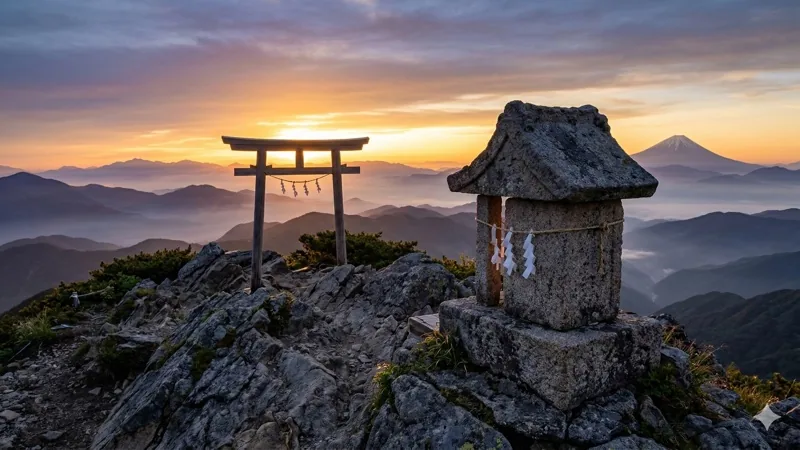
A small shrine near a summit, a moss-covered stone Buddha, a torii gate at a trailhead. When you walk in Japan’s mountains, you can find traces of older pilgrimages and living faith in the landscape. A few sacred peaks show what people came to pray for and how they trained there.
How mountains became sacred places
Depending on the region, mountains were seen as places where deities dwell, places connected to ancestors, or places subject to rules of entry. Reverence for nature, which predates the arrival of Buddhism in Japan, helped shape later traditions of mountain worship.
Water from the mountains irrigates fields, and forests supply firewood and timber. Mountains are a source of water and materials that sustain daily life, and they can also bring eruptions and landslides. Gratitude and awe have long found expression in local prayers and festivals.
At Ōmiwa Shrine in Nara, Mount Miwa itself is the sacred object. There is no separate main sanctuary. People worship the mountain through the worship hall, a practice that continues today.
Shinto, Buddhism and Shugendō
Shinto, Buddhism and local folk beliefs often overlap in Japanese mountain worship. The same mountain has meant different things to different generations and groups of pilgrims.
Shinto: worshipping the mountain
Some shrines, such as Ōmiwa at Mount Miwa, venerate the mountain itself. Elsewhere a lower shrine sits at the foot and an inner shrine, or okumiya, on the summit or mountainside, with a path connecting the two.
Buddhism: seeing the Pure Land in the mountain landscape
Another tradition reads Buddhist worlds in the shape of the mountains, their waters and their steam vents. Tateyama’s landscapes were associated with both hell and the Pure Land, while Mount Gassan in Dewa Sanzan was linked with the Pure Land of Amida Buddha. Walking the mountain became a pilgrimage through these worlds.
Shugendō: undertaking mountain training
Shugendō developed from mountain worship and Buddhist practice, especially esoteric forms of training. Tradition names En no Ozunu, also known as En no Gyōja, as its founder. Practitioners, called yamabushi, train body and mind by walking demanding mountain paths and undertaking other disciplines.
The separation of Shinto and Buddhism early in the Meiji era and the 1872 prohibition of Shugendō disrupted its institutions. Some practices continued locally, and organisations resumed public activity after World War II. At Dewa Sanzan and elsewhere, the practice of entering the mountains for training, known as mineiri, continues today.
Japan’s three sacred mountains: Fuji, Hakusan and Tateyama
Mount Fuji, Hakusan and Tateyama are known as Japan’s three sacred mountains. The paths towards their summits and the shrines at their feet preserve the traditions that grew around each one.
Mount Fuji: summit pilgrimages and Fuji-kō groups
On volcanic Mount Fuji, pilgrimage routes led from Sengen shrines near the base to the crater at the summit. During the Edo period, devotional associations called Fuji-kō helped organise ascents and brought more pilgrims to the mountain. Mount Fuji, its sacred sites and its pilgrimage routes became a World Cultural Heritage property in 2013.
Hakusan: pilgrimage routes from Kaga, Echizen and Mino
According to Shirayama Hime Shrine, the monk Taichō from Echizen made a pilgrimage up Hakusan in 717. Centres later developed in Kaga, Echizen and Mino, with routes to the inner shrine near the summit. Hakusan shrines in other parts of Japan reflect how far this devotion spread.
Tateyama: hell and the Pure Land in the mandalas
The steam vents of Jigokudani and the ponds high on the mountain helped devotees imagine hell and the Pure Land. In the Edo period, illustrated Tateyama mandalas depicting these places were used to explain the meaning of ascending the mountain and the prospect of salvation after death.
Mountains where pilgrimage continues
Beyond the three sacred mountains, people still undertake pilgrimages and mountain training in several places.
- Dewa Sanzan (Yamagata). Devotion and Shugendō practice continue on the three mountains of Haguro, Gassan and Yudono.
- Mount Ōmine (Nara). This is a sacred area of Shugendō. A religious boundary on Sanjōgatake restricts access by women.
- Mount Ontake in Kiso. Pilgrimage routes spread during the Edo period, and the Ontake-kō tradition continues.
- Mount Ishizuchi (Ehime). Worshippers ascend the mountain as an act of devotion. Along the summit route are places of practice where climbers use chains.
Stone chōishi markers measure distance, gyōba are places of training and okumiya are inner shrines higher up or deeper in the mountain. Looking for these features can reveal what a route once meant to the people who walked it.
Check the shrine, temple or local authority’s guidance for the religious boundary on Sanjōgatake and for local access and photography rules.
What hikers can see today
Even when you go for the views or the exercise, knowing the history of a shrine or a marker can change how you see the trail. Leave room for worshippers and follow local rules when looking at small shrines or stone statues.
An old pilgrimage path can show which villages and staging posts a modern trail once linked. Check which sections are open and follow the old markers and place names on a map.
On your next walk
From the three sacred mountains of Fuji, Hakusan and Tateyama to Dewa Sanzan, Ōmine, Ontake and Ishizuchi, people still go to the mountains to pray. Their history shows how reverence for nature, Shinto, Buddhism and Shugendō came together in different ways in different regions.
Next time you pass a torii gate or a small shrine, see who went farther up the trail and what they went to ask for. You’ll learn about the people who walked the path as well as the ground it crosses.
References and sources
- Ōmiwa Shrine: Worship Hall
- UNESCO: Fujisan, sacred place and source of artistic inspiration
- UNESCO: Sacred Sites and Pilgrimage Routes in the Kii Mountain Range
- Shirayama Hime Shrine: Hakusan worship and the mountain shrine
- Toyama Prefecture: The Tateyama mandalas
- Dewa Sanzan Shrine: Seasonal mountain retreats
- Tenkawa Village: Mount Sanjōgatake route
- Nagano Prefecture: Mount Ontake Quasi-National Park
- Ishizuchi Shrine: The teachings of Ishizuchi worship
- Japan’s UNESCO Associated Schools: Teacher’s guide to education for sustainable development using biosphere reserves