
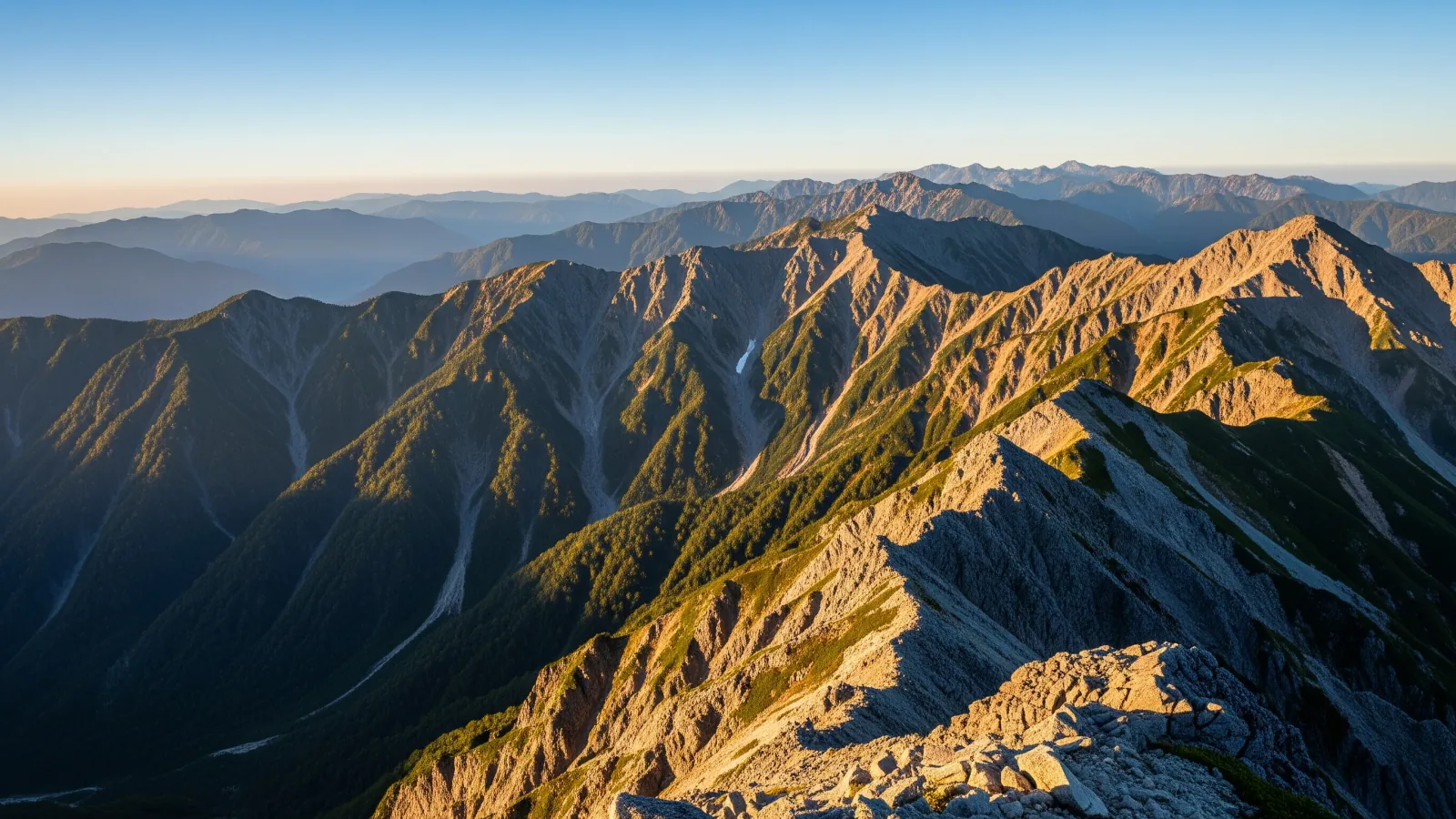
The Northern, Central and Southern Alps also appear on maps as the Hida, Kiso and Akaishi ranges. How did mountains in Japan end up with a name borrowed from Europe? The travel guides of the Meiji era and the mountaineering books that followed show how it caught on.
A name borrowed from the European Alps
The European Alps extend through countries including France, Switzerland, Italy and Austria. Mont Blanc and the Matterhorn rise among their peaks. In the nineteenth century, climbing such high mountains became a pursuit in its own right.
Climbers and travellers who visited Japan in the Meiji era compared the steep peaks and valleys of Hida to the Alps they knew. The comparison gave readers a way to picture mountains on the other side of the world.
Gowland calls the Hida mountains “Alps”
The British engineer William Gowland (1842–1922) is known for proposing the name “Japanese Alps.”
Gowland came to Japan in 1872 at the invitation of the Meiji government and worked at the mint in Osaka. He climbed in several parts of the country. The National Diet Library credits him as the first foreigner to reach the summit of Mount Yari, in 1878.
Gowland wrote about the mountains for A Handbook for Travellers in Central & Northern Japan, first published in 1881, edited by Ernest Mason Satow and A. G. S. Hawes. He suggested that the mountains of Hida might be called the “Japanese Alps.”
The name at that point referred to the Hida area. Its geographical meaning today covers three ranges.
Weston puts “Japanese Alps” in a title
One person who introduced the “Japanese Alps” to European readers was the British missionary Walter Weston (1861–1940).
Weston arrived in 1888 and climbed mountains alongside his missionary work. In the Hotaka range, he drew on the skills of Kamijō Kamonji, a hunter and mountain guide from Kamikōchi. His account, Mountaineering and Exploration in the Japanese Alps, was published in London in 1896.
His title and climbing accounts brought Japan’s high mountains to readers overseas. His writing also records the skills of local people who cut routes through difficult ground and guided climbers.
Kojima Usui and other Japanese writers on the mountains
Today we distinguish the Northern, Central and Southern Alps. One of the writers who popularised the names in Japanese was the mountaineer Kojima Usui (1873–1948).
Kojima helped found the Alpine Club in 1905, which later became the Japanese Alpine Club. His Japanese Alps volumes, published from the end of the Meiji era into the Taishō period, describe several areas, including Hotaka in the north and the Shirane Range in the south.
The three ranges today
- Northern Alps (Hida Range). Includes Mount Yari, the Hotaka peaks, Mount Tsurugi and Tateyama.
- Central Alps (Kiso Range). Runs through Nagano Prefecture and includes Kisokoma and Utsugi.
- Southern Alps (Akaishi Range). Extends across Yamanashi, Nagano and Shizuoka and includes Kita, Aino and Akaishi.
Research from the Geospatial Information Authority of Japan pairs the range names with Northern, Central and Southern Alps and uses “Japanese Alps” for the whole group.
Why both sets of names are in use
Hida, Kiso and Akaishi identify the ranges on maps and in geographic writing. Northern, Central and Southern Alps correspond to those ranges and also appear in climbing accounts and travel guides.
“Alps” can bring to mind high, rugged rock peaks and ridges. That image made it a way to introduce the Hida mountains before the term came to include the neighbouring ranges.
Find the range names on a map, then see how much territory “Alps” covered in an early mountaineering account. You can see how the same name has changed in use.
On your next walk in the Japanese Alps
Through travel guides, English-language mountaineering accounts and Japanese mountain writing, a name first used for the Hida mountains came to cover all three ranges. Gowland, Weston and Kojima Usui offer ways to trace that change.
Next time you walk in one of the three ranges, find it on a topographic map and see how an early traveller described the same mountains. You may recognise an older route or learn something about the people who guided climbers there.
References and sources
- National Diet Library: Dawn of Mountaineering, chapter 1
- Ernest Mason Satow and A. G. S. Hawes, eds.: A Handbook for Travellers in Central & Northern Japan, first edition (1881)
- National Diet Library: Dawn of Mountaineering, chapter 2
- Walter Weston: Mountaineering and Exploration in the Japanese Alps (1896)
- Japanese Alpine Club: Timeline, founders and presidents
- Shinshu University Library: Kotani Collection, modern Japanese books
- Geospatial Information Authority of Japan: Research on uplift in the Japanese Alps