
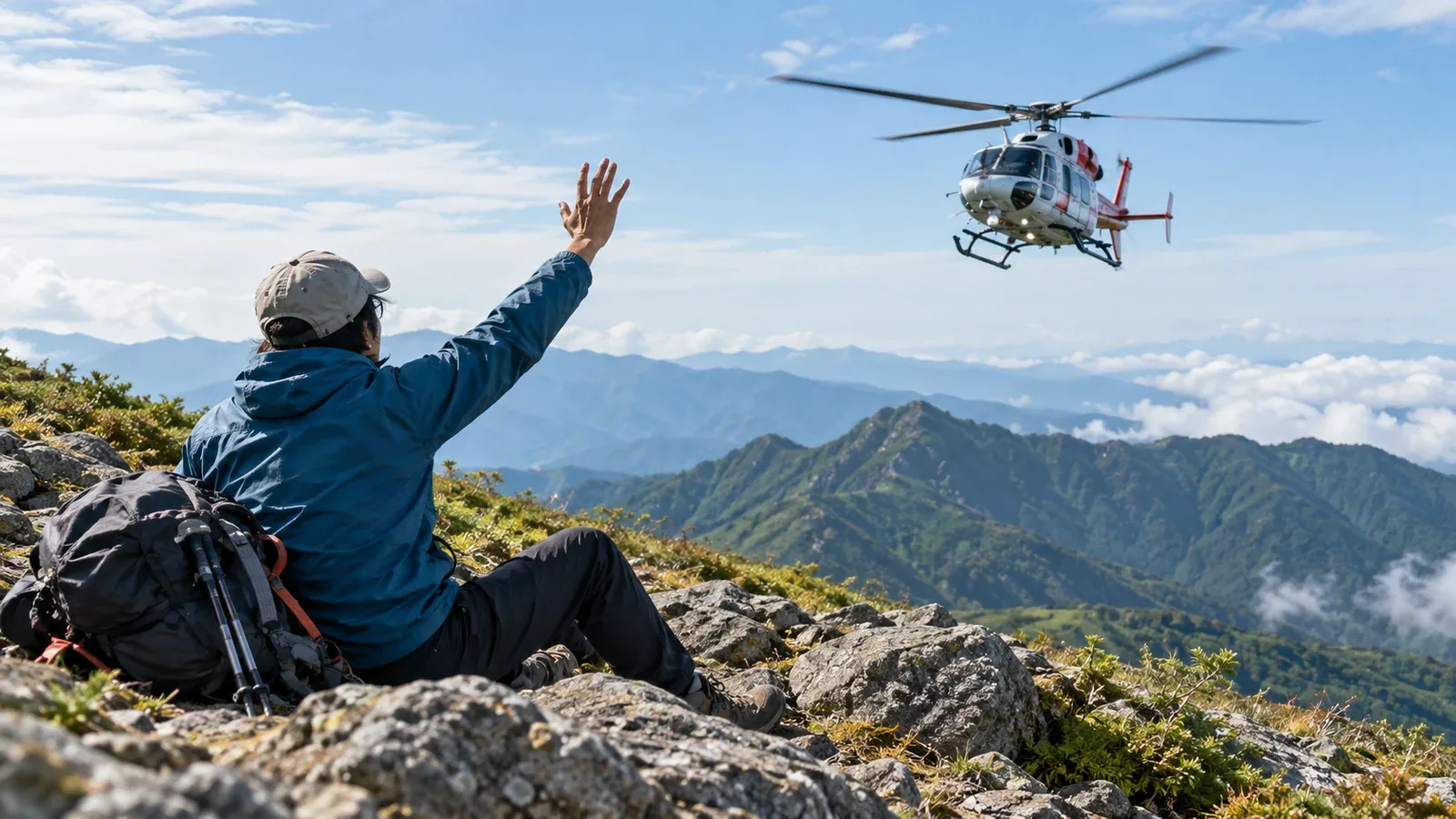
If you are stranded in the mountains in Japan, either 110 or 119 can put you in contact with mountain rescue. Call promptly. The dispatcher will assess what is needed, and the rescue service will decide whether an aircraft can operate.
Here is what each number is for, what information to give and what to do if your call fails. Regional police and fire services publish more detailed information for their own areas.
110 and 119 in the mountains
110 reaches the police. The police coordinate mountain search and rescue in many areas. Call 110 if you are lost, stranded or reporting an overdue person. Local police teams can coordinate ground and air resources.
119 reaches the fire and ambulance service. Call 119 for serious injury, sudden illness or another medical emergency. Fire and police services can coordinate when a mountain rescue requires several teams.
Search for a lost or stranded hiker: call 110. Urgent medical help for injury or illness: call 119. If you are unsure which to call, use either number straight away and explain the situation.
What to tell the dispatcher
Call as soon as you need help. Give the details you know, beginning with your location and the most urgent problem.
- Mountain and route. Give the mountain name and trail you were following.
- Current position. Give GPS coordinates if available, the last confirmed junction, a sign number or a visible landmark.
- What happened. Explain whether you are lost, someone fell or someone became ill.
- Injury or symptoms. Say if the person responds, breathes normally, can move or is bleeding.
- Group size and caller. Say how many people are there, how many need help and who is calling.
- Phone and signal. Give a callback number, remaining battery and whether the signal is unreliable.
Coordinates can help narrow the search. Save your route and map for offline use before departure. If you know only your last confirmed position, say that clearly and describe any landmarks you can see.
Speak slowly, answer the dispatcher’s questions and follow their instructions. Ask them to repeat anything you did not understand.
If there is no mobile signal
Try the emergency number first. If it fails, consider safe options without using up the daylight or power you need.
Try 110 or 119 even if the signal is weak. Japan Roaming began on April 1, 2026 as a service carriers can activate for disruptions such as major disasters or network outages. It does not provide general coverage in ordinary mountain dead zones. If your device and location support satellite SOS, use it when a mobile call will not connect.
Try another phone or a nearby safe spot if available. Do not climb to an exposed ridge or force an injured person to move. If a companion can safely reach a place with coverage, ask them to relay your location. Use a whistle or headlamp to signal from a safe place.
A filed hiking plan gives rescuers a starting point. Before the hike, submit it through a channel accepted for your route and give a copy to someone who knows when to expect you back. Agree on when they should act if you miss a check-in.
While waiting for rescue
Weather, terrain and visibility affect whether a helicopter can fly, hover or land. Rescuers may send a ground team. Follow instructions and prepare to wait.
Stay where you are if it is safe. Tell responders before moving if you are in contact. Move only to escape an immediate danger or as directed by the crew or dispatcher. Let the crew decide how to approach you.
Protect yourself from the cold. Put on dry insulating layers and a waterproof shell, and put insulation between you and the ground. Use your emergency shelter if available and monitor the injured person.
Make yourself visible only from stable ground. Follow the crew’s directions. Secure loose clothing, hats and other gear before the aircraft comes close. Rotor wash can carry stones and throw you off balance. Stay clear of the aircraft and hoist area unless the crew tells you what to do.
Private helicopters and rescue charges
Public police and fire rescues generally do not bill the person rescued, but local exceptions exist. Saitama lists ¥8,000 per five minutes of flight by its disaster-response helicopter in designated areas, with exemptions. A Nagano notice explains that if a private aircraft is used in the southern Northern Alps, its operator bills separately. Costs depend on the operation and the provider.
Some policies and membership schemes cover eligible search and rescue costs. Check activities, exclusions and limits before the trip. If you need rescue, make the call immediately even if you are unsure what is covered.
Before your next hike
Save your route, download an offline map, know where to read coordinates and file your plan where appropriate. Carry spare power and check whether your device supports satellite SOS in Japan. Note the mountain name, route and group size where you can find them during an emergency. A qualified guide can help you plan an unfamiliar route.
References
- National Police Agency mountain incident statistics
- Fire and Disaster Management Agency rescue information
- Prefectural police mountain rescue guidance
- Government of Japan mountain safety information
References and sources
- National Police Agency — Japan’s 2025 mountain incident figures
- Government of Japan — Mountain safety and rescue numbers
- Nagano Prefecture — Mountain emergency calls and helicopter safety
- Apple Support — Emergency SOS via satellite requirements
- Fire and Disaster Management Agency — Rescue activity reporting
- Gifu Prefectural Police — Mountain emergency response and helicopter safety
- Telecommunications Carriers Association — When Japan Roaming is available
- Saitama Prefecture — Rescue helicopter charges in designated areas
- Nagano Prefecture — June 2026 notice on private rescue costs