
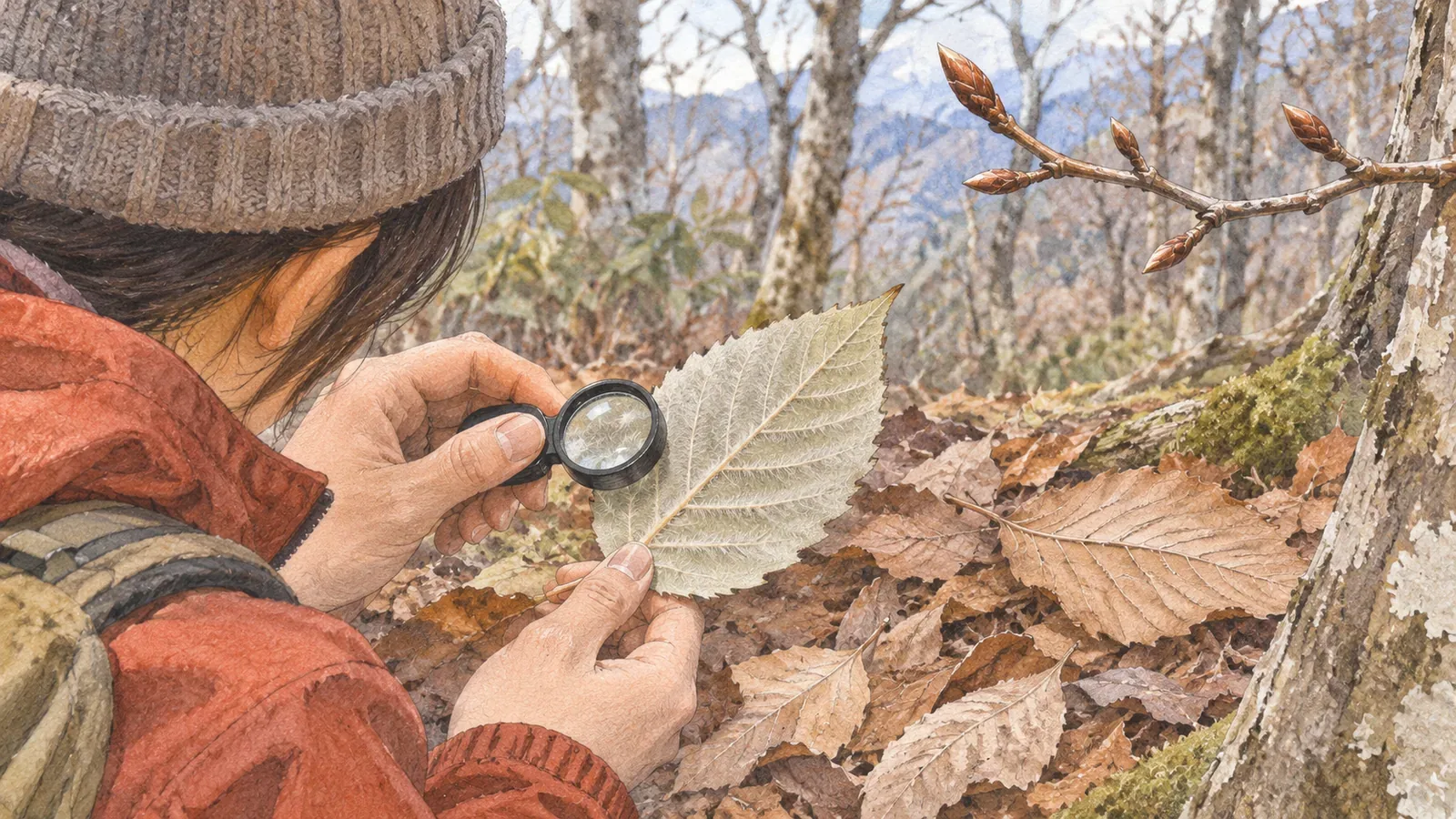
The underside of a fallen leaf can reveal hairs or veins you missed when looking at its colour from above. Start with a leaf already lying underside up on the path and look without touching it. The Rokkō vegetation guide and other sources show how to take that observation further, from the fallen leaf to nearby twigs and winter buds.
Why start with the underside
Autumn colours catch your eye, but they are difficult to use alone. Fukuoka Prefecture explains that chlorophyll gives leaves their green colour and breaks down as the temperature falls. Some species produce red anthocyanins or brown phlobaphenes, and the balance of pigments changes the colour. Ginkgo and Chinese hackberry are examples of yellow foliage, Japanese maple and wax tree of red, and Quercus serrata and Japanese zelkova of brown. The colours are hard to separate neatly and are all referred to as autumn colour.
Sunlight helps leaves produce anthocyanins. The Fukuoka guide describes how covering a small area before the leaf changes can make that area a different colour. From this we infer that leaves of the same species can vary with light. We suggest looking at the texture underneath and the shape alongside the colour. The Rokkō guide groups leaf shapes as simple, lobed, compound and needle-like, their arrangement as opposite, alternate or clustered, and their edges as smooth, wavy or toothed. It also describes the underside of individual species.
What the underside can tell you
The guide lists whitish undersides for Quercus serrata and short white hairs under the leaves of Chinese cork oak. Sawtooth oak and Japanese chestnut have hairless undersides. Micromeles japonica has whitish woolly hairs below and Micromeles alnifolia has a green, hairless underside. Carpinus laxiflora has a long, tail-like tip. Carpinus tschonoskii has a shorter tip and hairs on both sides. Comparing Quercus serrata with sawtooth oak or Japanese chestnut can help you recognise the difference. This is an editorial suggestion for practising with similar leaves.
Keep two limits in mind. The guide covers Rokkō. It describes Chinese cork oak as more common below about 400 m and Japanese mallotus as widespread at 650 m and below. Light and surrounding vegetation can differ between mountains at the same height. The guide describes leaves still on trees. A dry or damaged leaf on the ground can look different, so leave any identification open until you can compare it with a leaf on a tree. If hairs are too fine to see, record what you could make out in the photo.
From a fallen leaf to a twig and winter buds
Start by photographing a fallen leaf that is already underside up. Japan’s environment ministry warns that the leaves or sap of Asian poison ivy can cause a rash. Leave unfamiliar leaves where they are. Compare both surfaces in place only if you know the leaf is safe to handle and the site rules allow it. Record the paleness, hairs, tip and edge. Then stop on firm ground and look for a similar leaf on a twig. Write a separate note for each leaf until you know whether they match. A leaf may have blown in from another tree.
Two leaves facing each other at one node are opposite, while one per node is alternate. The Hokkaido bureau’s list for the Obihiro area describes opposite arrangement as relatively uncommon and useful for narrowing down species. Leaflets of a compound leaf can look opposite, so check the whole leaf. Manchurian ash and Amur maackia both have pinnate leaves, but the ash’s leaves are opposite and the maackia’s are alternate. A single fallen leaflet reveals little about the complete leaf. Look at nearby twigs and use the winter bud at the leaf base, as the Rokkō guide suggests, to see where the whole leaf starts. The leaves of Japanese walnut are crowded at the tips, but the buds and leaf scars show that the leaves alternate.
You can keep observing after leaf fall. The University of Tokyo’s Hokkaido Forest suggests winter as a chance to look at winter buds and leaf scars. Winter buds form from summer to autumn. The Forestry and Forest Products Research Institute describes buds with protective scales and naked buds, as well as leaf buds, flower buds and mixed buds. At the university forest, Magnolia obovata and Prunus ssiori have pointed buds, Japanese linden and Amur maackia have round ones, and Japanese walnut and Amur cork tree have scars that can resemble a monkey and a koala. Buds and scars vary within a species. For other areas, check similar trees and their distribution in a local guide. Return to a tree you observed from its leaves and compare its winter buds and leaf scars after leaf fall.
Check which rules apply before collecting anything
Photos of both surfaces can be taken in place. The environment ministry lists collecting or damaging designated alpine and other plants among activities requiring authorisation in special zones of national parks. In special protection zones, it lists damage to trees or bamboo, collecting plants and picking up fallen leaves or branches. This includes material already on the ground. The Hokkaido Regional Environment Office describes the broader restrictions in special protection zones, including collecting plants other than trees or bamboo.
In special zones, each park has a list of plants designated by the environment ministry for protection. The system preserves the character of the area and also helps protect rare species. Check the zone and land manager’s rules before picking anything up. If you are unsure, keep the leaf where it is and photograph what you can see. Quasi-national parks also have designated plants. Check the rules for prefectural parks, national forests and private land separately. Leave fallen leaves and fruit on site and take photos and notes home.
Start with a leaf whose underside is visible
The top colour changes with light and pigments. Start by recording how pale the underside is, whether it has hairs and what the tip and edge look like. Compare leaves still on trees, check whether the leaves are opposite or alternate, and use the winter bud to find where the whole leaf begins. In winter, look at buds and scars. Compare Quercus serrata with sawtooth oak, or Carpinus laxiflora with Carpinus tschonoskii. The examples come mainly from Rokkō and Hokkaido. Check the guides for the mountains you visit. Photograph an underside you can already see without touching the leaf. Leave any hidden surface blank in your notes. Compare the photo with leaves on trees or winter buds next time you hike.
References and sources
- Fukuoka Prefecture: why leaves change colour in autumn
- Rokkō Sabo Office: online vegetation guide to the Rokkō Mountains
- Hokkaido Regional Development Bureau: trees by leaf and bud arrangement
- The University of Tokyo Hokkaido Forest: winter buds and leaf scars of deciduous broadleaf trees
- Forestry and Forest Products Research Institute: taking a closer look at trees in winter
- Japan Ministry of the Environment: national park activities requiring permission or notification
- Hokkaido Regional Environment Office: activities regulated in national parks
- Japan Ministry of the Environment: plant protection in national and quasi-national parks
- Japan Ministry of the Environment, Ōdaigahara: Asian poison ivy