
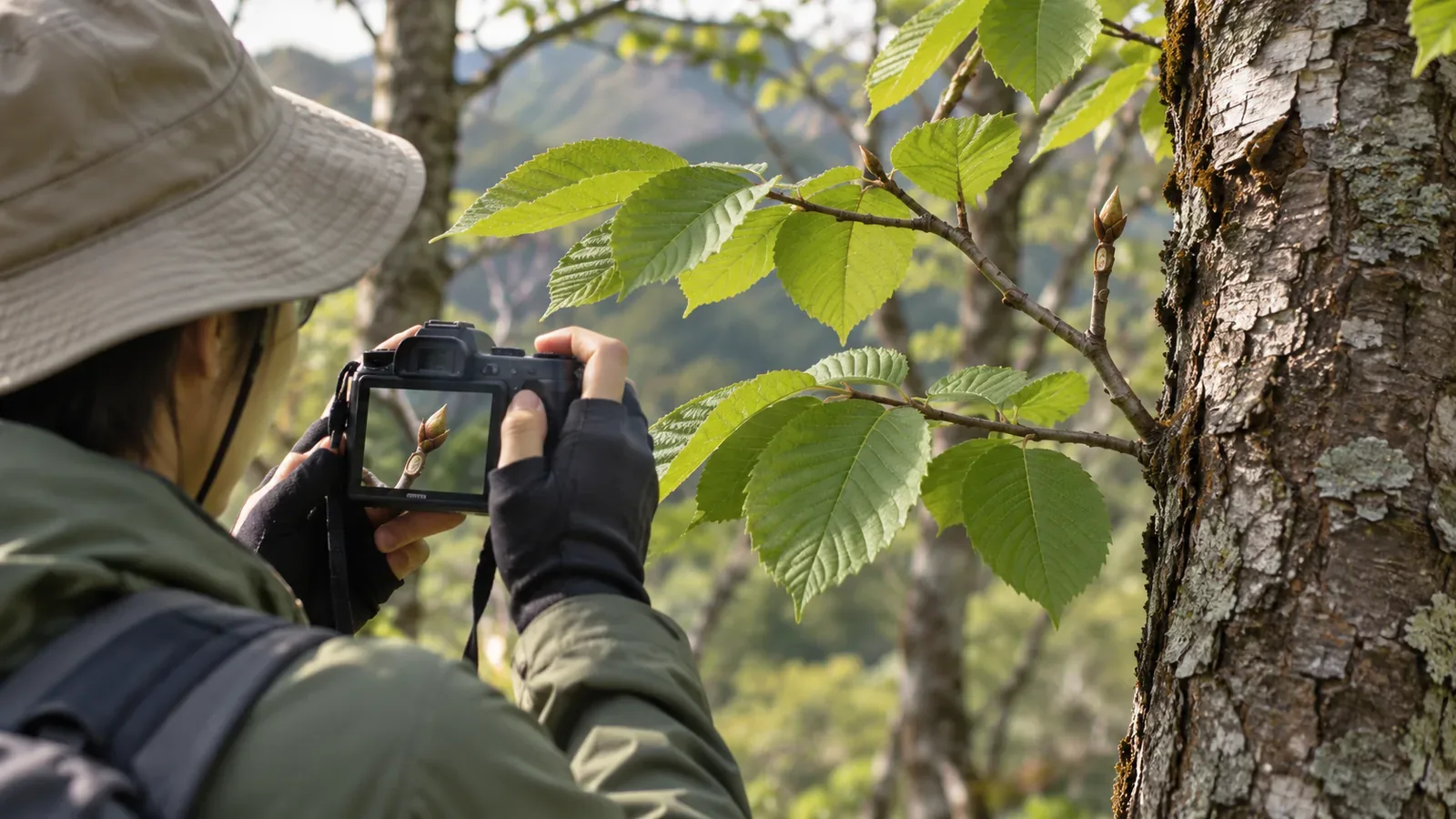
If a leaf alone does not identify a tree, put the name aside and record how the leaves are arranged, the winter buds and leaf scars, the underside of the leaves, the bark and the surroundings. What you could see and what you could not will help you compare with a field guide later. Here is an order to try based on public guides, with photographs and notes in place of collecting.
Why leaf colour and shape alone can be inconclusive
Autumn colour catches your eye but is difficult to use by itself. Fukuoka Prefecture explains that chlorophyll gives leaves their green colour. As the temperature falls, chlorophyll breaks down. Some species produce red anthocyanins or brown phlobaphenes. The changing balance of pigments changes what you see. Yellow, red and brown leaves can be hard to group neatly and are all described as autumn colour. The guide also explains how sunlight affects red pigments. Covering a small part of a leaf before it changes can make the colour develop differently there.
Use autumn colour together with details such as leaf shape and arrangement. The Fukuoka guide lists several trees that turn yellow, several that turn red and several that turn brown. Note the colour you saw that day and whether the branch was in sunlight so you can use that information alongside the other features.
Look first at leaf arrangement, winter buds and leaf scars
The Hokkaido bureau’s guide distinguishes opposite leaves, where two face each other at a node, from alternate leaves, with one at each node. Opposite leaves are less common in its list and can help narrow the possibilities. A compound leaf can mislead you if its leaflets face one another. Look at where the whole leaf attaches. Both Manchurian ash and Amur maackia have pinnate leaves. The ash has opposite leaves and the maackia has alternate ones.
To see where a leaf begins, look for the winter bud at its base, as the Rokkō guide suggests. Follow the leaf stalk back to the twig instead of relying only on the bud at the tip. The Hokkaido guide uses Japanese walnut as an example. Its leaves are crowded near the tip, but the buds and scars left by fallen leaves show that they alternate. If leaves are missing, photograph the arrangement of buds and leaf scars.
The University of Tokyo’s Hokkaido Forest explains that winter buds form from summer to autumn and vary by species. It gives pointed buds on Japanese bigleaf magnolia and the Shuri cherry (Prunus ssiori), rounded ones on Japanese linden and Amur maackia, and furry ones on northern kobushi magnolia. Japanese walnut leaf scars can look like a monkey’s face and Amur cork tree scars like a koala. Individual buds and scars vary too. Use regional guides for the species and ranges you might encounter, and compare several branches before drawing a conclusion.
Add clues from leaf undersides, bark and habitat
The Rokkō guide describes leaf undersides and bark that help distinguish local trees. The underside is whitish in Quercus serrata, white with short hairs in Chinese cork oak, and hairless in sawtooth oak and Japanese chestnut. Japanese whitebeam has pale, woolly undersides and Korean whitebeam (Micromeles alnifolia) has green, hairless ones. Carpinus laxiflora has a long, tail-like leaf tip, while Carpinus tschonoskii has a shorter tip and hairs on both sides. The fine vertical lines of Aphananthe aspera help distinguish it from Chinese hackberry and Japanese zelkova. Chinese cork oak has deeply fissured corky bark, and the bark of older Japanese zelkova flakes off in scales.
The same guide describes habitat. On Rokkō, Chinese cork oak is more common below about 400 m. Japanese mallotus is widespread at 650 m and below and grows in bright places such as clearings and forest roadsides. Treat these as Rokkō examples. When examining fallen leaves, note damage and missing pieces, and check them separately from leaves still attached. Where a leaf fell does not tell you which tree it came from. Note elevation and whether the tree was at a bright woodland edge or inside the forest to make comparison with local guides easier.
A field note you can make without collecting
We suggest taking only photos and notes and leaving everything on site. Japan’s environment ministry lists damage to trees or bamboo, collecting plants and picking up fallen leaves or branches among activities requiring permission in national parks’ special protection zones. Special zones also regulate collection or damage of designated plants such as alpine species. Designations vary by park. Check the relevant rules separately in quasi-national or prefectural parks, national forests or on private land. Find out from the manager or the ministry which zone your route crosses, and leave fallen leaves and fruit where they are.
Set up the note in this order. (1) Date, place, approximate elevation and whether you were at the woodland edge or inside. (2) Opposite, alternate or uncertain, and whether leaves or buds and scars were your evidence. (3) Simple or compound leaf, edge, hairs underneath and shape of the tip. (4) Whether you have photos of buds, scars and bark. (5) Possible names and which ones you could not rule out. Take a picture of the whole tree, the twig, any visible leaf surfaces and then the bark. If you add a scale object, do so only somewhere safe where you can place it at about the same distance from the camera. Leave branches where they are. The ministry says Asian poison ivy leaves and sap can cause a rash. Avoid touching unidentified leaves and write “not checked” if you cannot see the underside.
Use “confirmed”, “possible” and “unknown” for the name. Even without a name, a note with the other fields filled in can help you compare it later.
Record the evidence before deciding on a name
Leaf colour depends on pigments and light, so use it with the other features. Record opposite or alternate leaves, winter buds and leaf scars, the underside, bark, elevation and light in separate fields. A good note shows which details narrowed the possibilities and where you had to stop. The bark and distribution examples come from Rokkō and the winter bud examples from Hokkaido. Compare them with sources for the area where you hike.
References and sources
- Fukuoka Prefecture: why leaves change colour in autumn
- The University of Tokyo Hokkaido Forest: winter buds and leaf scars of deciduous broadleaf trees
- Hokkaido Regional Development Bureau: trees by leaf and bud arrangement
- Rokkō Sabo Office: online vegetation guide to the Rokkō Mountains
- Japan Ministry of the Environment: national park activities requiring permission or notification
- Hokkaido Regional Environment Office: activities regulated in national parks
- Japan Ministry of the Environment, Ōdaigahara: Asian poison ivy