
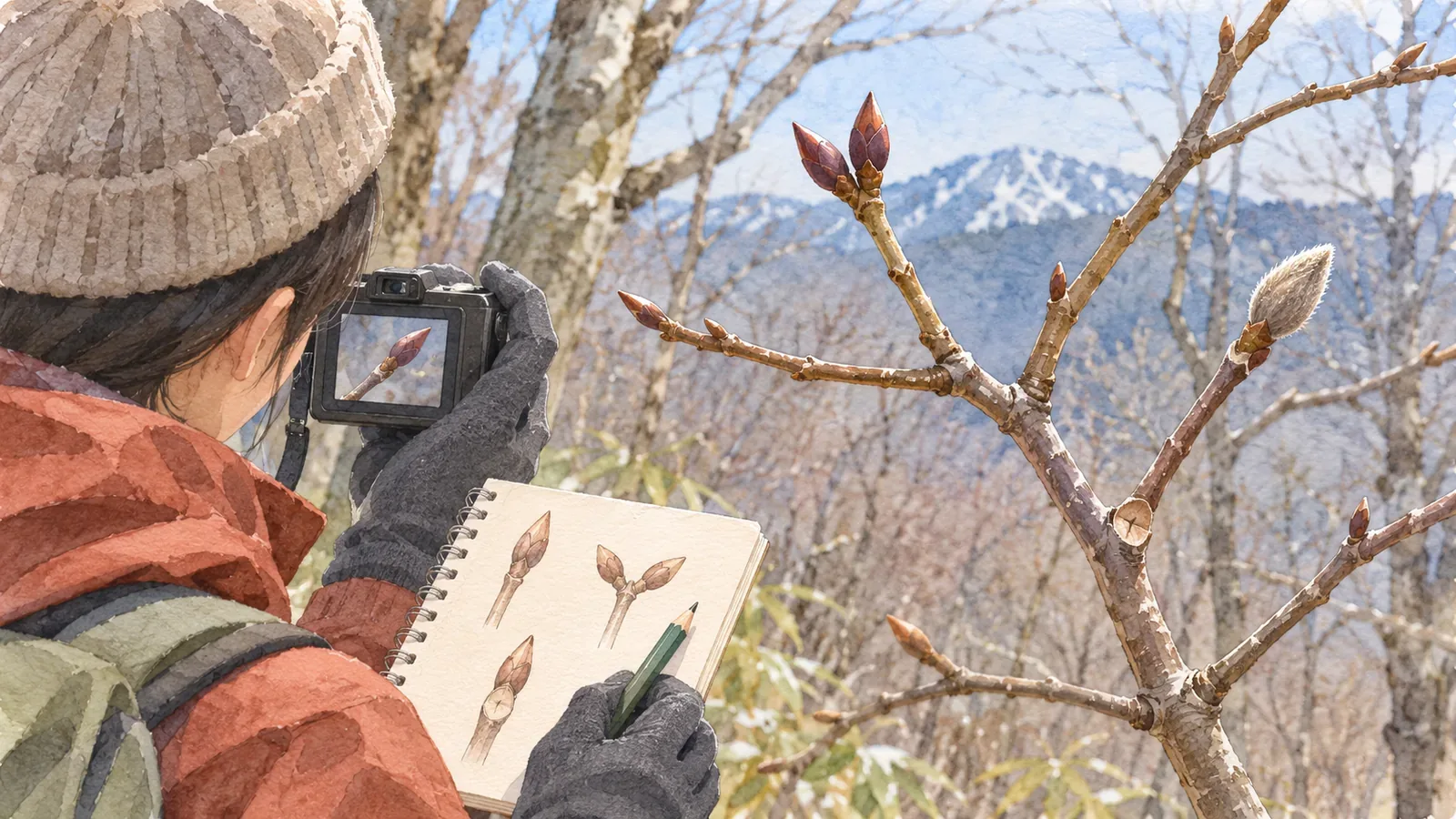
You can learn which tree you may be looking at without touching the buds. Look at their arrangement and shape, the leaf scars and where the buds sit on the twig. The University of Tokyo’s Hokkaido Forest explains that winter buds form from summer to autumn. Try photographing the buds and leaves together in autumn and returning to the same tree after leaf fall. Record what you can see without pulling branches closer or peeling the buds.
Start with the arrangement of the buds: opposite or alternate
Leaves and buds can occur in opposite pairs on the same node or alternate, one at each node. The Hokkaido Regional Development Bureau’s tree list says that opposite arrangement is relatively uncommon and a useful identifying feature. Finding opposite buds can narrow down the list of possible trees.
Compound leaves can be confusing. Each leaflet may face another across the middle of the leaf. Work out how the complete leaf attaches to the twig. Manchurian ash and Amur maackia both have pinnate leaves. Those of the ash are opposite and those of the maackia are alternate. Japanese walnut leaves are clustered near the twig tip, but the buds and scars show that they alternate. Check the buds and scars if it is hard to tell where the whole leaf begins. The list covers mainly Hokkaido, so use a field guide for your area to check the individual species.
Use bud shape, leaf scars and position to narrow the options
Once you know the arrangement, look at the shape. Some buds that survive winter have protective bud scales. Japanese walnut has naked buds without scales. The Forestry and Forest Products Research Institute describes leaf buds, flower buds and mixed buds. Different kinds of bud on the same tree can look different. The university forest shows pointed buds on Magnolia obovata and Prunus ssiori, rounded ones on Japanese linden and Amur maackia, and furry ones on northern kobushi magnolia. Compare the positions and other buds and check the possibilities in a local guide.
A leaf scar is the mark left when a leaf falls from a twig. In the university forest’s examples, a Japanese walnut scar looks like a monkey’s face and an Amur cork tree scar looks like a koala. We suggest writing down what a shape reminds you of to make it easier to compare later. Buds and scars also vary within a species. Look at several on the same tree and on nearby trees that seem to be the same species.
The Rokkō vegetation guide explains that the bud at the base of a leaf shows where the whole leaf begins. This helps you distinguish a compound leaf from its leaflets. If leaves are still on the tree, photograph the bud and the base of the leaf together. That makes it easier to picture the leaf when you return after leaf fall.
An order for observing without touching
We suggest looking at the whole twig before the details. (1) From a distance, note whether the buds are opposite, alternate or unclear. (2) Describe the shape as pointed, rounded, furry or something else. (3) Describe what the leaf scar reminds you of if you can see it. Write “not checked” if you cannot. (4) If leaves remain, photograph where the bud sits at the base of a leaf. (5) Note the date, place and a landmark such as a sign or rock. An “unclear” box helps you avoid a guess that makes a later comparison harder.
Leaf undersides and bark can help too. The Rokkō guide describes a whitish underside on Quercus serrata, short hairs on Chinese cork oak and hairless undersides on sawtooth oak and Japanese chestnut. The fine vertical lines of Aphananthe aspera help distinguish it from Chinese hackberry and Japanese zelkova. Older Japanese zelkova bark flakes off in scales. These are features for the trees described in the Rokkō guide. The relative abundance of Chinese cork oak below about 400 m is also an observation from Rokkō. Compare an autumn photo with leaves and a winter photo from the same position to see the buds and how they relate to the leaves, without touching the tree. Stop on firm ground before looking up.
Check the rules on collecting and damage
Japan’s environment ministry says collecting or damaging plants it designates is regulated in special zones of national and quasi-national parks. Each park has its own published list. In national parks, the permit list includes collecting or damaging designated plants such as alpine species in special zones. In special protection zones it also includes damaging trees or bamboo, collecting plants and picking up fallen leaves or branches. The Hokkaido regional office notes that special protection zones regulate a wider range of plant-related activity than special zones.
Leave buds and twigs intact. Look from the outside without breaking twigs, bending branches hard or peeling off bud scales. Check the zone boundaries and designated species for the park you will walk in. In quasi-national parks, check which authority handles permits and what rules apply on site. Check separate rules for prefectural parks, national forests and private land. Leave fallen leaves and twigs where they are and bring home photos and notes.
Observe in order and leave the identification open
Record arrangement, shape, leaf scars and position in that order. Use what you can see to narrow the choices. Opposite arrangement is a useful first clue. Treat compound leaves as whole leaves. Use the Hokkaido and Rokkō examples to learn where to look, and check species in a local guide. Compare more than one bud because they vary. Check park zones and designated plants before you go, and take an autumn photo with the leaves still on if you plan to compare the same tree after leaf fall.
References and sources
- The University of Tokyo Hokkaido Forest: winter buds and leaf scars of deciduous broadleaf trees
- Hokkaido Regional Development Bureau: trees by leaf and bud arrangement
- Rokkō Sabo Office: online vegetation guide to the Rokkō Mountains
- Forestry and Forest Products Research Institute: taking a closer look at trees in winter
- Japan Ministry of the Environment: plant protection in national and quasi-national parks
- Japan Ministry of the Environment: national park activities requiring permission or notification
- Hokkaido Regional Environment Office: activities regulated in national parks