
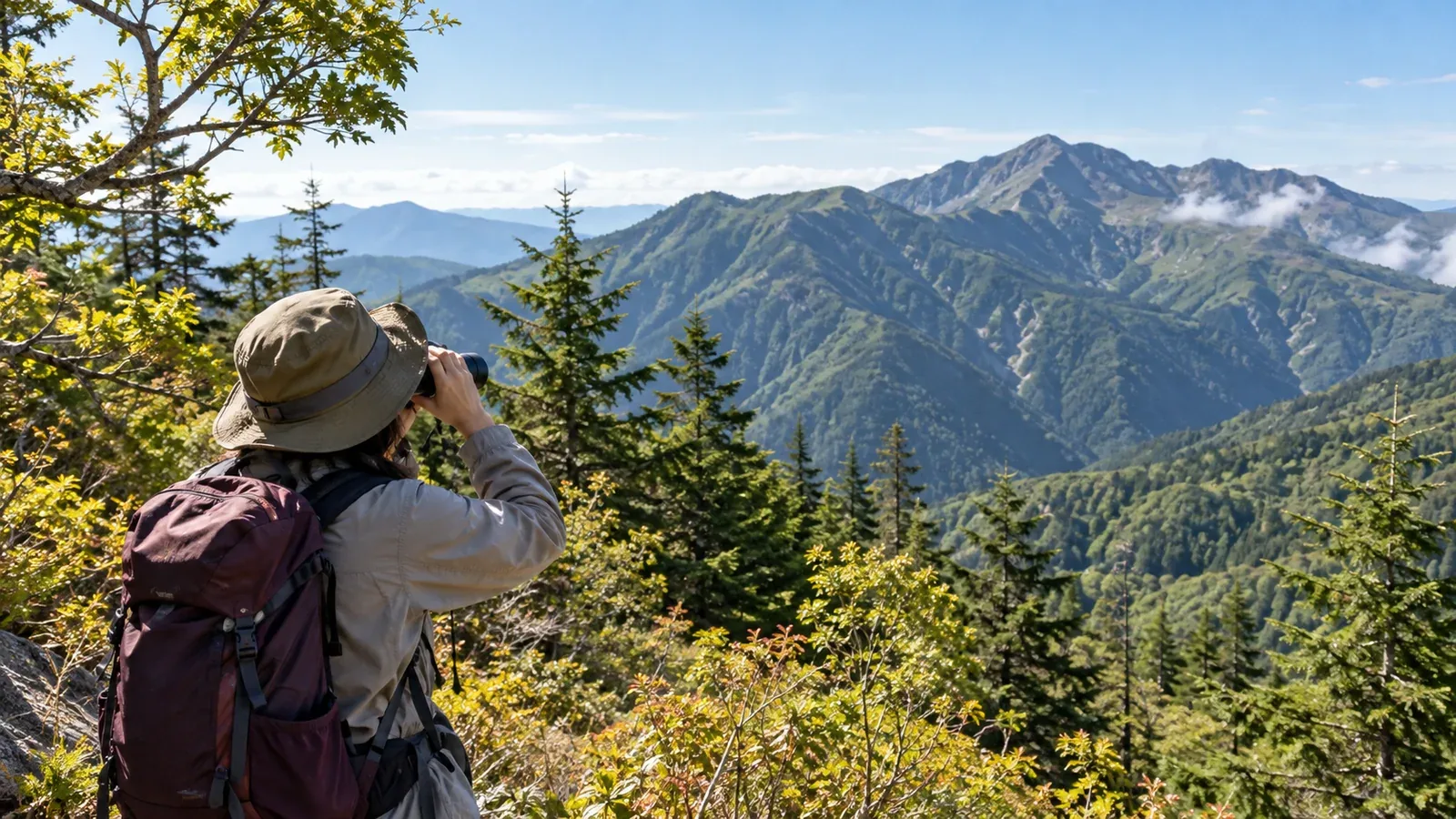
In a forest, a voice can come from above you or from deep inside a thicket without a bird in sight. Are the notes all high, or do you hear a pause between each one? Stop and listen for a moment and you’ll have more clues about what to look for.
This guide describes the sounds and typical habitats of ten birds you can encounter in Japan’s mountains. Voices vary among individuals and regions, so weigh what you hear alongside the season and the surroundings.
How to listen to a bird
A song can signal territory in the breeding season. Calls help birds keep in touch or warn of danger, among other things. A bird can sound different in different situations, so it helps to learn both its longer phrases and its short calls.
Put the pitch and pauses into words, and notice whether the last note goes up or down. A mnemonic turns a bird’s rhythm into a phrase you can remember. In Japanese, the Lesser Cuckoo’s call is often remembered as teppen kaketaka.
Voices from low hills and thickets
Japanese Bush Warbler
The well-known song from a thicket holds the first note, then breaks into short syllables that sound like hō-hokekyo. You may also hear a brief, repeated chack from low in the brush.
Lesser Cuckoo
This cuckoo migrates to mountain forests. Its clipped notes carry a long way, and the rhythm of teppen kaketaka is a clue. It sometimes calls in flight, so listen for the sound changing direction.
Varied Tit
Look in dense broadleaf woods. Listen for a nasal sound or a slightly husky call. If you see the bird, look for reddish brown from its breast down to its belly.
Long-tailed Tit
In forests on low hills, listen for thin notes or a short, rolling call. When several birds move from branch to branch, the calls move with them. If you spot one, notice the long tail on its tiny body.
Eurasian Jay
A loud rasp in the woods can be a clue to a jay. Jays also imitate other birds. If the sound changes, check the branches or look for a bird in flight before deciding how many species you’re hearing.
Voices from mountain forests and streams
Japanese Robin
In dark woods along a valley, listen for a clear note followed by a quick trill. Its song is sometimes compared to a horse’s whinny. If the water is loud, stop in a safe spot on the trail and listen for the repeated pattern.
Blue-and-white Flycatcher
In woods along streams, the song often comes from a treetop. The notes are drawn out and gradually fall, sometimes ending in a short buzz. If you see a male, look for a blue back and white belly.
Narcissus Flycatcher
A migrant that reaches Japan in spring. In mountain woods, listen for a short opening followed by bouncing, repeated phrases. A male’s yellow to orange breast stands out if you catch sight of it.
Voices from subalpine woods and dwarf pine
Red-flanked Bluetail
This bird breeds in high mountain forests and also appears in the lowlands in autumn and winter. It gives short, sharp calls and a fast, whistled song. If you see one, look for a bluish tail and yellow-orange sides.
Northern Nutcracker
A raspy gaa, gaa can carry across a conifer forest or a slope of dwarf pine. If you spot the bird, look for white speckles against its dark body. It caches dwarf pine seeds, and in autumn you may see it carrying them.
Three steps for recording bird sounds
Find a place where you can stop safely and write down three things. They make it easier to compare your observation with recordings after the hike.
- Describe the surroundings. Note roughly where the voice came from, such as a thicket, a streamside wood, or the top of a conifer.
- Describe the sound. Note whether the sound is drawn out, how often it repeats, and whether the pitch rises or falls at the end.
- Write down the date and time. Different birds pass through the same place during migration and the breeding season. Keep the date and time with your notes.
Compare your own recording or the app’s suggestions with a sound guide after you get back. Avoid playing recordings to draw birds in. If you come across a nest or chicks, move away quietly.
When sounds are easy to misread
Compare similar voices phrase by phrase. For example, compare the Blue-and-white Flycatcher’s slowly falling notes with the short, bouncing repetitions of the Narcissus Flycatcher. Consider where the sound came from and any markings you saw.
A short call may leave several possibilities. During autumn, winter, or migration, you may never hear the song you learned for the breeding season. If you have too little to go on, record the sound as unidentified.
Wind and streams can mask sounds. Echoes or running water can make it hard to tell where a voice came from or how long it lasted. Stay on the trail and listen again from a spot where it’s safe to stop.
Try it on your next hike
Choose two or three species you might hear at your destination and listen to reference recordings before you leave. On the trail, take your time. Note the rhythm, where the sound comes from, and the trees or streams nearby so you can compare later.
Sources
- Species accounts, habitats, and recordings (Wild Bird Society of Japan)
- Northern Nutcracker calls, habitat, and food caching (Niigata Prefecture)
- Identifying birds by voice, appearance, and habitat (Wild Bird Society of Japan)
- Birdwatching etiquette, including nests and playback (Wild Bird Society of Japan)
References and sources
- Wild Bird Society of Japan: Japanese Bush Warbler
- Wild Bird Society of Japan: Lesser Cuckoo
- Wild Bird Society of Japan: Varied Tit
- Wild Bird Society of Japan: Long-tailed Tit
- Wild Bird Society of Japan: Eurasian Jay
- Wild Bird Society of Japan: Japanese Robin
- Wild Bird Society of Japan: Blue-and-white Flycatcher
- Wild Bird Society of Japan: Narcissus Flycatcher
- Wild Bird Society of Japan: Red-flanked Bluetail
- Niigata Prefecture: Northern Nutcracker
- Wild Bird Society of Japan: Identifying wild birds
- Wild Bird Society of Japan: Birdwatching and photography etiquette