
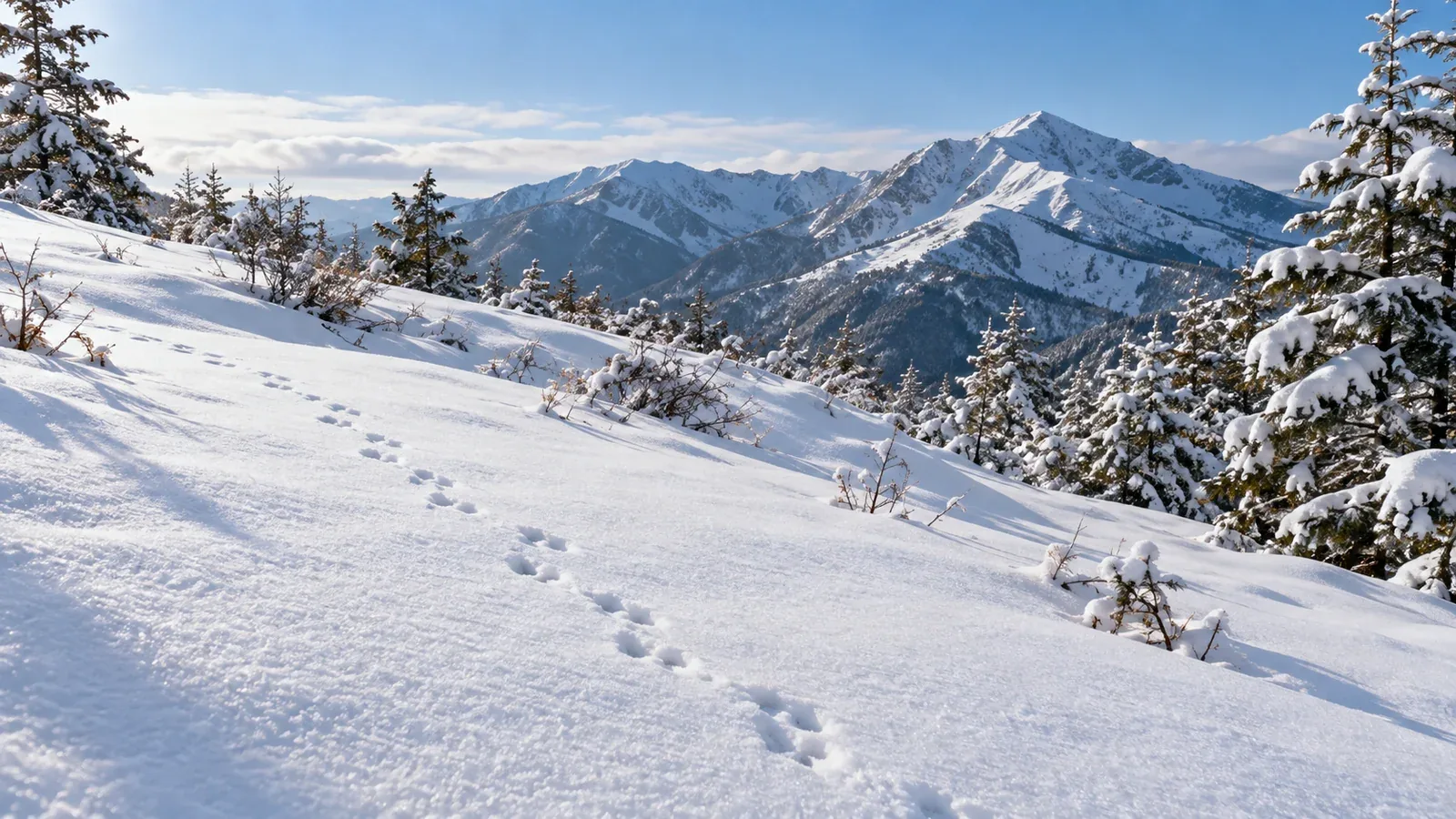
Tracks sometimes dot a snowy slope. A single print may look like a plain hollow. Look at several together and you may see whether an animal bounded along or walked in a single line.
Tracks tell you an animal passed through and can give you clues to its direction. The same animal may pass more than once, so you can’t count animals by counting their tracks.
Here’s how to read shapes and patterns and see what snow can do to them. Observe from a hiking trail or an open walking route.
Four things to look at first
Find a print you can see clearly and then look at the next one. Shape, pattern, snow conditions, and surroundings can help narrow down the possible animals.
Toes, claws, and hooves. Look for toe or claw marks and for a hoof split into two parts. Deep snow can hide the toes, and hard snow may show no claw marks.
How the prints line up. Look for a single line, pairs, or groups of large and small prints. A fox can place its hind feet in the tracks of its front feet. A hare leaves its larger hind prints ahead of its smaller front ones.
Depth and outline. How far a foot sinks depends on the weight of the animal, the hardness of the snow, and the way it moves. Sharp edges alone won’t tell you when a print was made.
Surroundings. See if the prints come from the edge of the woods, run along a stream, or cross the path. You can find clues from the trail without going where the tracks disappear.
Tracks you may see in Japan’s mountains
Hares
When a hare bounds, its larger hind prints land ahead in the direction of travel, with its smaller front prints behind. Even if the shapes are blurred, several groups of large and small prints can reveal the pattern. In Hokkaido, you may also see tracks of the Hokkaido mountain hare.
Foxes
When the hind feet land in the front prints, the tracks form a narrow dotted line. Clear prints may show toes and claws. Dog and raccoon dog tracks can look similar, so compare several steps before settling on an identification.
Raccoon dogs
Claws can show in a rounded print. A Forestry Agency guide shows examples that form a less straight line than a fox’s. Gait and snow conditions can alter the pattern, so look at the terrain and other prints too.
Japanese martens
In an observation from Mount Haku, tracks thought to be a marten’s appeared in pairs. When the animal bounds, hind and front prints can overlap, leaving what looks like two prints at a time. Hokkaido has animals such as the sable that leave similar tracks, so use a regional guide.
Sika deer
A cloven hoof leaves a print split into two parts. Hokkaido sika deer leave a similar shape. Japanese serow and wild boar can leave similar marks, so compare the hoof shape, the pattern, and which animals live locally.
Bears (Asian black bears and brown bears)
Bears have five toes, and claw marks may show in good conditions. Front prints are wider, and hind prints look longer when the heel makes contact. Prints can grow wider as snow melts. Size alone won’t tell you the species or the animal’s size.
If you suspect bear tracks or droppings, turn back safely without approaching or following them. Japan’s Ministry of the Environment also advises turning back if you find fresh bear sign. If you can’t tell how recent it is, leave the area and report the location to the land manager or local authorities.
How snow changes a track
A print’s appearance cannot tell you the time it was made. You can compare it with changes in the snow and weather to understand how its shape may have changed.
- Edges. Even a sharp edge can hold its shape for a long time if the snow stays cold and out of the wind.
- Snowmelt. Sun can round the edges and widen a print. Tracks made at the same time can look different in sun and shade.
- Windblown snow. Snow blown into a print can make it look shallower. The amount of snow in it doesn’t tell you how long it has been there.
- Snow covering the print. If you know when the covering snow fell, you have a clue that the print was there before that snowfall.
Even along one trail of prints, some can stay sharp while others blur in the sun or wind. Record the conditions you can observe and leave the exact time open.
Observing tracks from the trail
Snow can hide the shape of the path and its signs. Check that the route is open and that your equipment suits the snow. Observe from somewhere you can stop safely.
- Stay on the trail. Look at the prints you can see from the path. Let the tracks go if they disappear into brush or across a slope.
- Photograph the pattern. Take a picture that shows several steps and the surrounding terrain as well as an individual print. If you can do it safely from right beside the print, set a ruler or another reference down without touching it.
- Look for bird tracks too. Several thin lines in the snow may be toe marks from a bird. Look at the direction of the toes and how the prints are arranged.
- Leave the tracks in place. Use photos and notes. Avoid digging in the snow or touching animal signs, and follow the park’s posted instructions.
Try it on your next walk
On an open winter trail, pick a set of tracks you can see from the path. Record the shape, pattern, snow conditions, and surroundings. Compare your notes with a local tracking guide later.
Sources
- Snow tracks on Mount Haku and in the Southern Alps (Japan Ministry of the Environment)
- Tracks of hares, raccoon dogs, foxes, and wildlife in Hokkaido (Japan Forestry Agency and Japan Ministry of the Environment)
- Signs of brown and Asian black bears and when to turn back (Chitose, Kobe, and Japan Ministry of the Environment)
- How snow conditions and weather change tracks (Alaska Department of Fish and Game)
References and sources
- Chūbu Regional Environment Office: Fresh snow at the trailhead on Mount Haku
- Kantō Regional Environment Office: Whose tracks are these?
- Kinki-Chūgoku Regional Forest Office: Looking for animals by their tracks
- Japan Ministry of the Environment: Tracks in the snow on the Onnenai boardwalk
- City of Chitose, Hokkaido: Recognizing signs of brown bears
- City of Kobe: Information on Asian black bears
- Japan Ministry of the Environment: Bear encounter and response manual
- Alaska Department of Fish and Game: Impressions in the Snow