
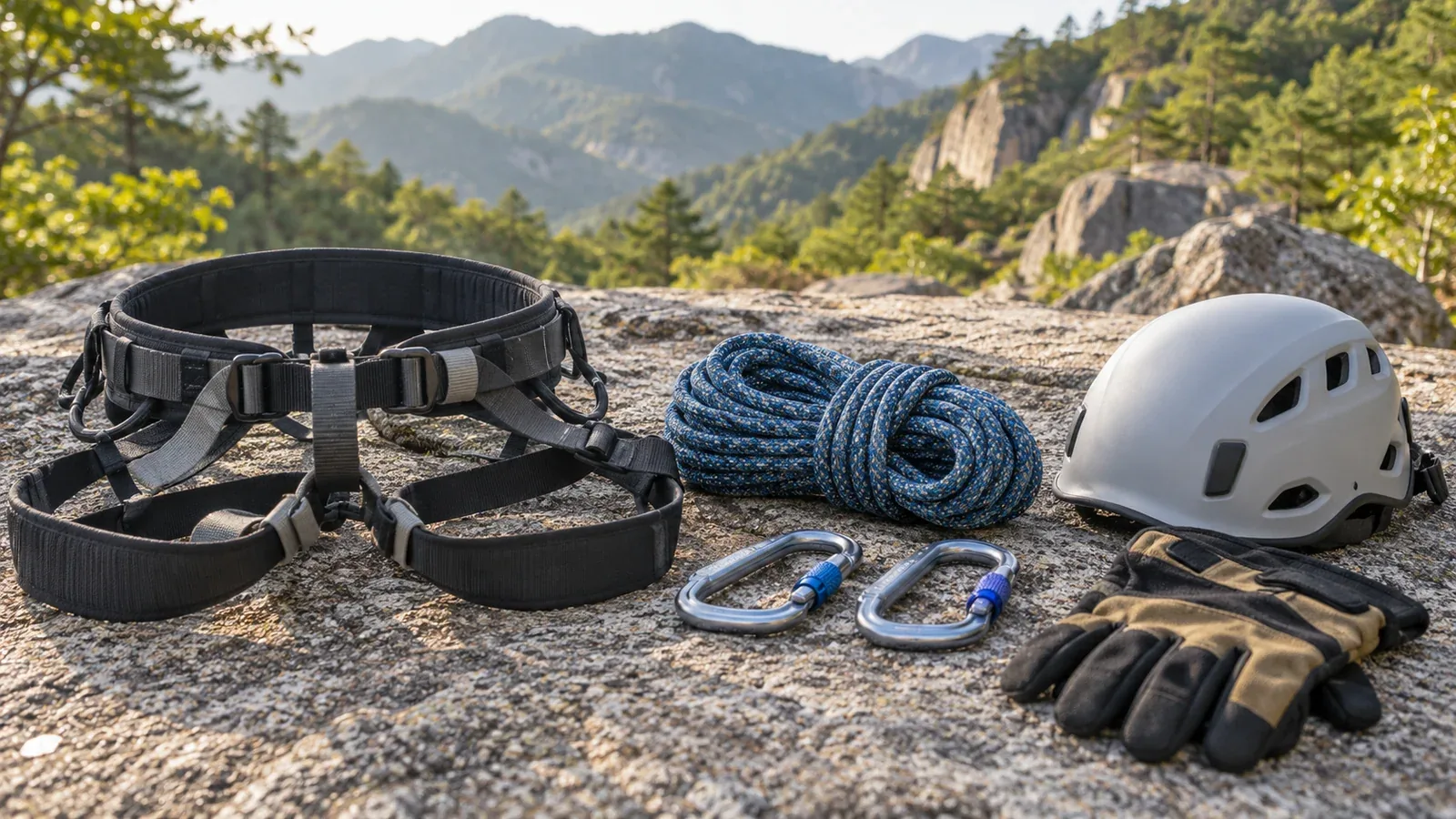
On rocky routes, “self-belay” can describe several different systems. This article deals with personal positioning at a verified anchor. Holding a trail chain is an aid to movement. Clipping to that chain with a sling does not turn it into a fall-arrest system.
Use this guide to identify when to stay on secure ground or change route and what to ask an instructor. Learn to use any system you depend on with qualified, hands-on instruction in the relevant terrain.
When a personal attachment may be appropriate
On ordinary hiking trails, use a sound chain for balance while keeping reliable holds and footing. Use a marked bypass or turn back before the exposed step if it is beyond what the group can safely manage.
The appropriate decision changes with the terrain and the system. Consider these examples before entering a section.
- A chain or fitting looks damaged or unreliable: stop and take an established alternative.
- Wet or icy rock leaves no reliable footholds: reassess from a stable position and turn back if you can.
- You need to adjust a pack, check a map or take a photo: wait until you can stop on secure ground.
- A queue forms: wait on a wide, stable part of the trail out of the path of rockfall.
- At a verified climbing stance, a trained climber may use a positioning system according to its instructions.
A positioning tether is one part of a known climbing system. For a route that requires protection against a fall, use only an appropriate system that the party knows how to verify and operate, or choose another route.
Equipment and its limits
Check the intended use, compatibility and instructions for each component. Train with the exact equipment before relying on it.
A climbing harness connects the climber to the system at its designated points. Follow the maker’s fitting and attachment instructions, and use the type suited to the planned activity.
Slings and personal tethers have different specified uses. A standard sling or a positioning tether without an energy absorber is not designed to arrest a free fall. Use equipment only as its maker specifies.
Carabiners have different shapes and locking mechanisms. Use a compatible connector in the intended orientation and check the gate and loading according to the instructions. The connector cannot make an unverified anchor safe.
Check the equipment’s declared standards and condition. The UIAA Safety Label and CE marking have different meanings. Use equipment with a known history and follow the maker’s inspection and retirement instructions.
Three checks before relying on a system
Check the anchor, the loading of the system and how you will leave the stance. These decisions depend on the particular equipment and terrain.
Verify the anchor
Do not assume that a trail chain, its bolts, a tree or a rock is a life-safety anchor. A visual check or a tug cannot confirm what loads it can take. If the route requires protection and you cannot verify the anchor and system, stop and use an established alternative.
Control the loading
Use a positioning tether only as specified by its maker. Check how the system could be loaded and avoid any position that could generate a fall outside its limits. Slack and moving above the anchor can increase the forces in a fall.
Reach or arm length is not a measure of acceptable loading. Before using any system, practise how to stay within its limits with a qualified instructor.
Moving or disconnecting
On a designated via ferrata, use the specified safety line and energy-absorbing equipment. Follow the operator’s rules, the maker’s instructions and the sequence you learned in training. Never apply a via ferrata procedure to a hiking chain or improvise a transfer between unverified points.
Use a secure stance to check your system with your partner before moving or disconnecting. For waiting or resting on a hiking trail, choose stable ground clear of the drop and rockfall.
Common mistakes
Assuming a trail chain can take a fall. A chain that feels solid may have been installed as a handhold. Do not count on it as protection without verification by those responsible for the system.
Wrapping a sling around the body. Use an appropriate harness and its specified attachment points as part of a suitable system. A loop of webbing around your body is not a substitute.
Taking a chance because the move is short. Consider the consequences of a slip on every exposed move. If you cannot protect or complete it safely, stay in a secure place and change the plan. In Japan, call 119 or 110 if someone is injured or there is no safe retreat.
Relying on new gear without practice. Learn on low-risk terrain with an instructor, repeat the checks and apply the skills only in the conditions you have trained for.
Training and experience
Practise fitting the harness, checking compatibility and identifying the system’s limits with a qualified instructor. Learn how to stop and reassess before committing to a move.
Look for a course that covers your activity and terrain. Ask which systems will be taught, what experience is expected and what skills need further practice.
For winter or alpine routes, obtain training specific to snow, ice, weather and retreat. Experience with summer rock or a via ferrata does not cover those conditions by itself.
Before your next exposed route
Check the manager’s route description, whether there is a maintained alternative and whether any technical protection is required. If your party cannot verify and manage the system, change the route or arrange qualified guidance before leaving.
Further reading
- Japan Mountaineering and Sport Climbing Association safety resources
- Japan Mountain Guides Association qualifications
- UIAA equipment standards and guidance
References and sources
- Japan Mountaineering and Sport Climbing Association · Safety resources
- Japan Mountain Guides Association · Guide qualifications
- UIAA · Climbing and mountaineering equipment standards
- UIAA · Static attachments and fall loads
- Petzl · Positioning lanyard instructions and limits
- UIAA · Energy-absorbing systems for via ferrata
- Petzl · Via ferrata partner check
- European Commission · CE marking and declaration of conformity
- Japan National Tourism Organization · Emergency numbers