
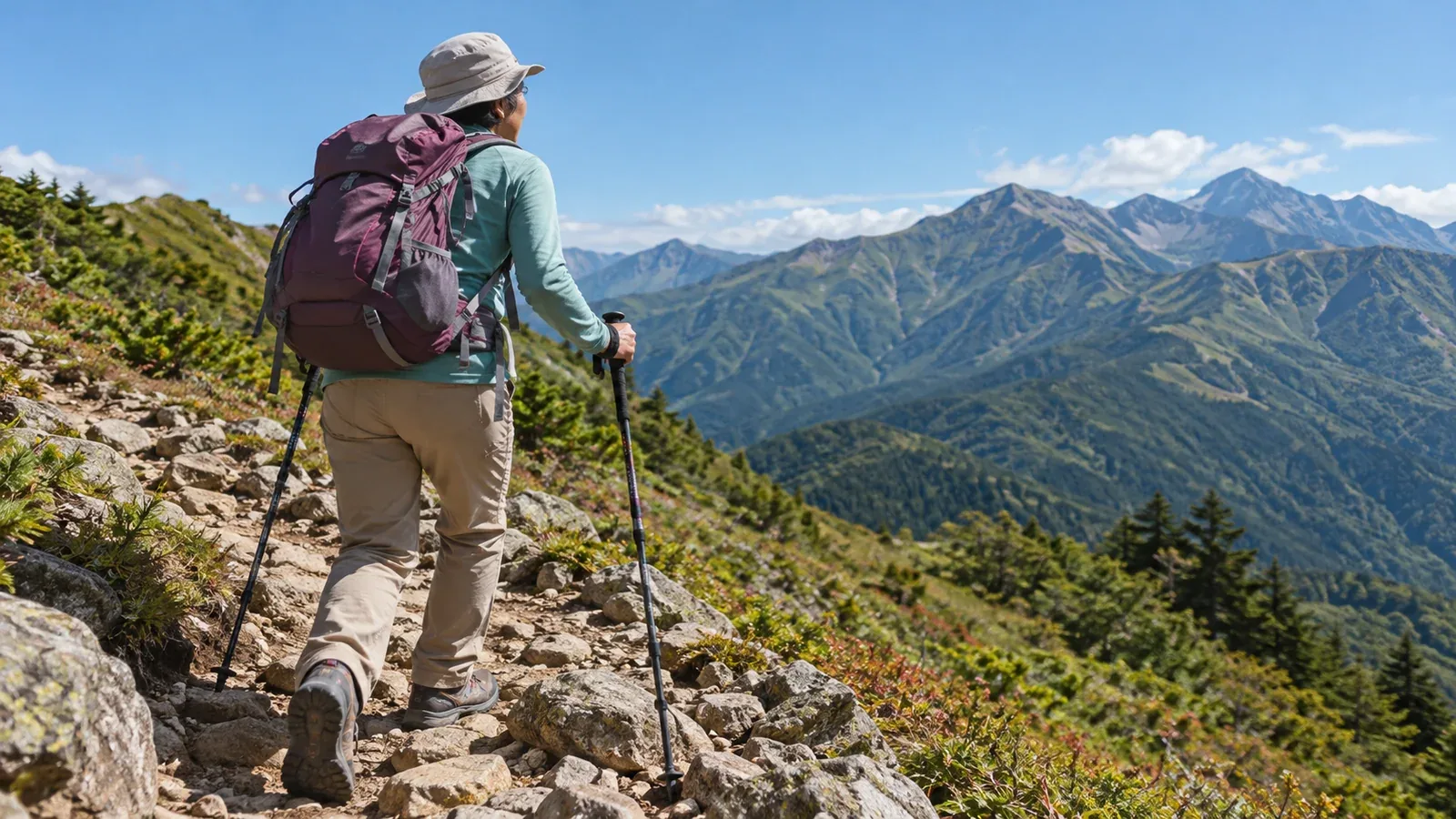
If you are starting to hike in your fifties, it is natural to wonder how your knees will feel, what pace suits you and how long recovery will take. Start with a route that fits how you move now.
Here's what can change physically in your fifties, how to manage strain on your knees, and how to plan your pace and build fitness gradually.
Physical changes that matter for hiking
Three changes are especially relevant to hiking.
First, maximum oxygen uptake, or VO₂ max, tends to decline with age on average. It measures how much oxygen you can use during intense exercise. Fitness and activity vary widely, so use your current pace as a guide.
Second, muscle strength can decline, especially in the legs with time. The muscles at the front of the thigh help control descents. They can be trained gradually, and recurring knee pain can have several causes.
Third, recovery can take longer after an unfamiliar effort. Notice how you recover before scheduling consecutive or more demanding trips.
Use these changes to adjust your planning and preparation.
How to look after your knees before they hurt
Knee pain is one of the first issues some new hikers in their fifties face. It often starts on the way down because the knee absorbs more impact, even if the ascent felt fine.
Use trekking poles well
Trekking poles can help with balance and may reduce some loading on the knees on descents. Practice on easy terrain, place the poles on stable ground and adapt their use to the surface and your footing.
On flat ground, adjust the poles so your elbows are bent around 90 degrees. Try a slightly longer setting for descents and a shorter one for climbs.
Pay attention to your downhill form
Choose a stable place to put your foot and let your knee flex as needed to control the movement. Foot placement changes with slope and surface. Avoid dropping heavily onto each step.
Shorter steps may help you stay in control. Estimate the descent time for the actual route and add a margin for slow sections and breaks.
Build strength around your knees before hiking
Build up gradually with movements you tolerate, such as standing from a chair, gentle squats or stepping down with support. Move slowly within a comfortable range.
If you have recurring knee pain or a history of injury or treatment, ask a health professional before increasing the load. After an injury, seek urgent care if you cannot bear weight, the knee locks or there is marked swelling.
Set your pace using published route times
Published route times are estimates. You might start with 1.2–1.5 times the walking time, then adjust for your pace, terrain and daylight and add breaks if they are not included.
Going uphill
Walk at a pace that lets you talk. Slow down or stop somewhere safe if you need to. If you develop sharp pain, severe or unusual breathlessness, or feel unwell, stop exerting yourself and consider returning or seeking help.
Taking breaks
Five to ten minutes of rest every hour can be a starting point. Stop sooner or longer if you need to, drink regularly and have food available. Put on a layer if you are cooling down.
Set a finish time first
Decide when you need to get back to the trailhead and work backward to a turnaround point. It's easy to use up your time by pressing on toward a summit. Agree before you leave that you'll turn around at the planned time even if you haven't reached the top.
What to hike in your first year
The first route helps you understand your stamina and get used to walking in the mountains. Use the following as a guide.
Keep the gain and distance manageable. For a regular walker, 300–500 m of ascent and three to four hours round trip can be a rough example. Choose considerably less if your fitness or knee is a concern.
Choose a maintained trail. Save sustained rock, chains and steep slopes for when you've built your fitness and skills. Weather, footing and pack weight make a difference even on a maintained path.
Go with someone. An experienced companion or beginner group can help you find a pace and provide support in an emergency.
One or two outings a month across the year can build experience and fitness while you learn how the seasons change conditions.
Equipment to pay particular attention to in your fifties
Focus on gear that helps you manage balance, load and temperature.
Footwear fit. Look for a secure fit and grip suited to the terrain. Try the shoes with your hiking socks and check for sliding when you simulate a descent.
Pack weight. Pack the essentials, including food, water, warm and waterproof layers, navigation and emergency supplies. Leave extras behind and try the loaded pack. A manageable weight depends on the route and what you can carry comfortably.
Layers and temperature. Choose layers you can adjust as you warm up and cool down. Keep an insulating layer dry for stops and changes in conditions.
What to do next
Pick a short, maintained trail nearby. Around 1.3 times the published walking time is one starting estimate, with extra time for breaks and delays. Ask a health professional if you are concerned about your knee. Nordwand’s Base Camps can connect you with people who know the area.
References
- National Police Agency, overview of mountain incidents.
- Japan Mountaineering and Sport Climbing Association, mountaineering materials.
- Ministry of Health, Labour and Welfare, Physical Activity and Exercise Guide for Health Promotion.
References and sources
- Physical activity and safety · Japan’s Ministry of Health, Labour and Welfare
- Knee pain and when to seek help · NHS
- Knee joint forces during downhill walking with hiking poles · Schwameder et al.
- Changes in aerobic capacity with age · Longitudinal study
- Planning and gear for day hikes · Nagano Prefecture