
Ever come home from a hike and found your legs exhausted the next day? Beginners often use more energy than they need because of how they walk. A few changes to your stride, breathing and breaks can make the same route feel much easier.
Here's why walking in the mountains calls for a different approach and what you can try on the trail. The principles can be adapted to different ages and levels of fitness.
Why a mountain trail tires you out
On level ground, you can put one foot in front of the other at a steady rhythm. On a mountain, the slope, step height and stability of the ground keep changing. Your leg muscles repeatedly absorb the impact.
Beginners often tire when they take long uphill steps, get out of breath or postpone breaks until fatigue builds. Addressing each of these can reduce the strain.
Keep your steps short and your movement even
Try taking steps shorter than your usual steps on level ground on steeper or uneven ground. Find a step length that keeps your footing stable.
Shorter steps can help keep your weight over a stable foothold and make movements easier to control on a steep slope.
Walking uphill
- Keep each step low. Look for smaller footholds rather than trying to clear a big step in one motion. On a high step, use both feet in two movements to spread the load.
- Look for a secure foothold. Use as much of the sole as the terrain allows. Choose a stable foot position on rocks, steps and roots.
- Avoid leaning too far forward. A slight lean is natural. Leaning so far you feel like you're falling adds tension to your back and waist. Relax your upper body and look a few meters ahead.
Walking downhill
Your legs work to control each downhill step. Take smaller, deliberate steps and slow down when the surface is uneven or slippery.
- Land gently and bend your knee slightly. Choose a stable landing for the terrain and let the knee flex as needed to control the step.
- Adapt your position to the slope. Use suitable support if you know how. If the terrain calls for skills you do not have, find a safe way to turn back.
- Take your time. Going faster increases impact and the risk of falling, so slow down deliberately on the descent.
Start by paying attention to your exhale
Breathing gets faster as a climb becomes more demanding. Slow down or stop somewhere safe if you are working harder than intended. Let your breathing settle into a comfortable rhythm.
One common technique is to coordinate breathing with your steps.
How to match breathing to your steps
- If useful, try breathing out for two steps and in for two on a gentle slope. You might naturally use one step for each phase on a steeper section. Keep a rhythm that feels comfortable.
- Let your breath out without forcing it. Relax your shoulders and adjust as the slope changes.
- Breathe through your nose, mouth or both, as feels comfortable for the effort.
Use the talk test as a rough guide to effort. If you can only say a few words without a breath, slow down or stop. If you are unusually short of breath, stop exerting yourself and consider seeking help.
Take a break before you're exhausted
It's easy to put off a break while you feel you can keep walking. It takes longer to recover once fatigue has built up, so schedule short rests before you reach that point.
A basic break schedule
Time is an easy way to manage breaks. A common pattern for beginners is to walk 40–50 minutes, then rest for 10–15. Adjust for the slope and how you feel. On a steep climb you might stop every 30 minutes.
Keep two things in mind when you stop.
- Choose whether to sit or stand. Pick a stable place out of the way, rest in the position that feels comfortable and put on a layer if you cool down.
- Drink and eat a little at a time. Adapt water and snacks to the heat, duration, effort and your needs. Keep them within reach.
What to check if your legs feel heavy
When you first notice heavy legs, check these four things in order.
- Has your stride lengthened? You may take longer steps without noticing when you tire. Shorten them deliberately.
- Is your breathing shallow? Slow down or stop and see whether you can breathe comfortably. Seek help if severe or unusual breathlessness persists.
- Has it been a while since your last break? Take the next one a little sooner.
- Have you had enough to drink and eat? Low energy can feel like weakness in your legs.
Using trekking poles as support
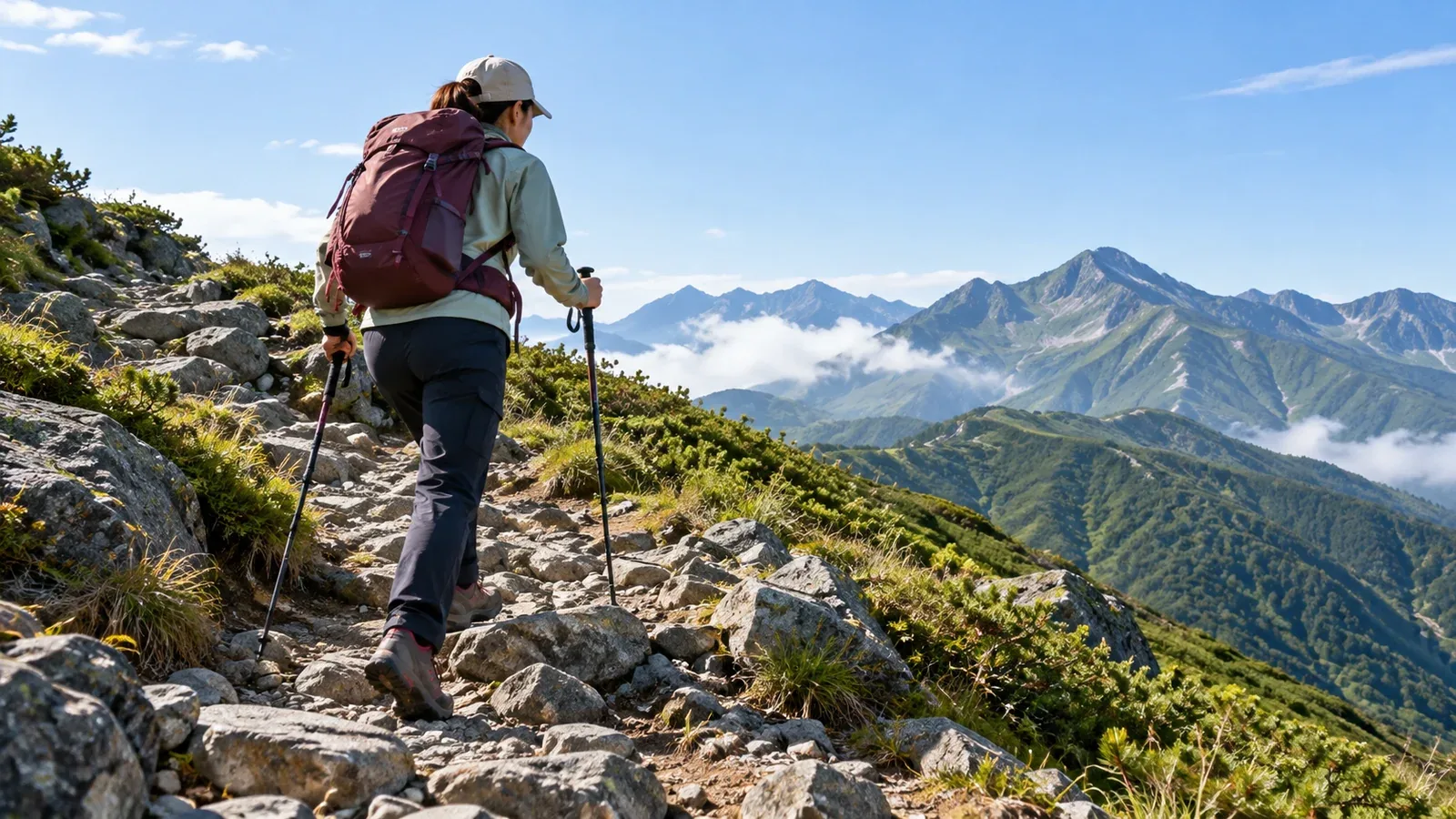
Poles can help with balance and may reduce some loading on the knees on descents. Practice on easy ground and choose stable placements for the terrain.
On level ground, set them so your elbows are bent about 90 degrees. Try them a little longer downhill and a little shorter uphill. Ask the shop to show you how to adjust your model, or check the manufacturer's instructions.
What to do next
On a familiar trail, try one change at a time. You might shorten your uphill stride or take a planned break before a steep section. Note your walking time, breaks and how you felt so you can plan your next outing.
References
- The talk test as a measure of exercise intensity.
- Japan Mountaineering and Sport Climbing Association, mountaineering technique and safety guides.
- Ministry of the Environment, materials on mountain toilets, trail conservation and hiking safety.