
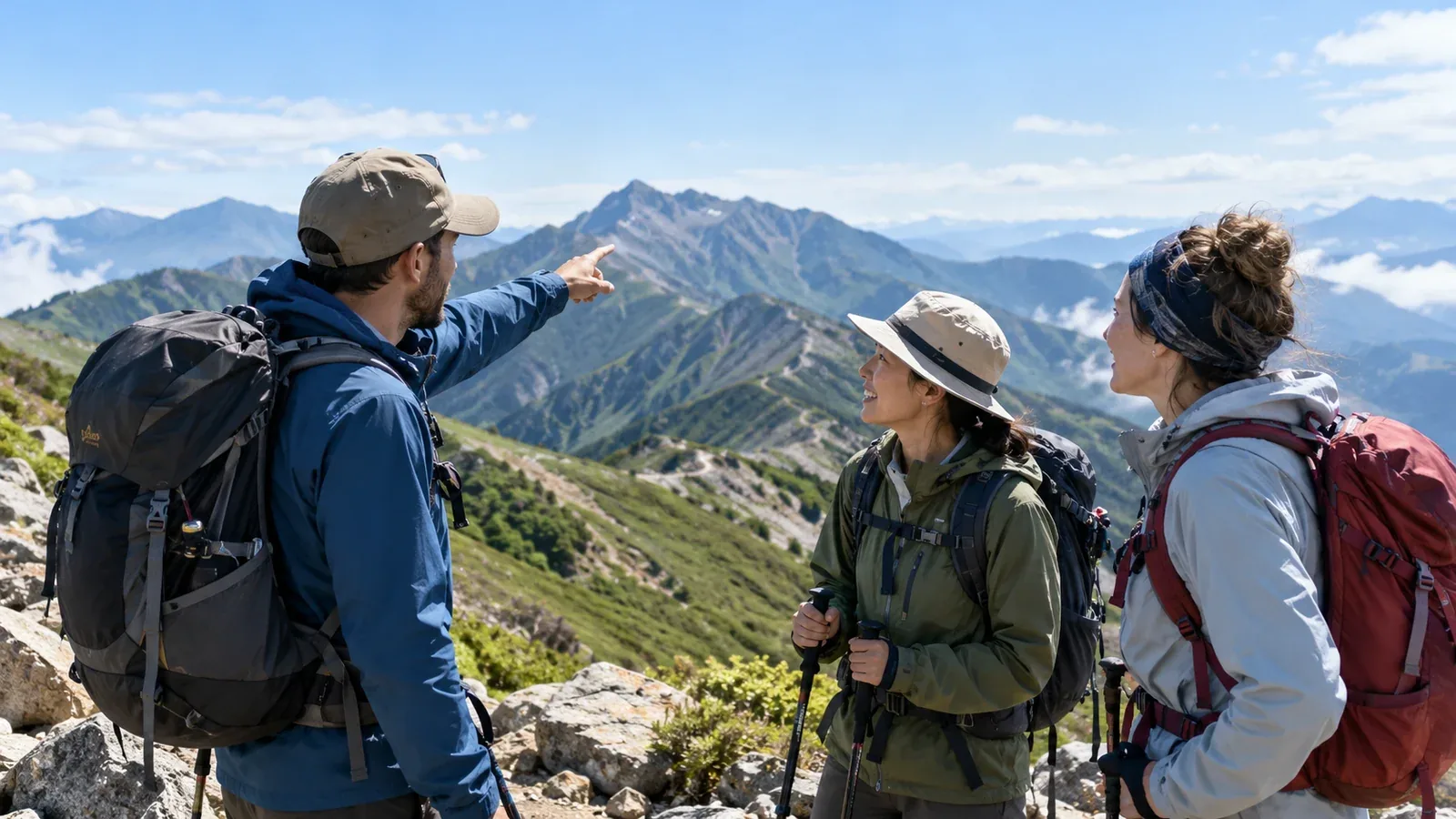
If a visitor speaks to you at a summit or on a trail, you may find yourself returning a nod and leaving it there because you are unsure what to say. As more visitors hike in Japan, there are more opportunities to exchange information that can affect someone’s safety.
This guide gives short English phrases for situations where a greeting is easy but the next sentence is harder. Each phrase has a specific use on the trail.
Trail conversations can be friendly and practical at the same time. A sudden change in the weather, a confusing fork, or someone feeling unwell is easier to handle when people can share what they know clearly. A few short phrases can help hikers look out for one another.
First words when passing someone or stopping for a break
On Japanese trails, people often greet hikers they do not know with konnichiwa. Visitors may already be familiar with the custom and say “Hello!” or “Hi!” first.
Here are some short greetings and conversation starters.
- “Hello!” or “Hi!” works in most situations.
- “Good morning!” or “Good afternoon!” is a slightly more formal greeting.
- “Great weather today!” is an easy way to start talking.
- “Are you heading to the summit?” lets you compare destinations.
- “Almost there!” can encourage someone on the climb if you know the destination really is close.
During a break, “Where are you from?” can open a conversation. If someone says “This is my first time in Japan,” you can reply, “I hope you enjoy it!”
Giving directions and describing a fork
Use these phrases when someone asks about the route or looks unsure which way to go.
When someone asks you
- “Which way is the summit?”
- “Is this the right trail to [place name]?”
Pointing to the route or a map makes your answer easier to follow.
- “Go straight.” Point out the path you mean.
- “Turn left at the fork” or “Turn right at the fork.” Point to the junction on the map if you can.
- “Follow the red markers.” Describe the color or shape you actually saw.
- “About 30 minutes from here.” Give the time as an estimate, since pace and conditions vary.
When you need directions
You can ask someone to help you check your own route.
- “Excuse me, is this the trail to [place name]?”
- “Could you show me on the map?”
Take out a paper map or open your hiking app and point to the place you are asking about. You can often resolve a question that way even with a limited shared vocabulary.
Sharing weather information and the decision to turn back
A sudden change in the weather is worth telling others about.
- “The weather is getting worse.”
- “There’s a storm coming.”
- “I heard thunder.”
- “It might be dangerous to continue.”
- “I’m turning back.”
- “You might want to turn back too.”
Use “might” when giving an assessment or suggesting an option. Be direct about what you observed, such as hearing thunder. Check forecasts and advisories from the Japan Meteorological Agency and local trail managers before setting out.
Illness, injuries, and emergencies
If someone is injured or feels unwell, speak clearly and check that they understood you.
Checking what happened
- “Are you okay?” is a simple first question.
- “Are you injured?”
- “Can you walk?”
- “Do you need help?”
Describing how you feel
- “I’m not feeling well.”
- “I twisted my ankle.”
- “I need to rest.”
Getting emergency help
- “We need to call for rescue.”
- “Do you have a signal?”
- “I’m calling emergency services.”
In Japan, contact the police on 110 or fire and ambulance services on 119 for emergency help. The numbers are the same for visitors. “I’m calling the police” or “I’m calling an ambulance” can tell someone who does not recognize the numbers what is happening. Before the hike, check the emergency guidance for the area where you will be.
Keeping a conversation going
These short phrases can help when you have time to chat beyond a greeting or a question about the route.
- “This is my favorite mountain.”
- “The view from the top is amazing.”
- “Is this your first time hiking in Japan?”
- “Have a safe hike!”
- “Take care!”
If the other person speaks some Japanese, it is fine to use a mix of English and Japanese. Words, gestures, and a map can go a long way. Showing someone you are trying to help can put them at ease.
On the trail, being understood matters more than perfect grammar. If someone needs a warning or a hand, a few clear words are enough to start.
Putting it into practice
Before your next hike, say the weather warnings and emergency questions out loud once or twice. It is easier to recall them when a situation comes up suddenly. Nordwand’s Base Camp can help you find hikers who have experience communicating with visitors, and you can also request a certified guide if you want language support on a hike.
References
- Japan Meteorological Agency, weather forecasts and warnings
- National Police Agency, mountain incident statistics and emergency contacts
- Fire and Disaster Management Agency, rescue services and 119 calls