
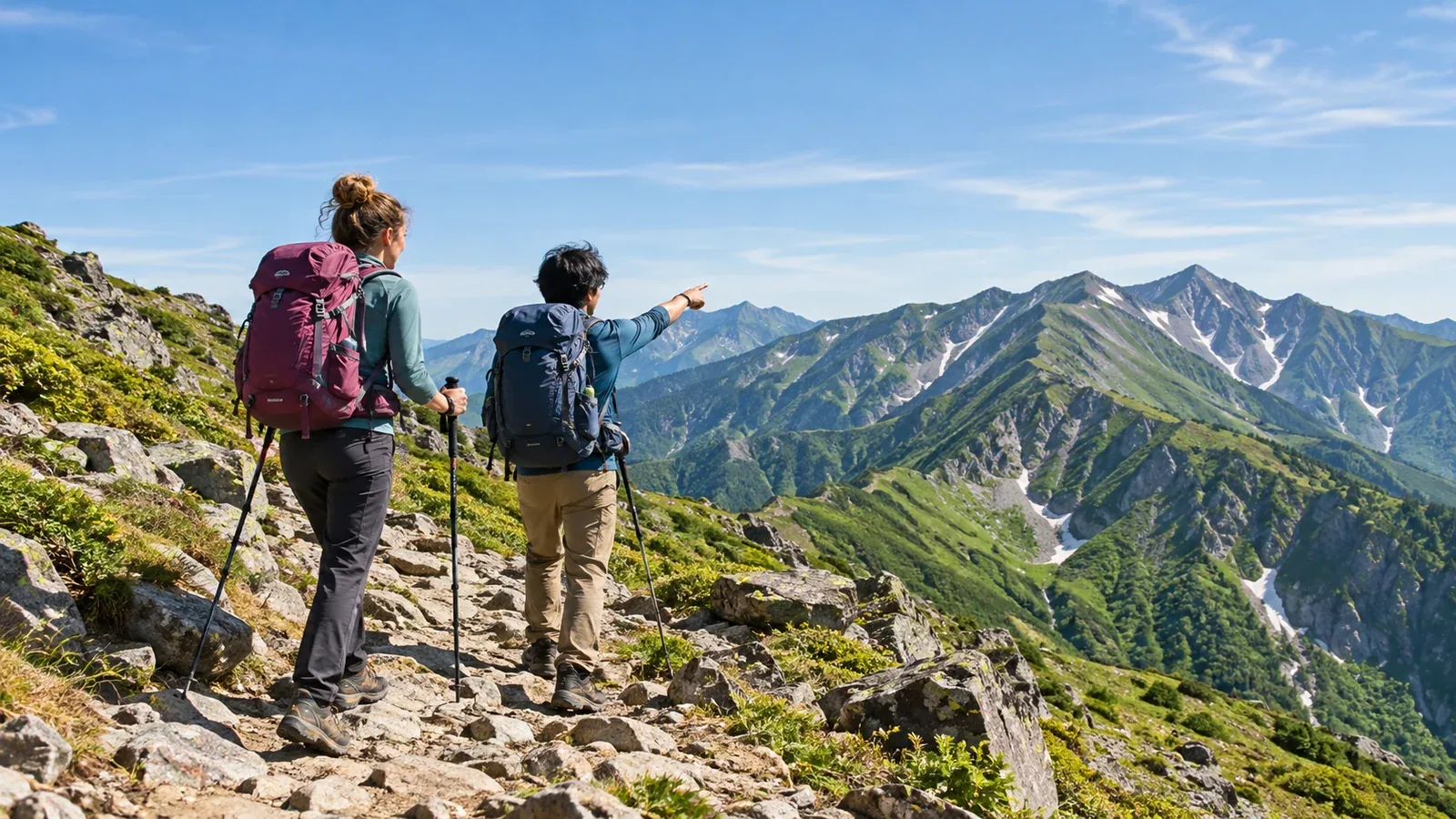
When you take someone from overseas hiking in Japan, think about which route will suit them and what you need to prepare. The choice depends on their fitness, experience, interests, and time in the country. Differences in language, equipment, and trail customs can catch people off guard.
This guide is for hikers in Japan who are helping visiting hikers plan a trip. Use it whether you are taking a friend out for the day or helping someone who has come to Japan to hike.
Four things to consider when choosing a route
Match your companions’ experience, fitness, interests, and schedule with the route’s difficulty, access, and quality of information. These four questions can help you narrow the choices.
1. Does the route suit their fitness and experience?
For someone new to hiking, a day hike of roughly three to four hours round trip is a conservative starting point if the terrain and pace suit them. Well-established destinations such as Mount Takao in Tokyo or the Rokko mountains in Hyogo can be easier to navigate. Check whether the specific route has signs or visitor support in a language everyone can use.
Experienced hikers may be interested in the Northern Alps or the Yatsugatake mountains. Steep terrain, the rainy season, typhoons, and rapidly changing conditions above the treeline can surprise people who know the Alps well. Ask your companions how they would prepare for the conditions on this route, even if they have completed difficult routes at home.
2. Can you get there and back easily?
Day hikes within reach of a city are easier to fit around other plans. Mount Fuji is a popular request, and its climbing season, fees, and rules on overnight ascent can change from year to year. Check the latest guidance from Shizuoka or Yamanashi for your trail, including whether you need to reserve or register.
For an overnight traverse, check hut availability early. When your companions are booking directly, confirm which languages the hut can use. You can offer to help with the booking or choose a hut that lists English support.
3. Can everyone read the signs and find reliable route information?
Multilingual signs can help people make decisions if you become separated or something goes wrong. Popular areas such as Mount Fuji, Mount Takao, Kamikochi, and the Shiratani Unsuikyo and Jomon Sugi routes on Yakushima tend to have more multilingual information. In less-visited areas, signs may be in Japanese only. Ask anyone who cannot read them to download the relevant offline maps before leaving.
4. What do they want to see, and when?
A view of Mount Fuji, autumn colors, and a winter outing call for different routes and preparations. Nasu, Oku-Nikko, and Tateyama are among the options for autumn colors. Snow-covered routes require considerably more equipment and skill. If someone is new to hiking in Japan, check their winter experience carefully before suggesting one.
Check equipment and rental options
Gear that works well at home may be a poor match for the route and weather you are planning for. Check the following together.
- Rain gear. Summer mountain weather in Japan can bring sudden heavy rain. Bring a waterproof, breathable shell. Cotton and jackets with only a water-repellent finish offer limited protection in heavy rain.
- Footwear. Road running shoes or light sneakers can offer less grip and support. They may be adequate on some well-maintained low trails. For steep or rocky routes, ask your companions to bring hiking footwear suited to the terrain.
- Headlamp. Carry one even on a day hike in case the descent takes longer than expected.
- Emergency blanket and first-aid kit. Check what your companions already carry and fill any gaps before setting out.
Some outdoor shops in larger cities rent gear. Nordwand’s partner shop search can help you find a nearby store. Confirm rental availability directly.
Prepare to communicate on the trail
A short shared plan can help even if you are unfamiliar with each other’s languages.
Share these details in advance.
- Give the meeting place and time with a map screenshot.
- Share estimated hiking time and elevation gain, and explain that the figures depend on conditions and the group’s pace.
- Agree on when to turn back if the weather worsens. If you hear thunder, leave exposed terrain and seek safe shelter promptly.
- Save emergency numbers for Japan: 110 for police and 119 for fire or ambulance.
Prepare a note with useful Japanese phrases, romanization, and English meanings. For example, tasuke o yonde kudasai means “Please call for help,” ashi o kujikimashita means “I twisted my ankle,” and kibun ga warui desu means “I feel unwell.” The note can help if you are separated. Learn the English equivalents if your companions use English.
Explain local rules and trail customs
Cover a few rules before you leave so everyone knows what to expect on the trail and at huts.
Packing out trash. Many trails have no bins. Carry food wrappers and bottles out with you. Some hut toilets charge a fee.
Protecting the trail. Stay on the path and leave plants undisturbed, especially in alpine areas with sensitive vegetation.
Staying in mountain huts. Huts often have rules about bedding, lights-out, and shared rooms, including for guests staying without meals. Check the hut’s website or its Nordwand partner listing before arrival.
Taking photos. Some mountains, such as Mount Oyama and Mount Ontake, have shrines or torii gates at or near the summit. Treat them as places of worship and follow any local rules about photography.
Decide when to turn back before you leave
If you are organizing the outing, take responsibility for calling it off when conditions warrant it. Visitors may feel pressure to carry on because they have traveled a long way, and that pressure can influence the rest of the group too.
Agree on specific triggers before departure, such as turning around if strong wind makes a ridge unsafe or leaving exposed ground early if thunderstorms are approaching. Check Japan Meteorological Agency forecasts and warnings, along with any mountain-specific forecast you use, the day before and again on the morning of the hike.
The risk of acute mountain sickness rises around 2,500 m. If someone develops symptoms such as headache, nausea, or unusual fatigue at altitude, stop ascending and descend safely if symptoms worsen. Anyone with an underlying condition or questions about their medication should talk to a healthcare professional in advance.
Putting it into practice
Ask about your companions’ experience, fitness, and goals. Use the four criteria to narrow the options to two or three routes. Share the gear checklist and turnaround conditions before departure. Nordwand’s Base Camp and certified-guide request feature may help you find a companion or guide with experience supporting visitors in their language.
References
- Japan Meteorological Agency, forecasts and weather warnings
- National Police Agency, annual overviews of mountain incidents
- Shizuoka and Yamanashi prefectures, official Mount Fuji climbing rules
- Ministry of the Environment, information on mountain toilets
- Yakushima World Heritage Area Management Plan, Yakushima Town and Forestry Agency