
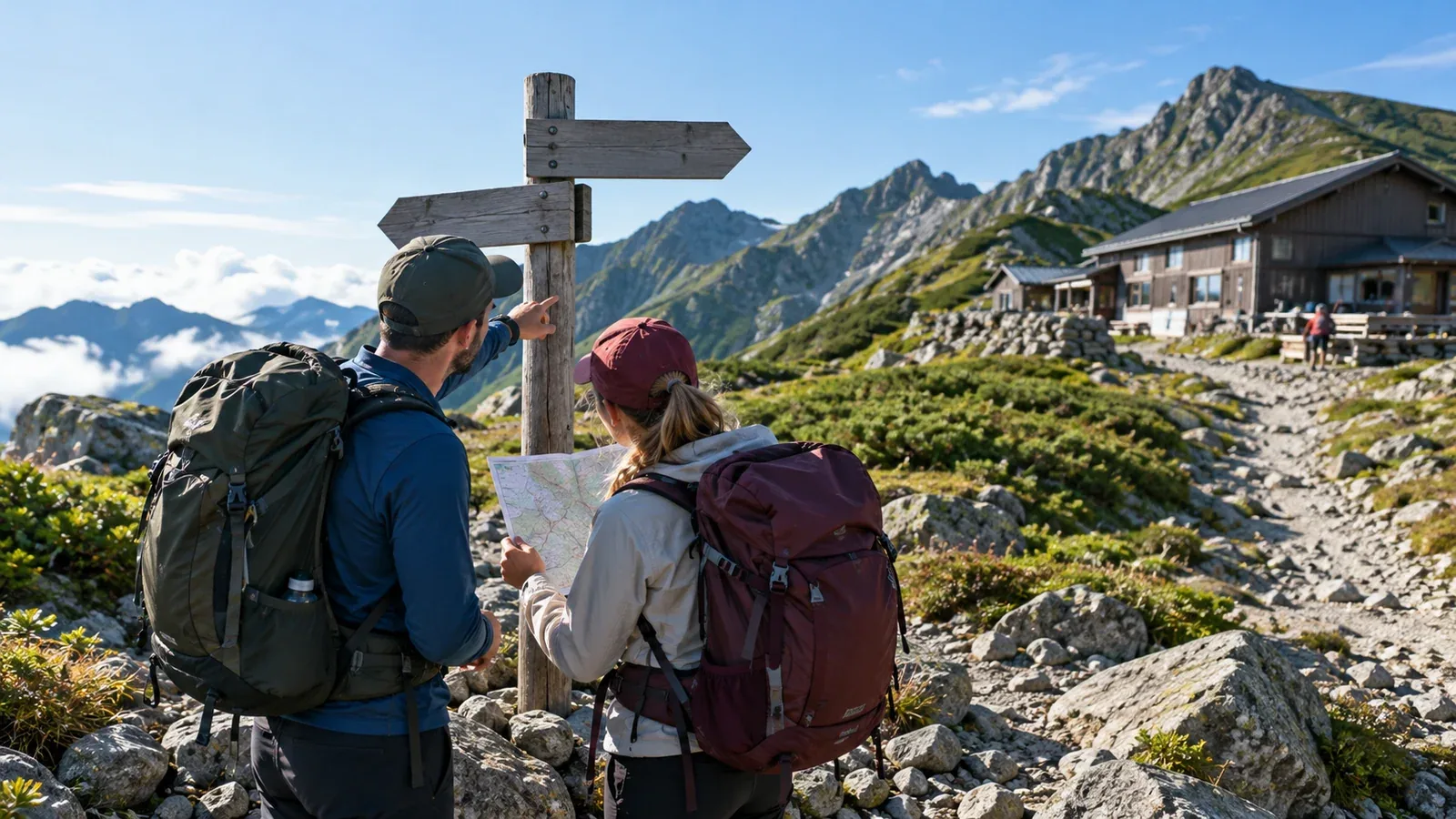
Japan has many well-maintained trails and mountain huts. Even so, hikers visiting from abroad often find parts of a trip harder than they expected. Difficulties often come down to information: the language on signs, unwritten trail customs, and how to get help in an emergency.
This guide looks at where visiting hikers can get stuck, how hikers in Japan can help, and what the same experience can teach anyone planning a hike abroad. Both perspectives can make the trail easier to share.
Where you will encounter signs in Japanese only
Many trailhead signs, junction markers, and warning notices are written only in Japanese. Internationally known areas such as Mount Fuji and Kamikochi tend to have more English signs. In less-visited areas, Japanese-only signs are common.
A sign at a fork may give only a place name and say that the trail heads in that direction. For English speakers, it can be hard to pronounce the name or relate it to the map. Terms such as tozando (hiking trail), tsukodome (closed), and kusariba (a section with fixed chains) are also easy to miss if you have not learned them.
Three situations can be particularly confusing.
- Filing a hiking plan. Trailhead drop boxes and paper forms may be labeled in Japanese only. More prefectures accept plans online, and some offer an English form. Before you leave, check the submission method with the prefectural police or the authority responsible for the trail.
- Closures and access restrictions. Local notices about trail closures, winter closures, and restricted areas are often in Japanese. An English website may take longer to reflect an update.
- Toilets and water sources. A sign may ask for a contribution or tell visitors to boil water. A hiker may walk past it without realizing what it says, even when they are trying to follow the rules.
Unwritten trail and hut customs
Hiking customs vary across countries and regions. A habit that feels routine at home may surprise people on a Japanese trail, and the reverse can happen when hikers from Japan go abroad.
Passing on the trail. In Japan, it is customary to give uphill hikers the right of way. On steep or narrow sections, work out who can step aside safely. A descending visitor may simply be unfamiliar with the custom, and a request in Japanese may go unheard or be misunderstood.
Mountain hut rules. Many Japanese huts set specific times for dinner, lights-out, and getting up. Outdoor shoes may be prohibited in certain areas, and shared sleeping rooms are common. These arrangements may differ from what a visitor has encountered in the Alps or elsewhere. If check-in or meal instructions are given in Japanese only, a visitor may watch what others do to work out what is expected.
Trash and toilet use. Many mountain areas in Japan ask visitors to carry out everything they bring in. Parks and local authorities may also set rules. Practices differ from place to place, so check how the area handles waste and follow the local guidance.
Language barriers in an emergency
Many visitors speak little Japanese. If the weather changes suddenly, they take a wrong turn, or they twist an ankle, it can be hard to explain what happened to the people nearby.
Keep three points in mind when preparing to call for help.
- Emergency numbers. In Japan, 110 is the police emergency number and 119 is for fire and ambulance services. Both may be involved in mountain rescue. Language support varies by service and area, and phone reception may be limited in the mountains. Before leaving, write down both numbers, the name of your hiking area, and its prefecture.
- Describing your location. If you cannot say the name of the mountain and junction in Japanese, show or read out the latitude and longitude from a map app. Set up GPS and offline maps before you leave.
- Gaps in phone coverage. Mobile data can drop out on the trail, which can make online translation unusable. Download an offline language pack in advance so you and the people helping you can still communicate.
How hikers in Japan can help
You can often help someone on the trail with very little spoken English.
Gestures and maps can help establish where you are. Point to your location and the junction on a paper map or app. Indicate which direction you mean. If the trail is closed, point to the sign or mark the closed section on the map.
A few short English phrases can help too. “The trail is closed,” “Boil the water before drinking,” and “Are you OK?” cover situations that can arise on the trail.
If a hut worker or trailhead attendant does not speak English, show them a translation app and gesture to the field where they can type. Preparing for situations like this makes it easier for everyone to share the trail.
What to prepare before hiking in Japan
A few checks before departure can make it easier to follow local rules and get help.
- Check how and where to file a hiking plan with the relevant prefectural police.
- Find local rules and restrictions in a language you can read. Start with the national park office or official tourism information.
- If you are staying in a hut, ask when booking whether instructions are available in English.
- Download offline maps and an offline translation pack.
- Keep 110 and 119 handy, along with the name of the prefecture where you will hike.
The same habits are useful when hikers from Japan go overseas. Check the route and local customs in advance, follow them on the trail, and make a plan for getting help.
Putting it into practice
When you meet a visitor who needs directions, start by pointing out your location and the direction of the trail on the map. That alone can help someone regain their bearings. Before a hike, check official sources such as the prefectural police, national park office, or municipality for current filing procedures and access restrictions. Nordwand’s Base Camp can also help you meet people who know the area.
References
- National Police Agency, Overview of Mountain Incidents
- Japan Tourism Agency, hiking information for international visitors
- Ministry of the Environment, rules and etiquette in national parks
- Fire and Disaster Management Agency, multilingual support for 119 emergency calls