
The Ravine and the Shelter
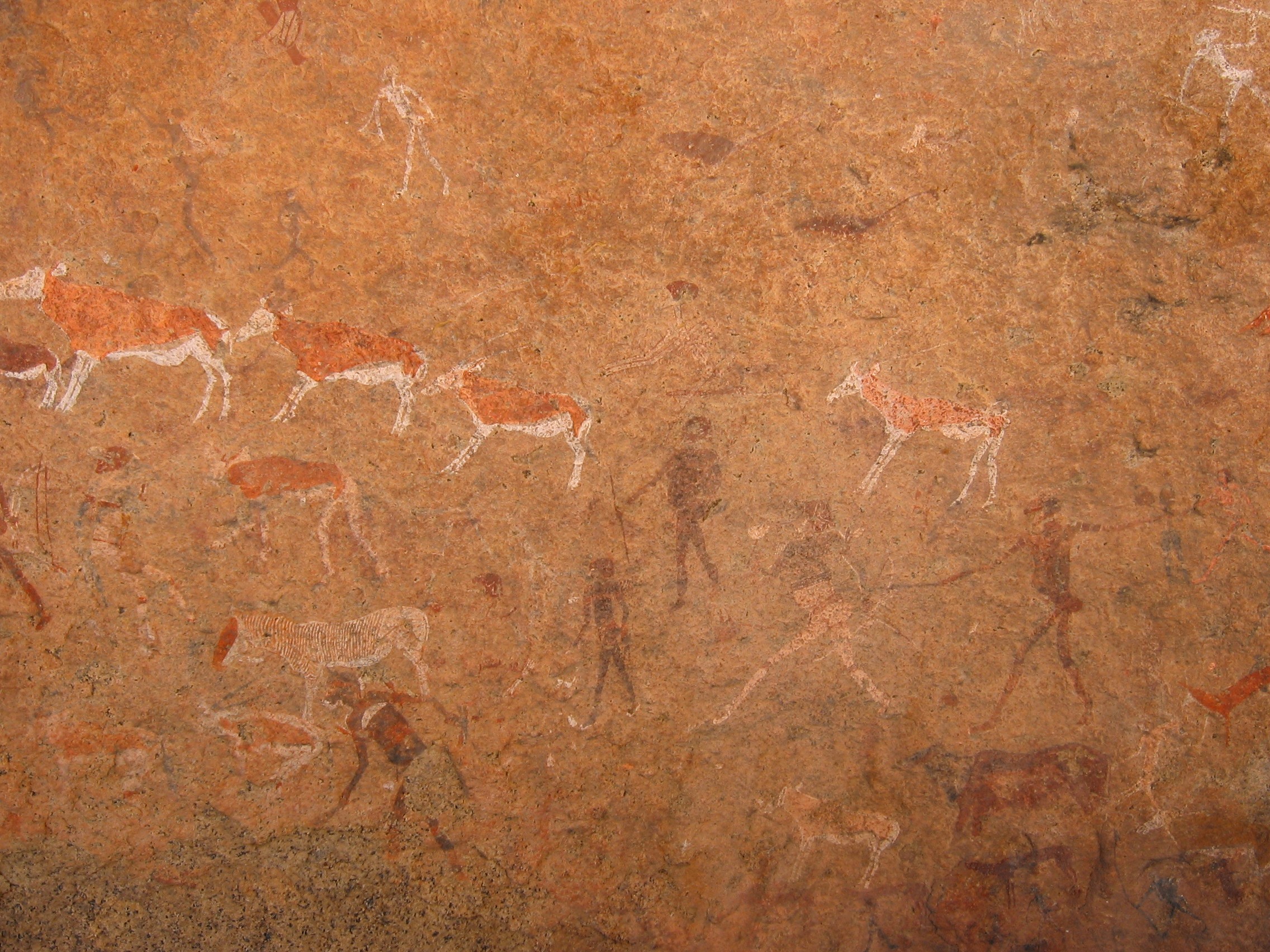
The Tsisab Ravine cuts across the eastern side of Dâureb, the granite massif also known as the Brandberg. In the 2004 photograph, red and pale animals stand out among darker human figures. The exact age of this painted panel remains uncertain.
H. Jochmann published an account of other Tsisab paintings in 1910. The shelter that became internationally known was one of many places in the ravine where artists painted on the rock.
The First Visits and Their Records
Reinhard Maack reached the shelter on 4 January 1918, two days after he, Georg Schulze and August Gries climbed Königstein. He sketched figures on the wall. The Frobenius Institute’s account dates the first publication of that sketch to 1930.
In December 1929 a local guide named Elias helped Maria Weyersberg find the shelter. She made a watercolour copy over two days. A reproduction appeared in Leo Frobenius’s book in 1931. The Frobenius Institute records the copy on display in a 1937 exhibition at New York’s Museum of Modern Art.
Interpretation and Its Revisions
Henri Breuil visited in 1947 and used the name White Lady in 1948. In a book published in 1955, he understood the central figure as a woman connected to the ancient Mediterranean. The Frobenius Institute notes that his tracing even shows the suggestion of a breast, a detail that is absent from other tracings.
Archaeologist Godfrey Gwasira describes later tracings by Harald Pager as evidence that the figure depicts a man. The surviving copies reveal where each observer emphasised or misread a detail on the same rock surface.
Survey and Monument Status
Between 1977 and 1985, Pager documented rock paintings across Dâureb. His field records were published in scientific catalogues. As part of that larger record, the Tsisab shelters can be studied alongside painted sites elsewhere on the massif.
In 2002 Namibia submitted the Brandberg National Monument Area to the World Heritage Tentative List. The submission includes the Tsisab panel as part of a landscape with numerous painted and engraved sites.