
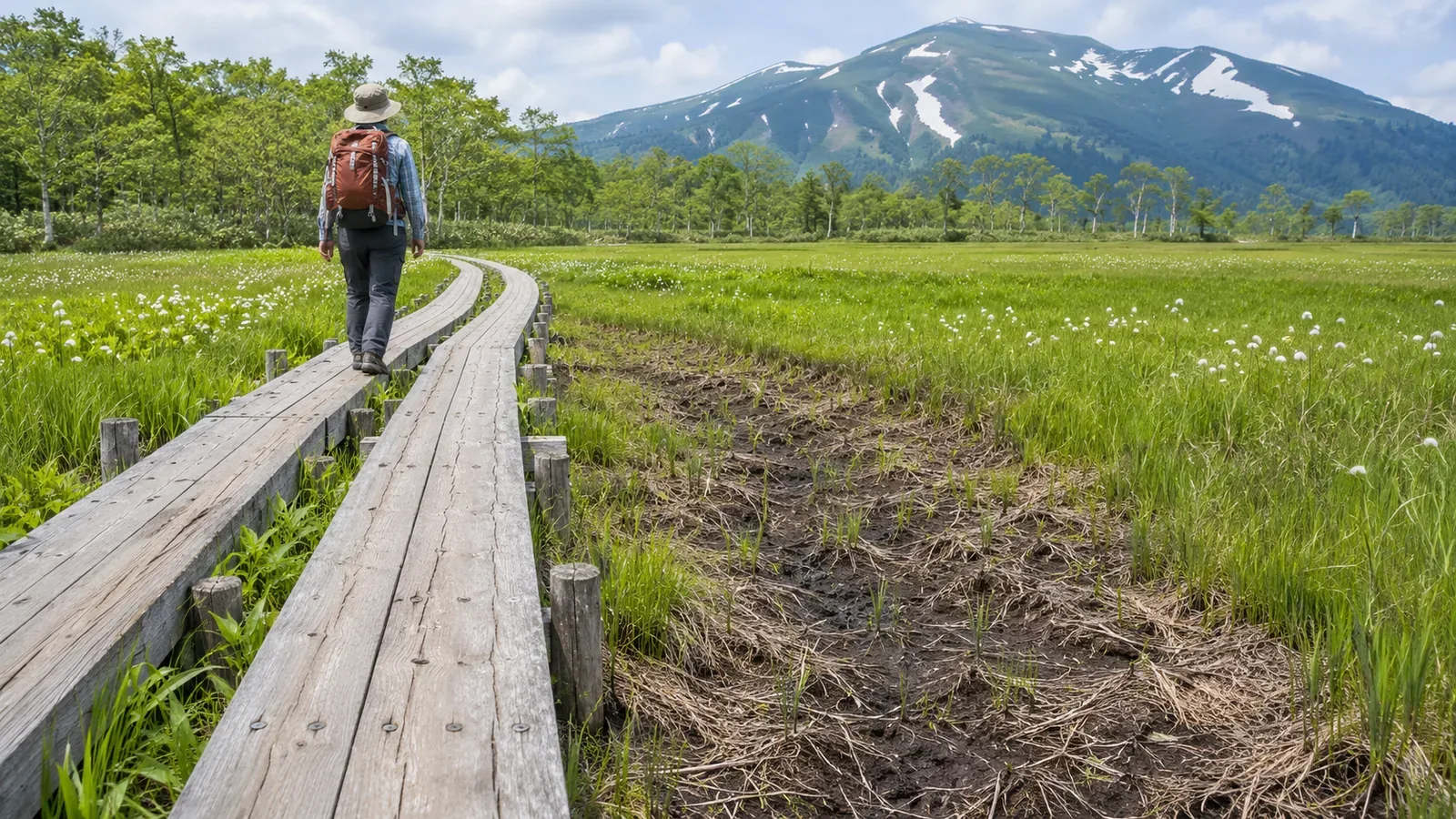
In Oze, some wetlands were damaged in a few years and had yet to recover more than half a century after restoration began. The records show what happened to the ground when people walked on it and how the restoration work has carried on.
A few years of damage, more than half a century of restoration
When boardwalks were scarce, visitors walked through wetlands, stripping vegetation and leaving peat to wash away. The Oze Preservation Foundation explains that bare patches spread as people stepped into the wetlands to avoid mud. Damage grew as visitor numbers increased around 1960.
Fukushima Prefecture says peat accumulates at about 1 mm a year. Wetlands that took thousands of years to form deteriorated within a few years. Gunma Prefecture also records that many people stepped into wetlands in the late 1950s and early 1960s, when there were still few boardwalks.
Conservation work at Ayamedaira began in 1966. According to Fukushima Prefecture, some areas were still unrecovered 55 years later, when its account was written. Gunma Prefecture’s booklet says that work at Ayamedaira and other sites had been going on for over 50 years at the time of publication.
What trampling does to the ground
Changes in the ground help explain the slow recovery. Gunma Prefecture says repeated trampling kills plants and can compact and dry the ground. Peat can crack or wash away in the rain, leaving plants unable to grow. The layer where plants take root can be damaged as well as the leaves and stems above it.
About 1 mm a year is the rate at which the peat that makes up the wetland accumulates. That figure cannot tell us how long a damaged patch will take to recover. Restoration can take years when plants lose the ground they root in as well as the vegetation at the surface.
Who started restoration, and when
Gunma and Fukushima prefectures began research and restoration in 1966. From 1969, Tokyo Electric Power Company hired an affiliated company to work mainly at Ayamedaira. In fiscal 1998 the Environment Agency, now the Ministry of the Environment, launched projects at Miharashi, around Lake Ozenuma and at Kumazawatashiro, among other places. The Oze Preservation Foundation began carrying out restoration for both prefectures in 1996 and for the agency in fiscal 1998. Each project covered different sites or work.
The 55 years quoted by Fukushima Prefecture describe how much time had passed for part of Ayamedaira when the article was written. To find out how a site is doing today, check surveys and information from its manager. Fukushima Prefecture’s January 2026 research overview says boardwalks and other measures reduced damage from trampling and points to growing numbers of sika deer and the arrival of non-native species as further challenges.
Fukushima Prefecture gives a typical boardwalk service life of about ten years, depending on conditions. Gunma Prefecture says wetland boards can rot or break in seven to ten years. The boards initially made it easier to cross muddy ground, then took on a role in protecting the wetland. Boards can be replaced. Rebuilding the soil and vegetation can take decades in some places.
What to think about before walking the boards
The Ministry of the Environment asks visitors to stay on the boards to protect fragile wetlands. Thinking through these three points before leaving can make decisions easier on the trail.
First, think of three situations that might tempt you off the boards, such as a photo, passing someone or avoiding a slippery spot. Gunma Prefecture describes how walkers trying to avoid slick serpentine on Mount Shibutsu left the trail and trampled plants. Decide ahead of time what you will do if the surface looks slippery.
Second, plan other options. Skip the photo or yield where you can wait safely. If you cannot cross a slippery section safely, consider turning back. The Oze Preservation Foundation asks people to keep feet and tripods out of the wetland, fit caps on poles and keep their tips within the trail. Third, avoid bringing in seeds. Weed seeds in dirt on your boots and clothes can threaten native plants, so the foundation asks you to remove mud on the seed-removal mats at trailheads.
If you are unsure, stop on stable footing and keep the passage clear before deciding. If there is nowhere suitable, leave the photo or notes until later.
Keep your feet on the boards and out of the wetland
Some wetlands that deteriorated within a few years were still recovering more than half a century after restoration began. Before leaving, think about when you might be tempted to step off and what you can do while staying on the boards. Check the latest notices from the manager for current access and restrictions.
References and sources
- Oze Preservation Foundation: Vegetation Restoration
- Fukushima Prefecture: The History of Conservation in Oze, Part 2, Managing Overuse
- Gunma Prefecture: Boardwalks and Vegetation Restoration in Oze (booklet extract)
- Fukushima Prefecture: Vegetation Restoration Research in Oze National Park
- Oze Preservation Foundation: Trail Etiquette in Oze
- Japan Ministry of the Environment: Visiting Oze National Park Responsibly
- Tokyo Electric Power Company: Protecting Oze’s Vegetation