
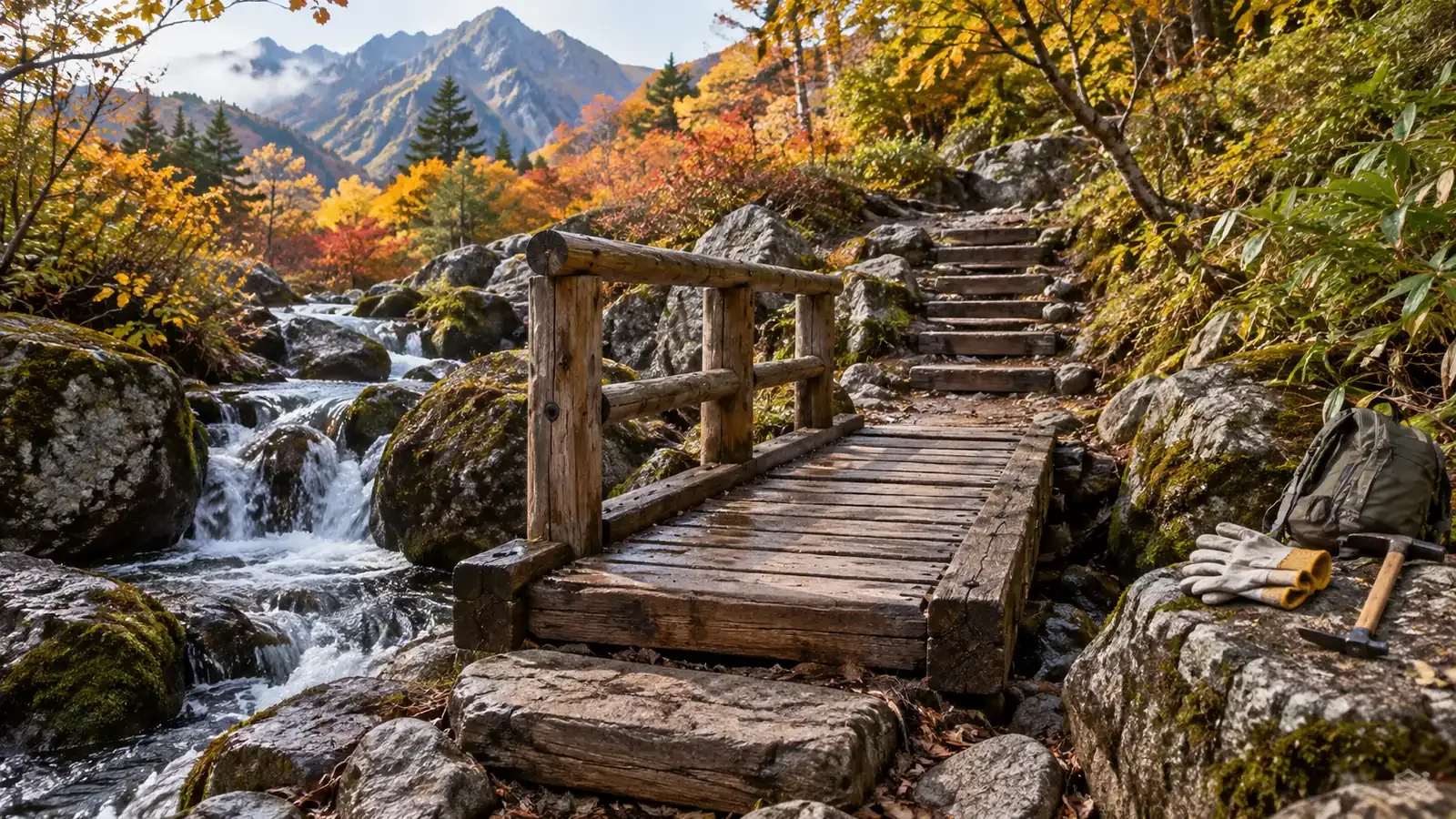
Since August 28, 2026, hikers have been able to donate to trail maintenance in Japan’s Northern Alps from a smartphone app. The hiking map app YAMAP worked with local governments and councils on a pilot for digital contributions. The Shinano Mainichi Shimbun reported it under a headline that pointed out how many hikers still did not know about the contribution. The payment option was new. The lack of awareness had long been a problem. Here is how the scheme works and how it differs from Mount Fuji’s ¥4,000 access fee.
August 28, 2026: app donations open for the Northern Alps
On August 27, 2026, YAMAP announced a pilot for hikers to make contributions in the Northern Alps and the Kujū range. It launched the following day, August 28. The initial areas were Toyama, Gifu, Niigata and Nagano outside the southern area of the Northern Alps, plus Kujū in Ōita Prefecture. The announcement listed Myōkō in Niigata as an area to add later.
With version 16.8.0 or later of the YAMAP app, you can pay before, during, or after a hike. Hikers choose how much to give and can use a credit card, Apple Pay, or Google Pay. The contribution is voluntary and does not affect access to the trails or the app.
It is worth looking at where the money goes. The local councils and municipalities receive the contributions. YAMAP provides the payment platform. According to YAMAP, the recipients use 70% for the purposes each area publishes. They pay YAMAP the remaining 30%, which includes an amount equivalent to 10% for processing and the costs of maintaining and running the system and telling hikers about it. The council on the Toyama side is chaired by the head of the Ministry of the Environment’s Chūbu-Sangaku National Park Management Office. A private app provides the payment feature, while the bodies responsible for the national park are central to the trial.
A voluntary donation, with ¥500 as the standard contribution
The app payment option builds on the Northern Alps Trail Program. Its councils bring together the Ministry of the Environment, local governments and mountain hut operators to involve trail users in the long-term upkeep of Chūbu-Sangaku National Park. One way users can take part is by contributing to the cost. The scheme has rolled out at different times: the Nagano side began a trial in fiscal 2021, Hida on the Gifu side began year-round operation in fiscal 2025, and Toyama’s first pilot year was fiscal 2024.
One standard contribution is ¥500, and donors decide how many to give. Existing payment options include cash in boxes at mountain huts, bank transfers and credit cards. Toyama lists possible uses including help on difficult sections of trail, repairing soil erosion, restoring vegetation, and recruiting and training people for maintenance work. The donations support part of the upkeep cost, and donors receive a Trail Supporter card.
Nagano Prefecture lists schemes in the northern and southern parts of the Northern Alps and in the Southern Alps. It is also considering introducing them in the Central Alps and the Yatsugatake range. The initiative reaches beyond the Northern Alps.
Mountain huts have kept Northern Alps trails walkable
Why ask hikers to contribute? A March 2024 report by the Administrative Evaluation Bureau of the Ministry of Internal Affairs and Communications examined how mountain trails were built and maintained. In Chūbu-Sangaku National Park, it identified people or organizations doing the maintenance in practice on 63 of the 72 routes in the park plan, about 88%. This includes routes with someone responsible for only part of the trail. That was the highest proportion among the national parks in the survey.
The report found that mountain huts were the most common providers of this practical maintenance. A prefecture or municipality may be formally responsible for a route, but hut staff have done the day-to-day work, from clearing vegetation and repairing worn paths to resetting stones so rainwater drains off the trail. The paths in the Northern Alps have stayed walkable because hut crews have been there to do the work.
That arrangement has come under strain. The same report says some huts shut down as visitor numbers fell during the COVID-19 pandemic and that longstanding staff shortages persist. It describes huts as essential to public services, including trail repairs, mountain toilet upkeep and assistance with rescues. The contribution asks hikers to share a small part of those costs.
One figure from the first year is available. The month-long 2021 trial brought in ¥5,413,311, according to the Japan Sport Council’s mountaineering training publication. As of September 2026, we could not find published figures showing what share of hikers in the trial area actually contributed. We know the amount collected, but we do not have a participation rate.
Mount Fuji’s ¥4,000 fee and the Northern Alps’ ¥500 donation serve different purposes
Many people hear about paying to climb a mountain and think of Mount Fuji. From the 2025 season, a ¥4,000 access fee per person applied to all four routes: Yoshida, Fujinomiya, Gotemba and Subashiri. Shizuoka’s prefectural assembly passed the ordinance in March 2025. Yamanashi, which had introduced a ¥2,000 fee the previous year, raised it to ¥4,000 in 2025. The same framework was in place for 2026.
Mount Fuji’s ¥4,000 fee is required by local ordinance. The Northern Alps’ ¥500 is a voluntary donation, and hikers can still use the trails without paying. The amount differs by a factor of eight, but what matters is how each scheme works.
The geography helps explain the different approaches. Mount Fuji has four main routes, with staff or gates to check hikers on each. Northern Alps trailheads are widely scattered. On the Toyama side alone, the national park has about 300 km of trails. Staffing enough locations to collect payment from everyone could swallow much of what was collected.
The challenges are making hikers aware and making it easy to pay
What changes when the app takes payments? The Toyama council’s fiscal 2024 general meeting documents list two main challenges for collecting contributions: low public awareness and too few ways to take part and pay. The proposals included adding places to donate cash and looking into cashless payments.
The council’s concerns were how few people knew about the scheme and how few payment options they had. The app feature grew out of that earlier discussion.
The same documents show why cashless payment was difficult. At the time, the council understood that PayPay required a business to be party to the contract, making it hard for a voluntary council without legal incorporation to apply. PayPay was understood to handle payments for goods or services, so the council concluded it would be difficult to accept donations directly, but a supporter card could be offered as a purchase. This was the council’s reading at the time. It does not describe the current rules for payment providers generally.
It is hard to say whether the 30% is high or low on its own. The council gets a way to take payments without building the system itself, and the app can tell many hikers about the scheme. The trial’s value will be clearer once we see how many people contribute and what the recipients report spending the money on.
In the part of the documents looking ahead, one view was that the program would be hard to sustain if authorities continued to avoid considering mandatory payments. A future park entry fee earmarked for maintenance was suggested as a goal. Going digital could defer that discussion, or a record of how many people contributed could help inform it.
Before deciding whether to give, find out who fixes your trail
Once you know who repairs the trail you are about to walk, ¥500 can look different. The Northern Alps Trail Program site breaks down the trails covered and plans for the money by area. Update YAMAP to version 16.8.0 or later to pay in participating areas. Donation boxes, bank transfers and credit cards are still options. The harder part is coming back the following year to check each council’s report on how the money was spent.
At Nordwand, we are also exploring ways to connect hikers with mountain huts and local communities.
References and sources
- YAMAP INFO Blog — A digital contribution for trail maintenance: pilot in the Northern Alps and Kujū (August 27, 2026)
- Shinano Mainichi Shimbun — Many hikers still do not know about the trail contribution as the northern Northern Alps trial app payments (August 28, 2026)
- Northern Alps Trail Program — Contributions for trail maintenance in Toyama
- Northern Alps Trail Program — Fiscal 2024 general meeting documents, agenda items 1–3
- Administrative Evaluation Bureau, Ministry of Internal Affairs and Communications — Survey report on trail development and maintenance (March 2024)
- Shinetsu Nature Conservation Office, Ministry of the Environment — Distribution of Northern Alps Trail Program supporter cards (April 24, 2025)
- Nagano Prefecture — Contributions for mountain conservation
- Northern Alps Trail Program — The council for northern Nagano and Niigata
- Yama to Keikoku Online — Mount Fuji climbing rules for 2026: ¥4,000 on all four routes and a July 1 opening for Subashiri (May 12, 2026)
- Nikkei — Shizuoka passes ordinance setting Mount Fuji’s access fee at ¥4,000 from summer 2025 (March 17, 2025)
- Official Mount Fuji Climbing Website — Mount Fuji hiking rules and etiquette
- Japan Sport Council — Mountaineering Training, Vol. 37