
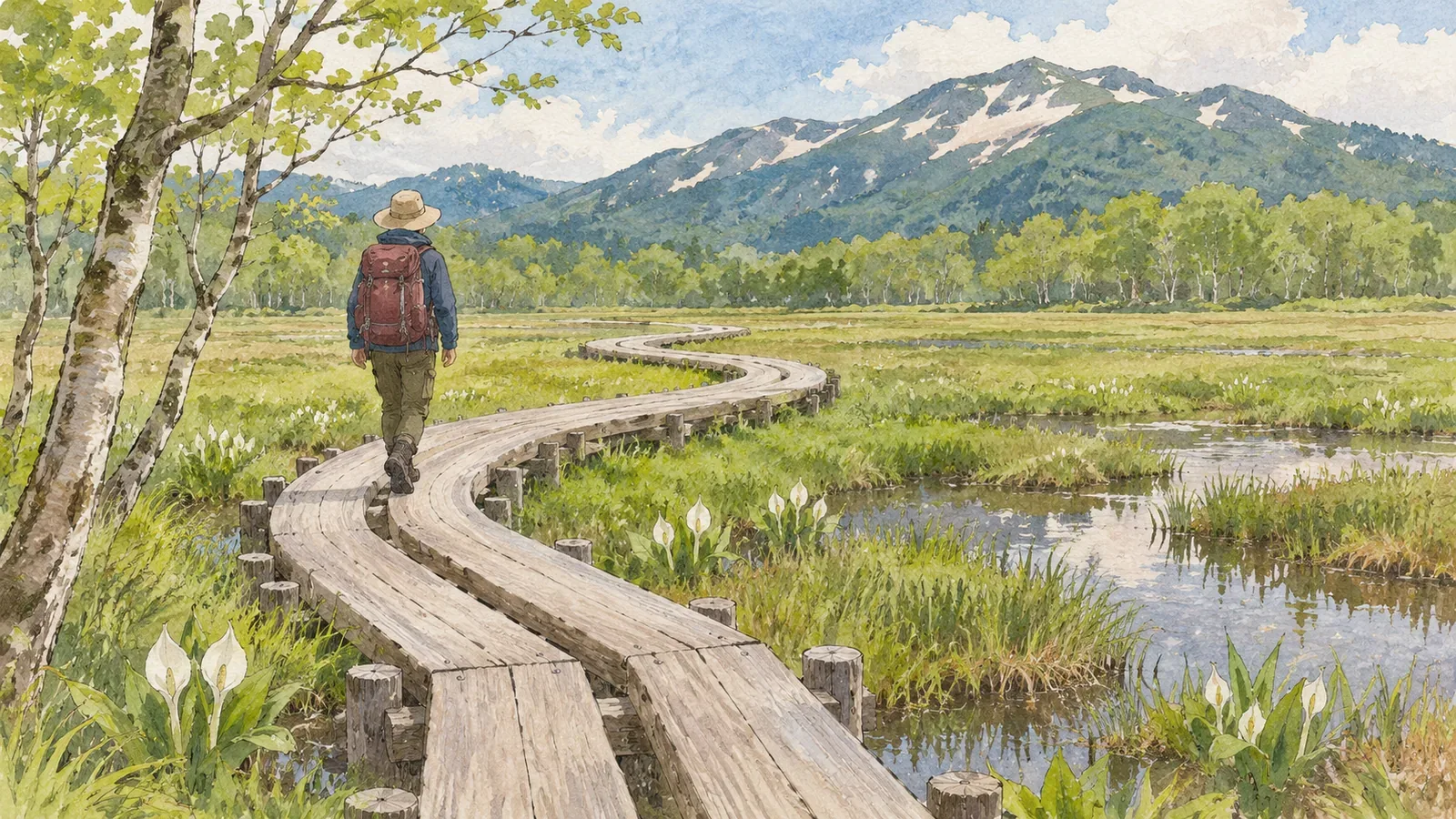
A boardwalk through a wetland can take a wide turn even when the next stretch looks close. To understand its route, consider the purpose of boardwalks in Oze and look at the plans for that section. Follow the designated boardwalk as it curves, and keep out of the wetland.
What boardwalks do
The Ministry of the Environment asks visitors to stay on boardwalks in Oze National Park because the wetland ecosystem is fragile. The Oze Preservation Foundation explains that the boards were installed to protect the wetland. A boardwalk gives people a place to walk and keeps foot traffic from spreading into the marsh.
The foundation’s educational material explains that in the late 1950s and early 1960s, when boardwalks were still scarce, visitors walked into wetlands and damaged the vegetation. Ayamedaira is a well-known example. Today, stay on the boards even when the ground beside them looks easier to walk on.
Fukushima Prefecture explains that Oze’s first boardwalks helped people avoid deep mud. Over time their main purpose shifted to wetland protection. Some were raised to reduce their effect on water flow.
How to find out why a boardwalk turns
The ministry’s management plan calls for boardwalks where vegetation needs protection or where deep mud makes walking difficult, among other places. It accounts for terrain and visitor use when deciding on one or two lanes. In wetlands, boards should be built so that sinking does not block water flow. To find out why a particular turn is there, look for design or construction records for that section.
To observe a turn, stop on stable footing where you leave room to pass. Stay on the boards and note what you see before and after the bend, including junctions, water and plants. Note where you took each photo and which way you faced. Record the features you can see. If people need to pass, pause the photography and give them room.
If you ask the manager or visitor center, show a map or photo that pinpoints the turn and ask whether design or construction information is available. If you find nothing, leave the reason open. The boardwalk’s conservation role applies across the wetland, while the reason for a particular turn depends on its location.
Follow the boardwalk in order
The other side of a bend can look close. Follow the boards all the way around it and keep out of the wetland. The foundation also asks visitors to keep feet and tripod legs out of the wetland when taking photos or resting. Check local guidance and use the rest areas open to visitors.
On narrow boardwalks, leave a gap between you and the people ahead and behind. Follow local signs and use suitable places to pass. Slow down and pay attention near bends where you may not see who is coming. When taking photos, keep the passage clear.
If wet planks or other conditions make you unsure of your footing, stop somewhere secure to review the route with your group. Keep to the boards. If a section is closed, check the manager’s directions and keep out of the wetland.
How the history of conservation informs today’s visit
Along with a photo of the boardwalk, record the purpose described on local signs, any restoration records and the time and date of the photograph. Before comparing an older picture, check records for repairs or changes in the route. Appearance alone gives little information about what work was done or when.
The foundation also works to restore vegetation in denuded wetlands. Staying on the boardwalk helps protect its surroundings. Recovery and maintenance differ from place to place, so check the latest local information.
Even if you do not know why the boardwalk turns, you can look out across the wetland and see how the water changes from one section to the next. Follow the boards so the next visitor can see the same landscape.
Check the reason for the bend and follow the boards
Many factors can shape a turn in a boardwalk. To understand a specific bend, check the manager’s records.
Stay on the boardwalk and use designated rest areas. Leave the wetland between the turns undisturbed.
References and sources
- Japan Ministry of the Environment: Visiting Oze National Park Responsibly
- Oze Preservation Foundation: Restoring Wetland Vegetation
- Fukushima Prefecture: The History of Conservation in Oze, Part 2, Managing Overuse
- Oze Preservation Foundation: Trail Etiquette in Oze
- Japan Ministry of the Environment: Oze National Park Management Plan, Chapter 6, Boardwalk Construction