
Japanese route guides and trip reports often warn about gareba or mention crossing a gōro field. Map apps use the same terms, but a dictionary does not always make clear what kind of ground to expect.
All three terms in this guide describe unstable ground made of loose stone. The size of the stones and how easily they shift vary, so the way you walk varies too. Knowing the distinction helps you picture what kind of care a route will require.
What the three terms describe
Start with the rough distinction by stone size.
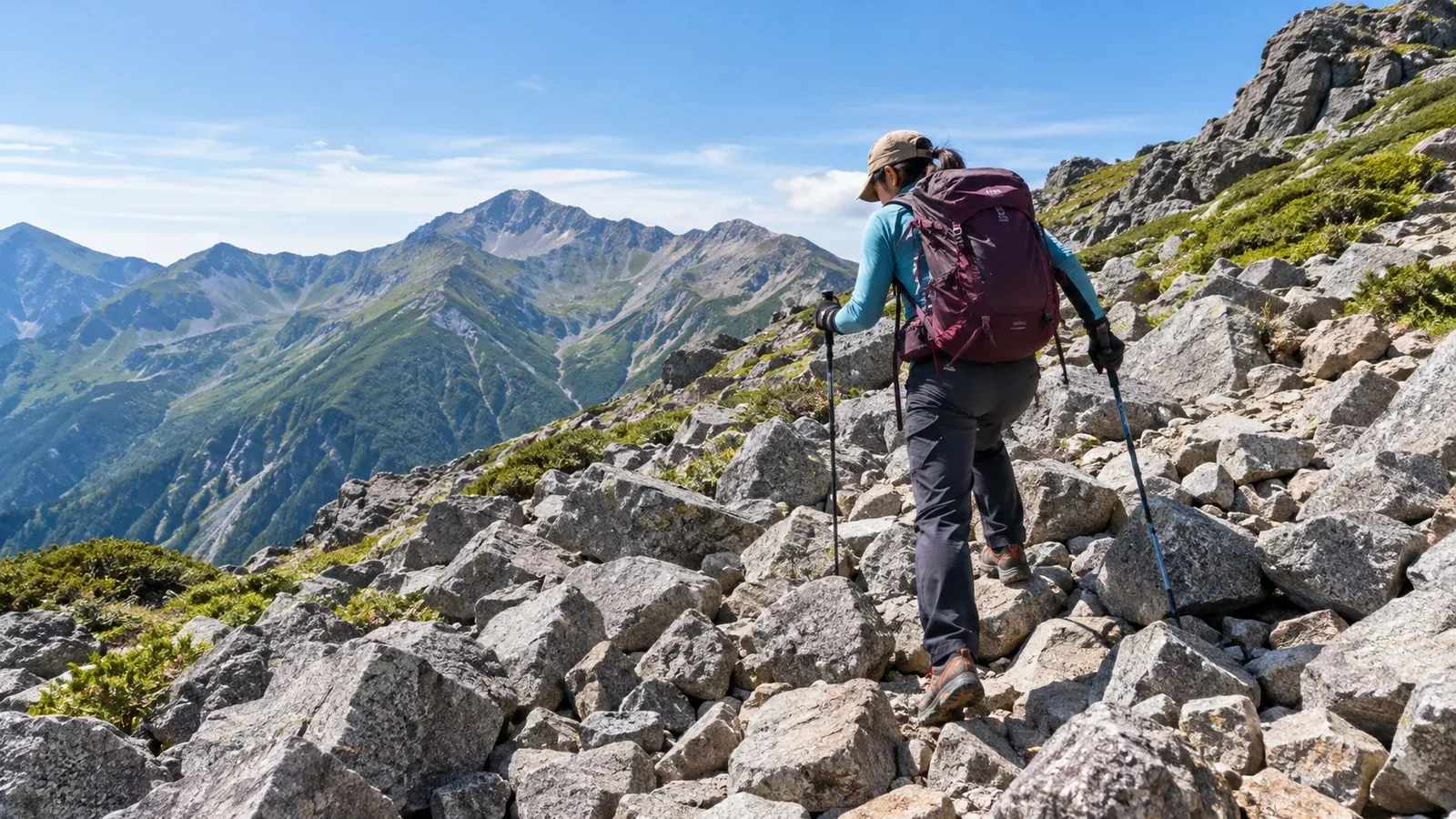
Gareba, a coarse scree slope, is a slope or area covered in loose rocks from fist-sized to about the size of a head. Individual rocks often sit unstably and may move when stepped on, or slide down the slope. This terrain is common on steep slopes, where falls and rockfall are a concern.
Zareba, a loose gravel slope, is covered in finer crushed stone, from sand-sized grains to pebbles. It shifts and slips underfoot, especially on the descent. Fine material often lies over solid bedrock, leaving footing less stable than it looks.
Gōro, a boulder field, is a jumble of rocks the size of a basketball or larger. Individual boulders are heavy and less likely to move, but a foot can catch in the gaps. You often see them in riverbeds and along streams. Japanese route reports may call them a gōro belt or a gōro stream.
In order of stone size, the terms go from zareba (fine) to gareba (medium to large) to gōro (very large). On the ground the boundaries are less clear, and coarse scree and fine gravel often occur together.
How to move on each surface
On coarse scree
Check whether a rock moves before committing your weight. Load it slowly, make sure it does not wobble, then take the next step. Short steps and a low centre of gravity help you keep your balance if a rock shifts.
Watch for rockfall. If you dislodge a rock, immediately call “Raku!” (rockfall) to warn hikers below in Japan. In a group, spread out so no one is directly above or below another person.
On loose gravel
On the ascent, place the whole sole on the ground and avoid pushing hard off the heel. A hard push can send the gravel sliding backward instead of moving you forward. Take short steps and put weight on each foot deliberately.
Descending loose gravel is especially slippery. Slightly bend your knees, lower your centre of gravity and take small steps, facing mostly down the slope. If you have trekking poles, use one in each hand to help with balance.
In a boulder field
Repeatedly stepping from one large rock to another can take more energy than expected. This kind of terrain can also take longer to cross than the map’s walking time suggests.
Look at the colour and texture of the rock to see whether it is wet or mossy before stepping onto it. Wet rock is much more slippery than dry rock. An ankle can also twist easily in this terrain, and stiff-soled, high-cut hiking boots can provide a more stable platform.
How soles and gear affect footing
On coarse scree, loose gravel and boulder fields, sole grip and stiffness affect how easily you can walk. A soft sole bends over irregularities, which can make it harder to balance on small rocks. A stiffer sole tends to give a steadier platform and may reduce fatigue over long stretches of rock.
The tread pattern matters too. The right boot depends on what you will use it for, your foot shape and your weight, so try boots on at a hiking shop.
Trekking poles can help with balance, particularly while descending loose gravel. In a boulder field it may be easier to grasp the rock with both hands free. Stow the poles when the terrain calls for it.
Using the terms to read a route
When a description or map note mentions gare, zare or gōro, read it as a cue to prepare for the following conditions.
- “Coarse scree present”: expect rockfall risk. Leave more space between members of the group. Check in advance whether the route calls for a helmet.
- “Steep loose gravel”: allow more time for the descent. Check the walking time and slope description to see whether sliding is a concern.
- “Long boulder field”: the section may take longer than the map’s estimate. Consider footwear with ankle support and plan for fatigue to build.
Trail conditions change with the season and recent rain or snowmelt. Before setting off, check current conditions with the local authority, a mountain hut or the trailhead noticeboard.
What to do next
Review the reports or descriptions for the route you plan to walk and see where they mention coarse scree, loose gravel or boulder fields. Other hikers’ Nordwand trip reports may include comments on the footing along the same route. If you are unsure about a section, you can also ask a certified Nordwand guide to accompany you.