
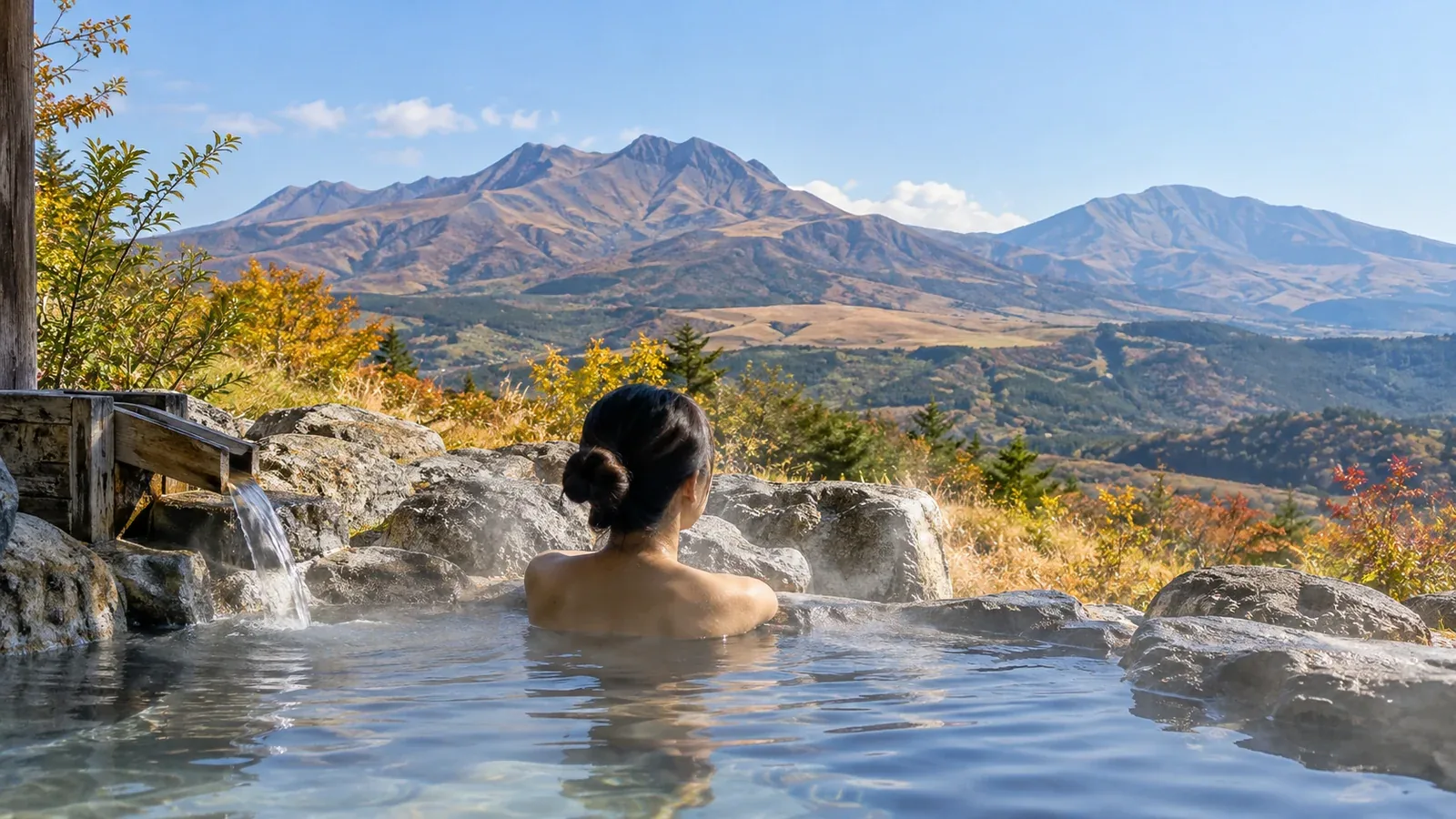
Kyūshū has many active volcanoes, and their heat feeds the island’s hot springs. In Aso, Kujū, Kirishima and Unzen, onsen towns lie at the foot of mountains or along roads leading to trailheads. You can stop at one after the hike or make an onsen inn your base. Access restrictions can change as volcanic activity changes, so check both the road to the trailhead and your walking route right up to departure.
This guide goes through several of Kyūshū’s best-known hiking areas, the hot springs that pair well with each one, the journeys involved and where to look for the information you need before you set off. Reviews and prices at individual inns and baths can change, so use the official sources for the details.
Why hiking and hot springs pair well in Kyūshū
Hot springs emerge along the flanks and foothills of volcanoes and in the land shaped by their calderas. If your trailhead and an onsen are in the same valley or on the same road, you can keep the detour short. Even within one mountain range, the road and distance depend on which trailhead you use, so check a map.
Kyūshū also has small public baths managed by local residents. Check whether they admit visitors, when they open and how to use them. If you stay in an onsen town and head to the trailhead the next morning, it is easier to get your gear organized at the inn.
Hikes and hot springs to pair in each area
The Kujū mountains with Yufuin, Nagayu and Kujū Onsenkyō
The Kujū mountains in Ōita Prefecture include Mount Naka, the highest peak on the main island of Kyūshū. They offer routes for everyone from beginners to experienced hikers. There are baths around the Makinoto Pass and Chōjabaru trailheads, and some in Chōjabaru welcome day visitors. Hokkein Onsen Sansō is a mountain hut near the Bōgatsuru wetlands that you reach on foot.
Depending on the trailhead, you can also consider Yufuin Onsen or Nagayu Onsen in Taketa, known for its carbonated spring water. Yufuin has plenty of places to stay the night before or after a hike. Even in Nagayu, rest and drink water first if you have just exerted yourself or feel very tired, and avoid a long soak.
With a car, you have more trailheads to choose from. If you use public transport, check which days the buses to Chōjabaru and Makinoto Pass run and how you will get back. The town of Kokonoe publishes a combined timetable covering municipal buses and private operators.
Mount Aso with Kurokawa Onsen and Uchinomaki Onsen
Mount Aso in Kumamoto Prefecture is an active volcano. Access rules for viewing Mount Naka’s No. 1 crater differ from those for hiking Mount Taka and Mount Naka. At volcanic alert level 2, restrictions can apply within about 1 km of the crater. Aso City lists bypasses that stay outside the restricted area. Check the latest information from the Japan Meteorological Agency and Aso City, and stay out of closed areas.
Kurokawa Onsen in Minamioguni is a well-known hot spring town with many inns and is a popular place to stay before a hike. Its bathing pass, the nyūtō tegata, gives access to outdoor baths at participating inns. Check the prices and participating baths on the official site or locally. Uchinomaki Onsen is near central Aso, making the journey to some trailheads shorter.
The Kirishima mountains with Kirishima Onsenkyō and the Ebino Plateau
The Kirishima range, on the border of Kagoshima and Miyazaki prefectures, includes a number of volcanoes. Mount Karakuni and Takachiho-no-mine are popular hiking destinations. Parts of the range have access restrictions, including areas near Mount Iō. Check the Kirishima-Kinkōwan National Park notices and the tourism and disaster-preparedness information from Kagoshima and Miyazaki for current restrictions.
Kirishima Onsenkyō lies partway up the mountains, a short trip from some trailheads. You can also find baths around the Ebino Plateau. Road conditions and opening hours can vary with the season and volcanic activity. Check restrictions first, then ask the facility if it is open.
Mount Unzen with Unzen Onsen
Unzen Onsen lies at the foot of Mount Unzen in Nagasaki Prefecture. The steaming fumarole fields known as jigoku give it a distinctive landscape. You can hike toward peaks such as Fugen or Myōken and visit the hot spring town on the same day, making for a compact itinerary.
Mount Unzen is also an active volcano. There are restricted areas on Heisei-Shinzan, and landslides have closed some sections of the Mount Fugen trails. Before leaving, check the Ministry of the Environment or Nagasaki Prefecture for the exact closures and routes you can use.
What to check while planning
Gather the following information in order as you plan your hike and onsen stop.
- Check volcanic restrictions. Read the Japan Meteorological Agency’s updates and the park or municipality’s access notices. Restrictions can change with little warning, so check again just before leaving.
- Check the season and forecast. Kyūshū can get heavy rain during the rainy season and typhoons from summer into autumn. Check the forecast, weather warnings and road and trail conditions after rain, including on the morning of the hike.
- Confirm your transport. Public transport serves only some trailheads. If you are renting a car, staying in an onsen town the night before can make it easier to start early without tiring yourself on the road.
- Confirm day admission. If you are coming just for a bath, ask the establishment about admission hours, regular closing days and busy periods. It can get crowded in the late afternoon.
- Check how you feel before driving. Drink water and rest after the hike. Avoid driving if you are sleepy or very tired. Consider changing drivers or staying overnight. Wait until you feel settled before taking a bath. If you have an existing health condition or are unsure about bathing, consult a doctor.
Stay at an onsen or stop after your hike?
There are two main ways to organize the trip.
Stay in an onsen town. Book a room in an onsen town and use it as a base for getting to the trailhead. Staying at the same inn before and after the hike means less luggage to move and a bath waiting for you at the end. Dinner and breakfast at the inn give you a chance to eat and replenish your energy. This works well on a first hiking trip to Kyūshū or if the baths are a main reason for your visit.
Stop after the hike. Hike for the day or stay in a mountain hut or campground near the trailhead, then visit a hot spring after the descent. This can suit a trip focused on a traverse or help keep accommodation costs down. Check beforehand whether the baths stay open late and welcome day visitors.
Choose based on what you and your companions most want from the trip, how much energy you expect to have and how much time you have.
Plan your trip
Start with the Japan Meteorological Agency’s volcanic information and check the local authority or park manager’s notices for the alert level and access restrictions at your destination. If you are booking a room, ask directly about the hours for day bathing. Nordwand’s Base Camp can put you in touch with hikers who know Kyūshū. In an unfamiliar area, you can also consider hiring a qualified guide.
Further reading
- Japan Meteorological Agency volcanic activity updates
- Ministry of the Environment information for Kirishima-Kinkōwan and Unzen-Amakusa National Parks
- Aso Volcano Disaster Management Council, Kumamoto Prefecture
- Tourism and disaster-preparedness information for Ōita, Kumamoto, Kagoshima, Miyazaki and Nagasaki prefectures
References and sources
- Japan Meteorological Agency | Information for hiking on volcanoes
- Ministry of the Environment | Mount Mimata route and Hokkein Onsen Sansō
- Town of Kokonoe | Community buses and combined trailhead timetable
- Aso City | Bypass routes for Mount Taka and Mount Naka
- Kurokawa Onsen Ryokan Association | Bathing pass
- Ministry of the Environment | Mount Karakuni and Ōnami Pond route in Kirishima
- Ministry of the Environment | Partial trail closure on Mount Fugen in Unzen
- Ministry of the Environment | Hot spring bathing precautions