
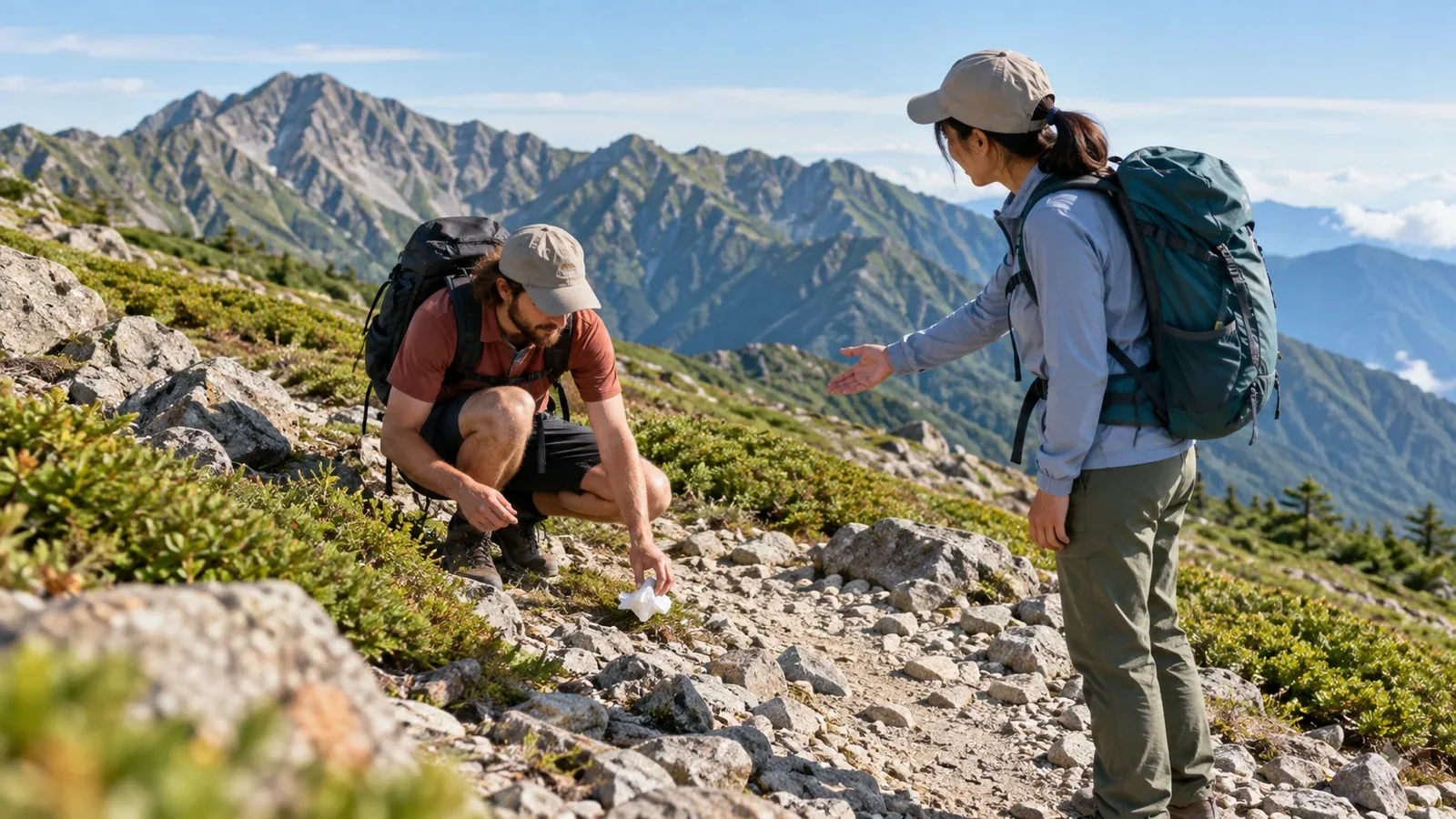
What do you say when you see a visitor leaving litter on the trail? Many people hesitate. A language barrier, uncertainty about what's customary elsewhere and the possibility of an awkward exchange can make it easier to walk past.
Often the information hasn't reached the hiker. A sign may be only in Japanese, a hut may explain its rules only out loud, or a visitor may have been given a trash bag without knowing what it's for. These gaps can lead to unintended mistakes. Here's how to speak up on the trail and help the information reach people before they set out.
Why it helps to explain the local practice
Packing out trash, staying on designated trails and keeping shared hut spaces quiet are familiar practices to many people who hike in Japan. A first-time visitor may have had no reason to learn them yet.
In some mountain areas in Europe, North America or Southeast Asia, there are bins at trailheads or summits, and hikers are used to leaving trash in them. If there's no sign saying to take rubbish home, a visitor might reasonably look for a bin. A calm explanation gives the person a chance to help keep the trail clean for everyone who follows.
How to speak up on the trail
People are more likely to listen when they know what you're asking and feel at ease. Try these approaches.
Keep it short, clear and friendly. “Please take your trash with you.” A sentence that simple works even if you don't speak much English. A phone app such as Google Translate can help with longer messages. A calm voice and a friendly expression matter more than getting every word right.
Explain the local rule. “Here, hikers take all their trash back with them.” Describing what's expected makes it easier for someone to understand and act on the request.
Offer a bag. Handing someone a spare trash bag makes the request clear and gives them a way to act on it. A few extra small bags can come in handy on a hike.
Phrases you can use and when to try a translation app
Here are a few short phrases for common situations.
- Packing out rubbish. “Please take your trash with you. There are no trash cans on this mountain.”
- Staying on the trail. “Please stay on the trail. It protects the plants here.”
- Keeping quiet in a hut. “Quiet hours start at [time]. Could you speak a little more quietly?”
For other languages, try the camera or voice tools in an app such as Google Translate or DeepL. Open the app before you speak. Short sentences reduce the chance that the translation changes what you mean.
How to get the information to hikers sooner
A conversation reaches one person at a time. Clear information before a hike can help more visitors arrive knowing what to do. Individual hikers can help in several ways.
Tell trailhead and hut managers what you notice
If a trailhead lacks multilingual signs or a hut has no explanation of its rules in English, let the manager or local authority know. A specific example of where a sign or a translated notice would help can give them a place to start.
Share existing multilingual guides
Japan's Ministry of the Environment publishes national park guidance, and some municipalities and mountain management groups publish etiquette and hiking information in English, Chinese or Korean. If you talk with visiting hikers online, share relevant official guides. Check the municipality or national park office for the latest information on the area.
Share what you know in hiking communities
Visitors often plan using social media and hiking communities. Posts about packing out rubbish and what to bring, written in Japanese and English, can reach people while they're still planning. Nordwand's community is one place to share information in more than one language.
What you can do when you couldn't speak up
Sometimes the timing or situation makes it hard to approach someone. You can pick up litter when it's safe, see whether the trailhead has clear signs, report any gaps or bring more spare bags next time. Do what you can keep doing.
Hikers of any nationality can leave litter, and visiting hikers also pick it up. Look at what's happening in front of you and be ready to explain the local practice calmly when it would help.
What to do next
Try the voice and camera features in your translation app before your next hike, and pack a few spare bags. If a trailhead or hut would benefit from multilingual information, tell the manager or local authority. You can also use Nordwand to share trail etiquette with people planning a visit to Japan.
Further reading
- Ministry of the Environment, multilingual rules and etiquette for national parks.
- National Police Agency and prefectural police, mountain incident statistics.
- Official hiking information from local authorities and national park offices.