
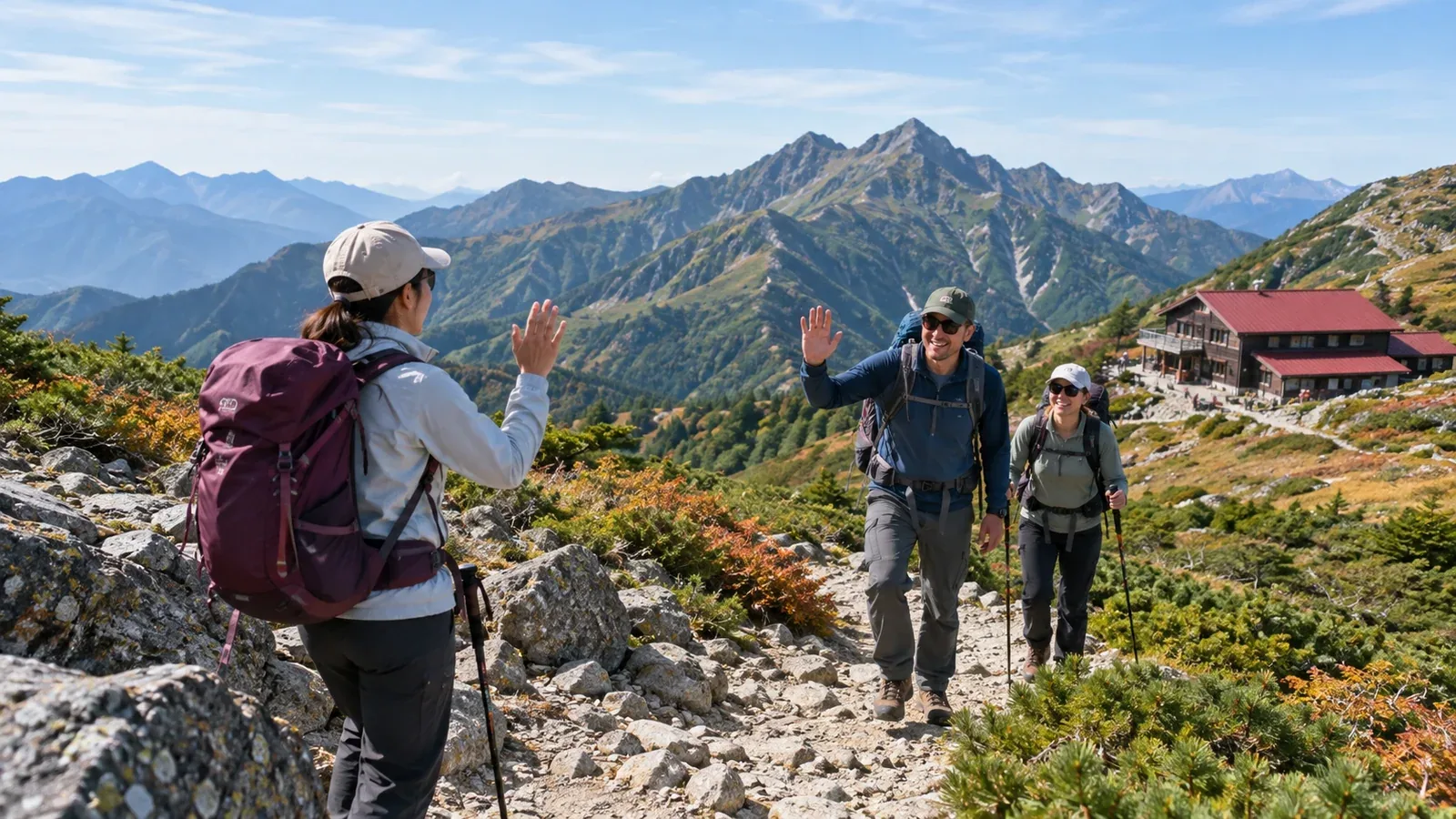
Have you ever said konnichiwa to a visitor on the trail and seen a puzzled look? Or been asked in English about a hut rule or a hiking plan and struggled to explain it on the spot?
Japan shares many trail customs with other places. Visitors may still encounter practices that work differently from what they know, such as how hikers greet each other, file a plan, or stay in a hut. Understanding how the customs relate to safety and helping others can prevent misunderstandings.
The examples below explain both what to do and why it matters. Use them as a starting point and adapt them to the route or hut you are talking about.
Why hikers greet people they pass
Saying konnichiwa lets both people acknowledge each other on the trail. It can make it easier to notice someone who is struggling and to alert people before passing in a narrow or steep section.
Here are two ways to explain the custom in English.
A short explanation
“In Japan, hikers often greet each other on the trail. It’s a way of saying ‘I see you, and I’m here.’ It helps everyone stay aware of who’s around.”
A little more detail
“Many hikers in Japan greet people they pass with konnichiwa. It’s polite and gives you a chance to check how someone is doing. If they seem to be struggling, a greeting can make it easier to offer help. Seeing other hikers can also be reassuring if something goes wrong.”
A visitor may be used to a different way of greeting people outdoors. Explaining the custom can make an unexpected greeting feel more familiar.
When and why to file a hiking plan
A tozantodoke is a hiking plan you submit before setting out. It records your intended route and gives rescuers somewhere to start looking if you are reported missing.
Filing is mandatory under local rules in some areas and strongly encouraged in others. Requirements can change. Check the prefecture’s official information and signs at the trailhead for the route you plan to hike.
Here are a few ways to explain it in English.
What the plan is for
“In Japan, hikers are encouraged to submit a tozantodoke, or hiking plan. Some areas require one. It records your planned route, schedule, and emergency contacts. If you go missing, rescue teams can use that information to start a search.”
When filing is required
“Whether you have to file depends on the route and the prefecture. It’s good practice to submit a plan even where it’s voluntary.”
Where to submit it
“Check the prefecture’s instructions or the trailhead notice. Depending on the area, you may be able to submit it online, through the local police, or in a designated box at the trailhead.”
It helps to explain what happens to the information. You are leaving details that can help people locate you if you do not return as planned.
What to expect at a Japanese mountain hut
A yamagoya, or mountain hut, serves much the same purpose as a staffed hut or refuge elsewhere. Booking, meals, and shared spaces may work differently from what a visitor expects.
Booking
“Many huts in Japan require advance booking, especially in peak season. Check whether your hut accepts walk-ins before you go. Staff use reservations to plan for the number of guests they can accommodate.”
Shared sleeping rooms
“Many huts have shared rooms. You may sleep in a tatami room, sometimes called a zashiki, or in a dormitory. Expect to sleep near other guests. Earplugs can be useful.”
Meals and lights-out
“If your booking includes meals, they’ll usually be served at set times. Some huts turn the lights out around eight or nine in the evening because many hikers get up early. Check the times and keep noise down after lights-out.”
Boots and wet gear
“Leave muddy boots where staff direct you. Some huts provide indoor footwear. If there’s a drying room or a place for wet gear, use it and keep shared areas clear.”
Staff work in a mountain environment with limited supplies and space. Some huts can answer questions in English. Check the hut’s official information and how to contact it before leaving.
How to explain local rules in English
A useful explanation covers the custom, the reason for it, and where to check it for a specific route.
- What to do. Describe the action in a short sentence.
- Why it matters. Explain how it relates to safety, helping others, or respecting a place.
- Where to check. Point to a trailhead sign, local government site, or the hut’s own page.
Details vary by region. A phrase such as “This is what the trail manager asks here. You can check the details at the trailhead” makes clear which rule you mean.
The Ministry of the Environment has English pages for some national parks. Trailheads in some popular areas also provide signs in English, Chinese, and Korean.
Putting it into practice
Try one of these phrases when you meet a visitor on a hike. A short explanation of the greeting is often enough to start a conversation. Look up hiking plan procedures and hut booking requirements with the relevant local authority or hut before departure. Nordwand’s Base Camp can also help you share information with hikers planning to visit the same area.
References
- Ministry of the Environment, National Parks of Japan and local visitor rules
- National Police Agency, Overview of Mountain Incidents and information about hiking plans
- Prefectural hiking plan systems and filing requirements