
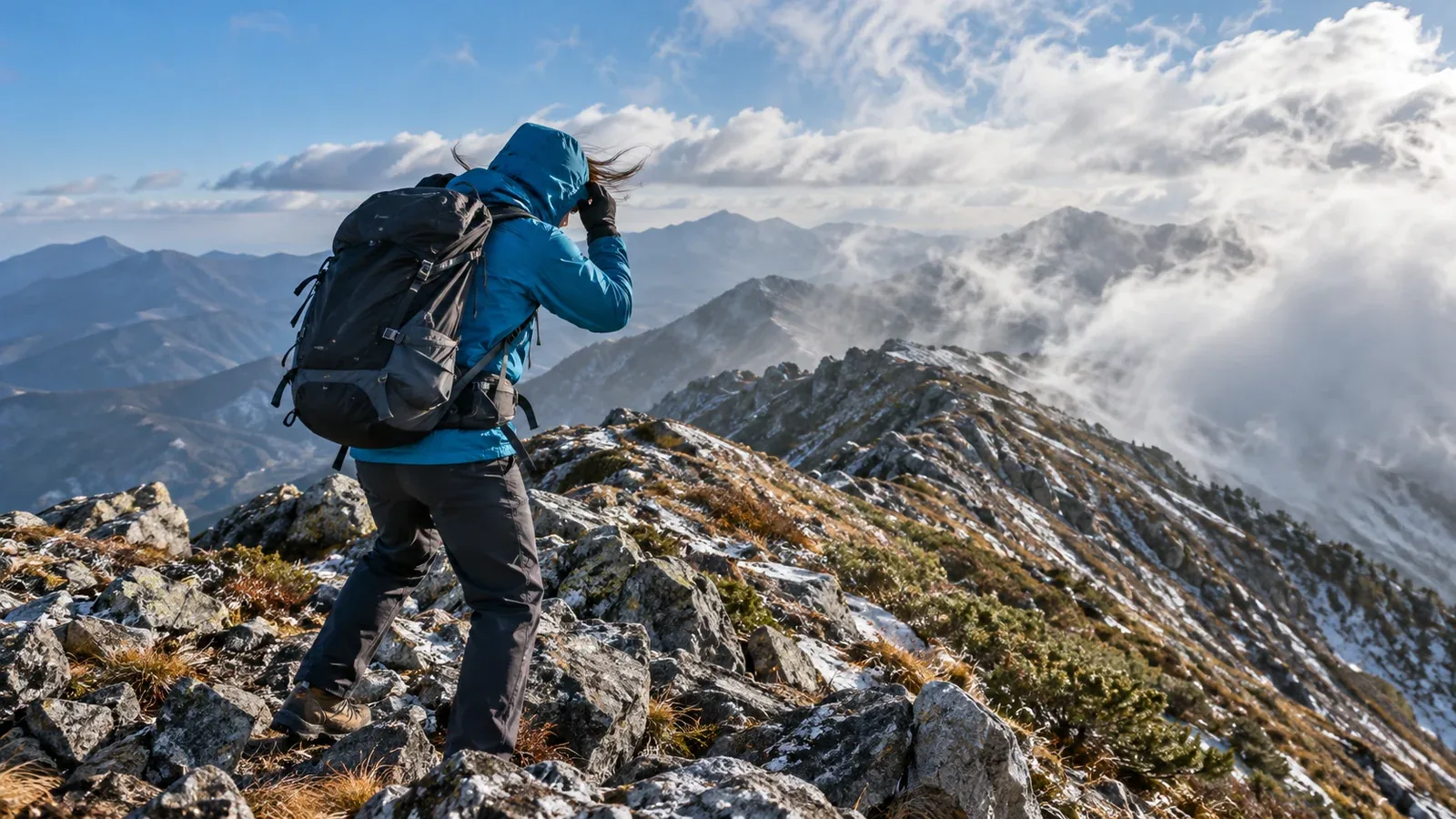
A wind forecast can tell you a great deal about a hike if you read it alongside the route. A sheltered approach and a narrow ridge above the treeline can feel very different, even on the same outing.
Wind can upset your balance or draw heat away quickly. Cold, wet clothing, a heavy or bulky pack, and terrain where a stumble could become a fall all make the effects more serious.
Use the figures below to understand what wind can do. Then look at the gusts, the exposed stretches and where your group can safely turn back.
What wind speeds feel like on foot
Wind speed in metres per second (m/s) tells you how far the air moves in one second. Multiply by 3.6 to get kilometres per hour. For example, 10 m/s is 36 km/h.
The Japan Meteorological Agency (JMA) describes the following effects for general outdoor conditions using average wind speeds.
- 10 to less than 15 m/s: Walking into the wind becomes difficult and umbrellas are hard to use.
- 15 to less than 20 m/s: Some people cannot walk into the wind steadily and may fall.
- 20 to less than 30 m/s: From 20 to below 25 m/s, it can be difficult to stand without holding on, and flying debris can cause injuries. From 25 m/s, the JMA describes outdoor activity as extremely dangerous.
- 30 m/s and above: The JMA puts these speeds in its highest wind-strength category. Outdoor activity remains extremely dangerous.
Use these ranges as a guide to the effects of wind. Even a lower wind speed can leave little room to recover your balance on a narrow ridge or sloping rock. The movement of trees alone cannot tell you the wind speed on the ridge.
What makes the same wind more hazardous
Think about your ability to stay warm and keep your footing over the whole exposed stretch.
Temperature and wind chill. Wind increases heat loss from exposed skin. Check the temperature alongside the wind, especially above the treeline in autumn and winter, and put on windproof and insulating layers while you are still sheltered.
Rain, snow and wet clothing. Wet clothing and continued exposure to wind can contribute to hypothermia even when the air temperature is above freezing. Get into shelter and address wet clothing early.
Pack fit and balance. A bulky pack or loose gear can catch the wind. Secure loose straps and equipment, and adjust the pack so the load sits close to your body.
Terrain and local gusts. Wind can accelerate through a saddle or be turbulent around a crest or rock outcrop. Assess the next stretch from a stable, sheltered position. Expect conditions to differ on the other side of the ridge.
What to check in the forecast
Look up the date, time, elevation and location covered by each forecast before applying it to your route.
Lowland and mountain forecasts. A town forecast describes conditions in a different setting. Check a mountain forecast for the elevation and times at which you will be on exposed ground, and use JMA forecasts and warnings for the wider area. Local mountain information may also describe conditions on the route.
Average wind and gusts. In JMA terminology, wind speed is the average over 10 minutes, and instantaneous wind speed is a three-second average. Maximum gust refers to the highest instantaneous wind speed in the period. The ratio varies with conditions, so use a separate gust forecast where available.
The night before and the morning of the hike. Look again before setting out. A shift in wind direction, earlier strengthening or colder rain can change which parts of the route are viable.
How to decide when to turn back
Agree on the decision points while planning. Mark the last sheltered junction or turnaround point before each exposed section, and discuss what will trigger a change of plan.
Use three questions when you reach each decision point.
- Can everyone move steadily? If anyone struggles to stay balanced, needs frequent stops or is getting cold, skip the next exposed section.
- What comes next? Think about gusts, narrow ground, wet or icy rock, low visibility and what a stumble would mean.
- Can you get back safely? Check whether the wind is likely to strengthen during the return and whether the retreat route is known and still usable.
Use the forecast to give yourself room to change plans. Keep checking the temperature, precipitation, fatigue and the condition of the whole group as you go.
If you decide to turn back, take a known, usable route to shelter or lower ground while you can still move safely. If moving would put you at greater risk, protect the group from wind and cold in the safest available spot and call for help if you cannot retreat safely.
Checking the wind before stepping onto a ridge
Make the check from secure footing while there is still an easy way back.
- The night before: Check summit and ridge wind, gusts where available, temperature and precipitation for the expected time of passage.
- On the morning: Check the latest forecast and warnings. Change the route or postpone if conditions no longer give you a safe margin.
- Before leaving shelter: Check actual conditions, how steadily people are moving and whether everyone is warm enough. Sound and moving trees can flag stronger wind ahead.
- At the last protected point: Decide whether everyone can safely cross the whole exposed section and return. If there is doubt, take the planned alternative or turn back from there.
Put it into practice
On your route map, pick a stretch that will be exposed to the forecast wind direction. Mark the last safe place to turn back, check what the wind and gusts are expected to do during both the outward and return legs, and tell your group when you will change the plan.
Sources
- Japan Meteorological Agency: wind terminology, wind effects, forecasts and warnings
- UK Met Office and US CDC: mountain forecasts and cold exposure
- Nagano Prefecture and the National Police Agency: hiking information and mountain incident statistics
References and sources
- Japan Meteorological Agency: wind terminology
- Japan Meteorological Agency: average wind and instantaneous wind speed
- Japan Meteorological Agency: wind strength and its effects
- Japan Meteorological Agency: weather forecasts
- Japan Meteorological Agency: weather warnings and advisories
- UK Met Office: guide to mountain forecasts
- US Centers for Disease Control and Prevention: preventing hypothermia
- Nagano Prefecture: mountain hiking information and enquiries
- Japan National Police Agency: mountain incident statistics