
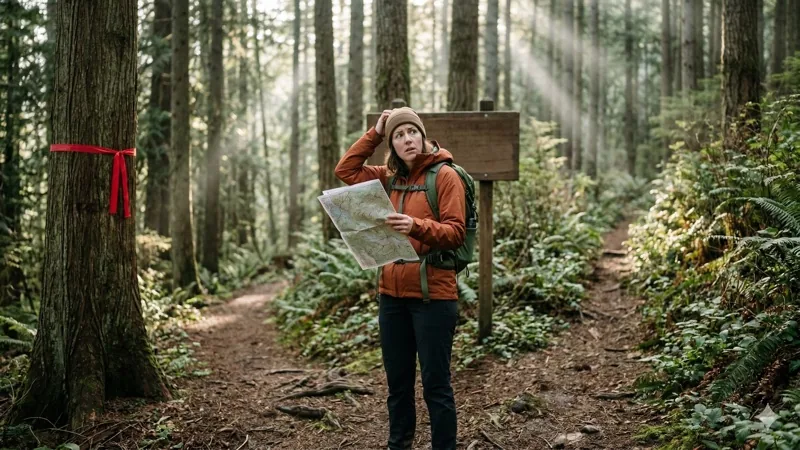
“Was that the right turn?” If you have wondered that on a trail, stop and check before going farther. In Japan’s 2025 mountain incident report, losing the route was the largest category among people involved, at 30.9%. It can happen to experienced hikers as well as beginners. Here is how to recognize it, find your position and decide whether it is safe to retrace your steps.
Why It Is Easy to Follow the Wrong Path
A map and GPS can help you find your position. Use them early, while you still know which trail and junction you last passed.
A wrong turn can look like a trail. Animal tracks, streambeds and paths used for forestry may all look walkable at first. In forest, trees can block the view and make it harder to tell which direction you are heading.
Once you think a path is right, you may give more weight to signs that support the idea. This is called confirmation bias. If the terrain, direction or distance from the last junction does not fit, stop and compare the map with what you can see.
When Turning Back Is Safe
If you suspect you have lost the trail, stop somewhere safe. Use your map, compass, offline GPS and recognizable landmarks to check your position. Avoid going farther just to see whether the paths join up.
Your last known point may be behind you. Retrace your steps only when you can identify the way and use it safely. Going farther can make returning harder for several reasons.
- A streambed or steep slope can be hard to climb back up, and it may expose you to a fall.
- Phone service can be patchy in valleys. Avoid taking a risk to look for a signal.
- Fading daylight, fatigue and rushing make it harder to choose a safe way back.
If you cannot safely return or someone is hurt, seek help early. In Japan call 110 for police or 119 for fire and ambulance. Give your coordinates if available, your last known point and the condition of the group. Once you have a safe position, stay there and follow the dispatcher’s instructions. Use warm layers, shelter and a whistle if needed.
Before and During the Hike
A few checks make it easier to notice a wrong turn early and decide what to do.
Before You Leave
- Take a paper map and compass. Download your phone map and test it offline, and carry backup power. Practice using both kinds of navigation.
- Look up your junctions and the direction you will take at each one. Identify possible places to turn back.
- File a hiking plan through the accepted local channel and share the route, expected return and when to raise the alarm with someone you trust.
On the Trail
- Check your position regularly, especially at junctions and breaks. Stop somewhere stable where people can pass.
- Look back occasionally. A junction can look different from the other direction, so note a landmark you can recognize on the return.
- If something feels wrong, stop and check before moving on. Decide whether you can retrace your steps safely or need help.