
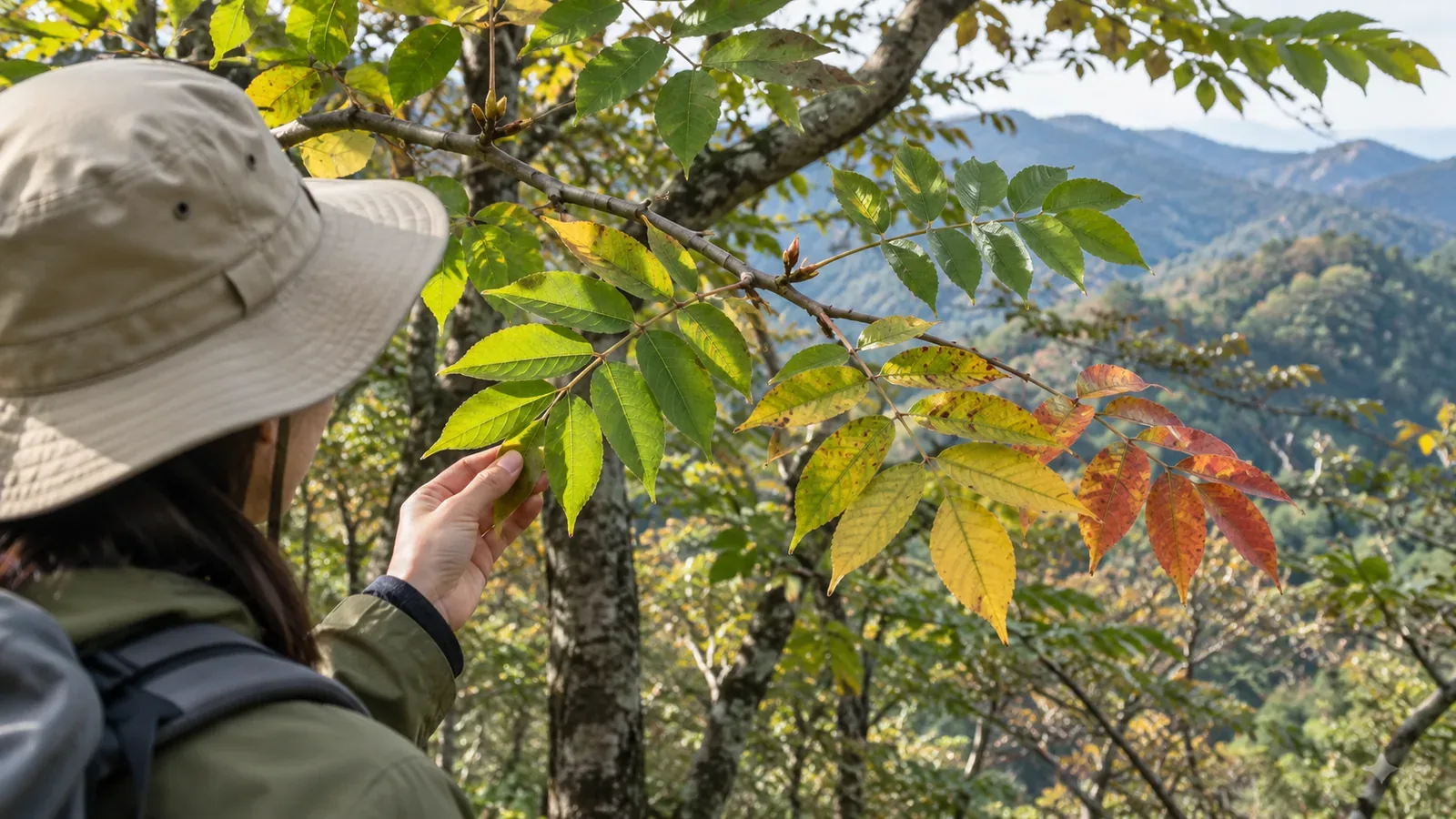
Leaves on one tree can vary in shape depending on where and how they grow. Before identifying the tree, work out what counts as one leaf and where on the branch it grows. Compare several leaves on the same branch so you can record what they share and where they differ. This guide uses university and public-agency sources to show how to observe with photos and notes, leaving the leaves in place.
Work out what counts as one leaf
On some compound leaves, leaflets face each other and can give the impression that whole leaves grow in pairs. The Hokkaido Regional Development Bureau's guide treats the entire group of leaflets as one leaf when determining the arrangement. Manchurian ash and Amur maackia both have pinnate leaves, for example, but the ash's leaves are opposite and the maackia's are alternate. Japanese walnut leaves bunch near the tips of branches. Winter buds and the scars left by fallen leaves show that the arrangement is alternate.
The Rokko Sabo Office's digital guide uses the winter bud to locate the base of a leaf. Follow the leaf stalk back to the twig and use the bud at its base to see which set of leaflets belongs to one leaf. The Hokkaido list also notes that relatively few trees have opposite leaves, so the pattern can help narrow the possibilities. The list focuses on Hokkaido. Compare similar species in a field guide for the area you are visiting.
The Rokko guide also gives an example of variation on a single plant. Kusaichigo (Rubus hirsutus), a shrub, has pinnate leaves with three to five leaflets. The shape of a leaf can vary with its position on the same plant. Once you have used the winter bud to identify a whole leaf, compare several leaves from lower on the branch and from near the tip. One leaf can show only part of the variation on the tree.
Compare position and light within a tree
Colour can vary across one tree too. Fukuoka Prefecture's explanation says leaves are green because chlorophyll is their most abundant pigment. As temperatures fall in autumn, chlorophyll breaks down. Depending on the species, red anthocyanins or brown phlobaphenes form and change the mix of pigments. Anthocyanin production requires light. Covering a patch of a leaf before it turns can leave that patch a different colour.
That helps explain why a sunny branch and a shaded branch on the same tree might colour differently. The source also lists sunny conditions and a wide day–night temperature range as factors in vivid autumn colour. Yellow, red and brown shades can blend into one another, so use other features to identify a tree. The source gives daily lows of 8°C or below for the onset of colour and around 5–6°C or below for further change as rough guides. It gives no dates by mountain elevation.
Tatsuhito Fukuhara's plant morphology notes explain how leaves on one plant can vary with growing conditions, growth stage and position on a branch. Sun leaves tend to be smaller and thicker, while shade leaves tend to be larger and thinner. Some differences are obvious, while others take a comparison of many leaves. Note the position on the branch, sun or shade, number of leaflets, tip, edge and underside in the same order. When leaves are farther away, compare the features you can make out. Perspective can distort apparent size.
Use the underside and bark to narrow the possibilities
When the upper surface is ambiguous, look at the underside, tip and bark. According to the Rokko guide, Quercus serrata has pale undersides, Quercus variabilis looks whitish from short hairs, and Quercus acutissima and Japanese chestnut have hairless undersides. Micromeles japonica has a whitish, woolly underside, whereas Micromeles alnifolia is green and hairless underneath. Carpinus laxiflora has a long, tail-like tip, whereas Carpinus tschonoskii has a shorter tip and hairs on both sides. Aphananthe aspera has fine vertical stripes on its bark, helping distinguish it from Chinese hackberry and Japanese zelkova. Quercus variabilis has deeply fissured, corky bark, while old Japanese zelkovas shed scales.
Check whether the same features recur on several leaves along a branch, then compare them with the bark. Leaf shape may vary, but that alone tells you little about the presence of hairs. If you cannot see hairs, check the image detail and whether the leaf is damaged. Record what you could see and leave the rest open. The Rokko guide is regional. Its observations about Quercus variabilis being common below roughly 400 m and Mallotus japonicus being widespread below 650 m apply to the Rokko Mountains. Check a local field guide for other mountains.
Leave plants where they are and return for winter buds
Winter adds clues unavailable in the leafy season. The University of Tokyo's Hokkaido Forest explains that winter buds form from summer to autumn. It describes the sharply pointed buds of Japanese bigleaf magnolia and the round buds of Japanese lime. Leaf scars differ too. Japanese walnut's can resemble a monkey's face and Amur cork tree's a koala's. The forest notes that even on the same species no two buds or scars are exactly alike. Compare lookalike species before making an identification.
Record the branch's position in autumn, then return to photograph the winter buds and leaf scars. Since a winter bud marks the base of a leaf, you can use your autumn notes and winter photographs to confirm that you found the same branch. Keep the identification tentative if you still lack enough features.
Japan's Ministry of the Environment says that in special zones of national and quasi-national parks, collecting or damaging plants designated by the environment minister is restricted. Designations vary by park. In national parks, collecting or damaging alpine and other protected plants in special zones can require permission. Special protection zones have broader rules, including for collecting plants, fallen leaves and branches. Check the zone and the conditions for prefectural parks, national forests or private land at your destination. Leave fallen leaves and fruit where they are. Use photographs and ask the land manager if you are unsure.
From one leaf in autumn to the same branch in winter
Use the winter bud to locate the base of the leaf. Record branch position, light, underside features and bark in a consistent order. This makes it easier to distinguish variation on one tree from differences between species. Note the position in autumn, photograph the buds on the same branch in winter and keep a photographic record in place of collecting. Check the rules for each mountain you visit.
References and sources
- Japan Ministry of the Environment — Protection of plants in national and quasi-national parks
- Japan Ministry of the Environment — Activities requiring permission or notification in national parks
- Hokkaido Regional Environment Office — Activities regulated in national parks
- Fukuoka Prefecture — Why do leaves change colour in autumn?
- University of Tokyo Hokkaido Forest — Winter buds and leaf scars of deciduous broadleaf trees
- Hokkaido Regional Development Bureau — Trees by leaf and bud arrangement
- Rokko Sabo Office — Digital guide to the vegetation of the Rokko Mountains
- Tatsuhito Fukuhara, University of Teacher Education Fukuoka — 4-3. Leaves
- Rokko Sabo Office — Kusaichigo (Rubus hirsutus)