
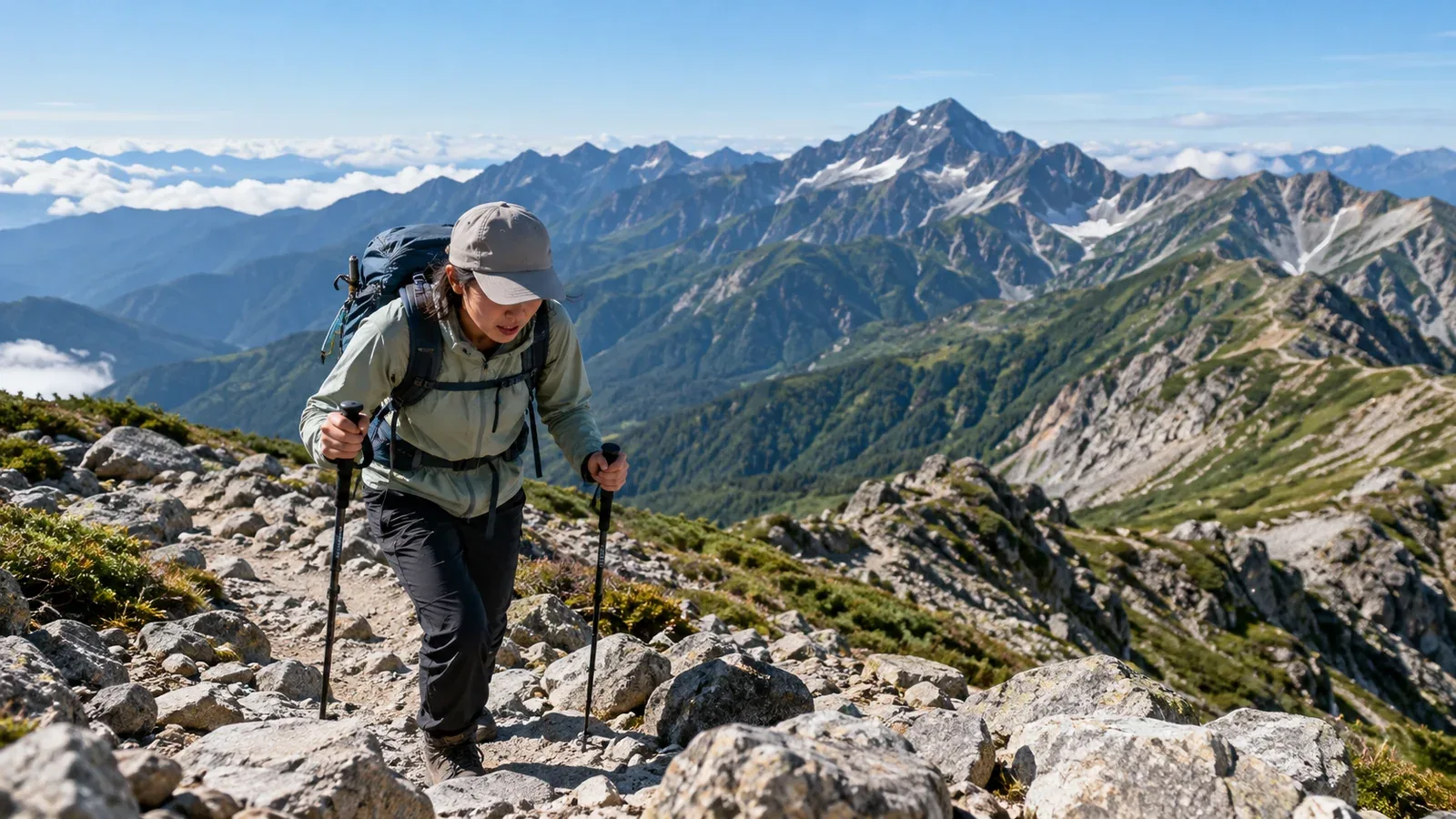
On a high mountain, you can find yourself out of breath at a pace that feels easy at sea level. As altitude increases, air pressure drops, making it harder for oxygen to pass from your lungs into your blood. Your body responds by changing how you breathe, among other things. Adjusting takes time.
Understanding the effect of pressure helps you talk with your group before you leave about when to slow down and which symptoms mean you need to descend.
Why air pressure drops as you climb
Atmospheric pressure at any point comes from the weight of the air above it. Standard pressure at sea level is about 1,013 hPa. At higher elevations there’s less air overhead, so the pressure is lower.
Oxygen still makes up about 21% of the air at high altitude. As total air pressure falls, so does the pressure contributed by oxygen, known as its partial pressure. Oxygen needs a pressure difference to move from the lungs into the blood, so it becomes harder to take up even if you breathe the same way.
According to the U.S. CDC, at around 3,050 meters the partial pressure of oxygen in the air you breathe is about 69% of its value at sea level. That figure differs from both the percentage of oxygen in the air and the oxygen saturation in your blood. How fast you go up and how long you stay also affect the strain on your body.
How your body responds to low oxygen
Some changes begin as soon as you arrive at high altitude. Others take place as you spend time there and acclimatize.
Right after you arrive
As oxygen becomes harder to take up, your body responds by breathing faster and deeper. Your heart rate may also rise. A small study on the summit of Mount Fuji reported a link between increased blood flow to the brain and headaches at altitude.
When you breathe deeper and faster, you expel more carbon dioxide and the level in your blood drops. As a result, your blood becomes more alkaline. This is called respiratory alkalosis.
Acclimatization over several days or longer
Over several days the kidneys excrete bicarbonate, adjusting your acid–base balance and helping you sustain the increase in breathing. The increase in red blood cell production takes longer. Changes in breathing do most of the work in the first few days of acclimatization.
Symptoms and emergency signs of altitude illness
Altitude illness includes acute mountain sickness (AMS), high-altitude cerebral edema (HACE), and high-altitude pulmonary edema (HAPE). People who aren’t acclimatized are at greater risk when they go up to about 2,500 meters or higher.
Headache is common with acute mountain sickness. It can come with nausea, loss of appetite, dizziness, or fatigue. According to the U.S. CDC, symptoms usually begin 2 to 12 hours after arrival at altitude.
Being unable to walk straight, giving confused answers, or becoming unusually drowsy are emergency signs of possible HACE. Breathlessness at rest, or a cough with worsening breathing, can indicate HAPE. In either case, call for rescue immediately and get to a lower altitude as quickly as you safely can.
Fitness does not prevent altitude illness. A mountain you’ve climbed without trouble can pose a different risk if you go up faster or sleep higher. Tell your companions as soon as you notice symptoms.
How to decide whether to go higher
For an overnight trip, check the highest point you’ll reach during the day and the altitude where you’ll sleep. Above 3,000 meters, the Wilderness Medical Society recommends raising your sleeping altitude by no more than 500 meters a day, with a day at the same sleeping altitude every three to four days. People acclimatize at different rates. Some need to go slower.
If you feel unwell at altitude, stop somewhere safe and decide what to do based on your symptoms.
- Headache, nausea, or dizziness. Stop ascending and don’t sleep any higher. Descend if symptoms persist or worsen. On Mount Fuji, the official guidance for even mild symptoms is to rest somewhere safe, then descend slowly.
- Unsteady walking, confusion, or altered awareness. Call for rescue immediately. Stay with the person and accompany them to a lower altitude if it’s safe to do so.
- Breathlessness at rest, or a cough with worsening breathing. Call for rescue immediately and keep the person’s exertion to a minimum. Get to a lower altitude promptly if it’s safe, and don’t let them descend alone.
For emergencies on Mount Fuji or elsewhere in Japan’s mountains, call 110 or 119. Give your location, nearby huts or signs, and the person’s symptoms. If there is a staffed hut or first-aid station nearby, ask for help there.
What to decide before you leave
Check the elevation profile and choose places to sleep, rest, and turn back. If you’re gaining altitude quickly by car or bus, leave yourself time to settle in before setting out uphill.
Drink water as you go. Dehydration can cause headaches or fatigue, but drinking extra water won’t prevent altitude illness. If symptoms begin, stop gaining altitude. Drinking water alone is not enough.
The U.S. CDC recommends avoiding alcohol for the first 48 hours at high altitude. Keep exertion light and give yourself extra time on the first day.
If you’ve had altitude illness, have a heart or lung condition, or can’t avoid a rapid ascent, talk to a clinician familiar with altitude medicine before departure. Whether acetazolamide or another medication is suitable depends on your health and itinerary.
What to check for your next hike
Mark the highest point on the route, your sleeping altitude, descent options, and emergency numbers on your map or trip plan. Check the weather and trail information before leaving. Share the plan so everyone knows what to do if someone starts feeling unwell.
Sources
- Oxygen partial pressure, acclimatization, symptoms, and response (U.S. CDC)
- Ascent recommendations and clinical guidelines (Wilderness Medical Society)
- Research on headaches and cerebral blood flow at Mount Fuji’s summit (Osaka Metropolitan University)
- Emergency contacts and what to do on Mount Fuji (Official Website for Mt. Fuji Climbing), and an overview of altitude illness (Gifu University School of Medicine)
References and sources
- U.S. CDC Yellow Book: High-Altitude Travel and Altitude Illness
- Wilderness Medical Society: Clinical Practice Guidelines for Acute Altitude Illness, 2024 Update
- Osaka Metropolitan University: Investigating altitude illness at the Mount Fuji Weather Station
- Official Website for Mt. Fuji Climbing: In case of emergency
- Gifu University School of Medicine: About altitude illness