
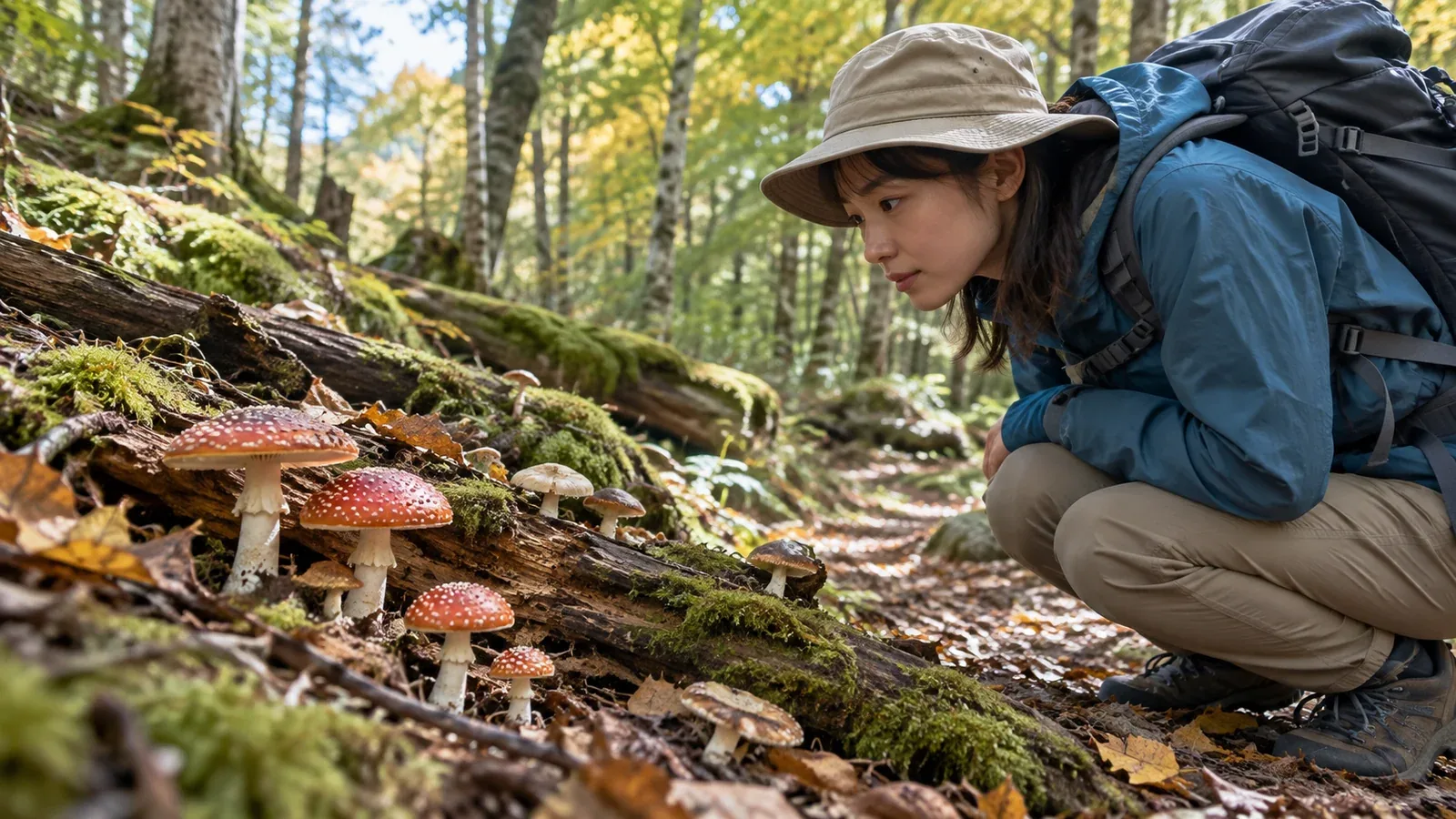
On a mountain trail, you might spot mushrooms among fallen leaves or next to a mossy log. Leave them where they are and take a closer look from the path.
Some poisonous mushrooms closely resemble edible ones. Even within a species, shape can change with the setting and time of year. A photo or image-recognition result can’t tell you whether a mushroom is safe to eat.
Here’s why they’re hard to tell apart, what to do if you might have eaten a poisonous one, and how to observe them from the trail.
Why appearance doesn’t tell you what’s edible
Muted colors, signs of insect feeding, and a stem that splits lengthwise are all unreliable signs of edibility. Boiling, grilling, or salting a mushroom of unknown identity won’t make it safe to eat.
For example, Japan’s health ministry warns that the poisonous tsukiyotake can be mistaken for oyster or shiitake mushrooms. The white destroying angel contains toxins that can be fatal.
A mushroom can look different before and after its cap opens. Growing conditions can also affect shape and color. A close match to a photo in a field guide is insufficient to confirm the species or whether it’s edible.
Knowing a few poisonous species goes only so far
Learning common poisonous mushrooms shows you what kinds of mix-ups can happen. A mushroom can still be poisonous even if it doesn’t resemble the examples you’ve learned.
Japan’s agriculture ministry notes that edible and poisonous mushrooms sometimes grow in the same place. Mushrooms that appear to be growing side by side on a log can belong to different species. Once they’re mixed together, they’re hard to sort out.
Even if a mushroom resembles one you’ve eaten before, it could be a different species. Leave it where it grows. Avoid tasting a small amount or using flavor or smell to judge whether it’s edible.
Symptoms can take time to appear
How soon symptoms develop depends on the mushroom. Japan’s health ministry reports that the destroying angel can cause vomiting, diarrhea, and abdominal pain roughly 6 to 24 hours after ingestion. The symptoms may ease before liver or kidney damage becomes apparent.
If you may have eaten a poisonous mushroom, promptly contact a medical facility and get medical care even if you feel well. In Japan, call 119 for an emergency such as abnormal breathing or impaired consciousness. If you’re unsure about getting medical care, call the Japan Poison Information Center’s hotline. Don’t try to make anyone vomit. Say when and how much they ate, and bring any leftover mushrooms or cooked food when you go for care.
Observing mushrooms in the mountains
You can enjoy watching mushrooms from the trail by looking at their color, shape, and what they grow on.
Know the rules for collecting
- In Japan’s national forests, the restrictions on taking things without permission apply to mushrooms too. Rules vary by site and protected area. If an organized outing includes collecting, check the organizer’s and land manager’s instructions.
- For help learning names and ecology, look for a guided nature walk, a local museum, or material from a mushroom specialist.
What to look for
- From the trail, look at where the mushrooms grow, such as a fallen log, bare ground, or leaf litter.
- If small caps and open ones are visible in the same area, compare their shapes.
- Use your camera’s zoom for a closer look and leave the mushrooms untouched and in place.
- Include the surrounding forest and the wood or ground the mushrooms are growing on in your photos.
- If you don’t know the species, say so in your notes. Keep unknown mushrooms out of anyone’s kitchen and avoid describing them as edible.
What a photo can tell you
Save the date, the mountain area, and what the mushroom was growing on, such as soil or a log, with your photo. This makes it easier to compare observations later. Image search or AI can suggest names to look up. They cannot tell you whether a mushroom is edible.
Enjoying mushrooms as part of the forest
The same trail can reveal different mushrooms after rain or as the seasons change. Compare the leaf-covered forest floor with the surface of a damp fallen log.
Some fungi break down wood and leaves. Others live in association with tree roots. Looking at what mushrooms grow on can get you thinking about how they’re connected to the forest around them.
Visit the same spot in another season and you may notice changes in cap size, how many mushrooms there are, or the vegetation nearby. You can record these differences even if you don’t know the names.
Try it on your next hike
When you spot mushrooms, photograph them and their surroundings from the trail. Note the date and what they’re growing on. For cooking, choose cultivated mushrooms or other mushrooms from a known supplier.
Sources
- Common poisonous look-alikes and symptoms of destroying angel poisoning (Japan Ministry of Health, Labour and Welfare)
- Preventing wild mushroom poisoning (Japan Ministry of Agriculture, Forestry and Fisheries)
- Who to contact and what to do after suspected poisoning (Japan Poison Information Center), and rules on collecting in national forests (Japan Forestry Agency)
References and sources
- Japan Ministry of Health, Labour and Welfare: Preventing food poisoning from toxic mushrooms
- Japan Ministry of Health, Labour and Welfare: Natural toxin profile for the destroying angel
- Japan Ministry of Agriculture, Forestry and Fisheries: Preventing wild mushroom poisoning
- Japan Poison Information Center: Beware of food poisoning from toxic mushrooms
- Japan Poison Information Center: Public poison hotline
- Japan Poison Information Center: What to do after a poisoning
- Kanto Regional Forest Office: Access to national forests