
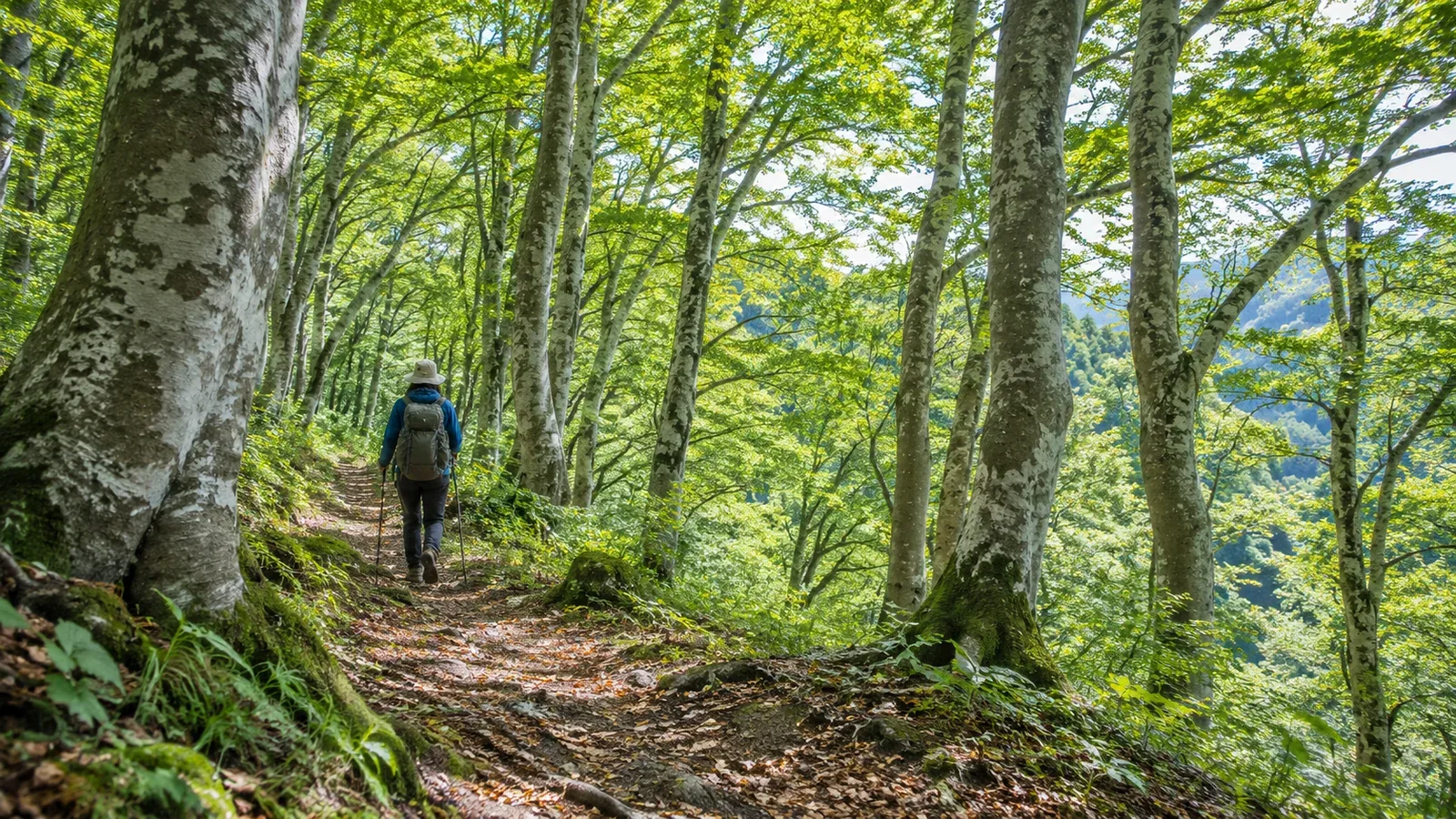
On a hike in Japan, you may find yourself in a light-filled forest of smooth gray trunks. Japanese beech is one of the characteristic deciduous trees of Japan’s cool-temperate forests. According to the Forestry Agency, it ranges from Kuromatsunai in Hokkaido to Mount Takakuma in Kagoshima Prefecture.
Animals eat its nuts, and fungi and insects live in the wood after a tree dies. The leaf litter and soil give rain and snowmelt somewhere to soak in. Once you learn to recognize the bark and leaves, it’s easier to notice how water and wildlife are connected in the forest.
How to recognize Japanese beech
Japanese beech (Fagus crenata) is a tall deciduous tree in the beech family. Some stands, such as those at Shirakami-Sanchi, have large old trees. Others are secondary forests where young beeches grew back after logging.
The bark is gray and fairly smooth. On some trees you’ll see patches of lichen. The leaves are egg-shaped with wavy edges and a series of veins running toward the margin. When you see trunks of a similar color, look at the leaf shape too.
In autumn, the husk, covered in hairlike projections, splits open to reveal small triangular nuts. The crop varies from year to year. According to the Forestry and Forest Products Research Institute, on the Sea of Japan side of Tohoku and central Japan, crops of beech nuts and mizunara acorns can influence where Asian black bears are seen. Before hiking, check local sightings and alerts as well as information about the nut crop.
Where to see beech forests in Japan
You can walk through beech forests from snowy areas on the Sea of Japan side to mountains on the Pacific side. The trees that grow alongside the beech vary by region.
Tohoku and the Sea of Japan side. The Shirakami-Sanchi World Natural Heritage site, which straddles Aomori and Akita prefectures, preserves extensive old-growth beech forest. A dwarf bamboo called chishimazasa grows on the forest floor, reflecting the heavy snowfall.
The mountains of Kanto. In Kanagawa’s Tanzawa range, natural forest with Japanese beech and Nikko fir grows above roughly 800 meters. Seeing conifers among the beeches makes an interesting comparison with Shirakami-Sanchi.
Western Japan and Kyushu. On Mount Daisen in Tottori Prefecture, old-growth beech forest survives on the mountainside. At Mount Takakuma, in Kagoshima near the southern limit of its range, beech sometimes grows with evergreen broadleaf trees such as the Japanese evergreen oak akagashi.
A local vegetation map or a guide to protected forests can help you locate beech stands along your route. The elevation they grow at varies across Japan.
What to see in each season
The light on the same trail changes before the buds open, once the canopy has filled in, and after the leaves fall.
Spring. Before the leaves open, light reaches the forest floor and small flowers may bloom. When the new leaves come out, sunlight filtering through them makes the woods look bright. Elevation and lingering snow affect when the buds open.
Summer. The canopy shades the forest floor, a change you can feel when you step out of an opening. Exposed roots and wet rocks can be slippery after rain, so choose your footing carefully while staying on the trail.
Autumn. The leaves turn from yellow to brown. The best viewing time depends on the range, the elevation, and the year’s temperatures. Check recent foliage reports from the municipality or visitor center before you go.
Winter. Once the leaves have fallen, the trunks and branches stand out, even at a distance. Snow can hide signs and the shape of the trail. Check winter access, and if you’re unfamiliar with traveling on snow, choose a snow-free season or a different route.
What to look for in a beech forest
Lower your gaze from the trunks to the forest floor, the stream, and the fallen wood. Even around one tree, the setting changes with the season and the spot you’re in.
Leaf litter and water. Fallen leaves and porous forest soil help water soak into the ground. How muddy a trail gets after rain also depends on how compacted the soil is and where water collects.
Fallen wood and fungi. Fungi break down fallen wood. You may see moss and small creatures on the damp surface. Look from the trail and leave the wood where it is.
Tree hollows and animals. Birds, bats, and other animals may use cavities in old trees. A mark on the trunk won’t tell you on its own what animal made it. If you see a bear or fresh signs of one, keep away and follow local guidance.
The edge of the beech stand. A slope with many beeches can give way to other broadleaf trees or conifers. Open your map and compare the mix of trees on ridges and in valleys.
What to know about protecting beech forests
The number of beeches tells you only part of how a forest is doing. Look also at what grows underfoot and where the next generation of trees can take root.
Deer browsing. In places such as Tanzawa, sika deer browsing is a concern for vegetation. In some spots you can compare the undergrowth and young trees inside and outside a fence from the trail.
When nearby oaks die. Mizunara oak belongs to the same family as beech, in a different genus. In Japanese oak wilt, a fungus carried by an ambrosia beetle blocks the channels that carry water through the tree. Powdery wood debris around the base is a clue you can look for. Appearance alone doesn’t establish why a tree died.
Entering old-growth forest. Access to the Shirakami-Sanchi World Heritage core area is limited to certain routes, including existing trails and designated routes that require advance notification. Check the relevant land manager before you go, as access can change even on walking trails.
Try it on your next hike
Choose a trail through a nearby beech forest and check access and bear reports. Look at the trunks, leaves, and forest floor from the path. You’ll start to see how the same forest can look different from one slope to another.
Sources
- Japanese beech traits and range, wildlife and water in beech forests (Tohoku Regional Forest Office)
- World Heritage significance and access to Shirakami-Sanchi (Tohoku Regional Environment Office)
- Beech forests in Tanzawa, Daisen, and Takakuma (Kanagawa Prefecture and Japan Forestry Agency)
- Beech nut crops and bear sightings, and how Japanese oak wilt works (Forestry and Forest Products Research Institute and Japan Forestry Agency)
References and sources
- Tohoku Regional Forest Office: Japanese beech
- Tohoku Regional Forest Office: A guide to observing beech forests
- Tohoku Regional Environment Office: The significance of Shirakami-Sanchi
- Tohoku Regional Environment Office: Access to Shirakami-Sanchi
- Kanagawa Prefecture: About Tanzawa
- Kinki-Chugoku Regional Forest Office: Daisen Forest Ecosystem Reserve
- Kyushu Regional Forest Office: Management plan for the Takakuma Mountain Biological Community Reserve
- Forestry and Forest Products Research Institute: Why bears appear near settlements
- Japan Forestry Agency: Japanese oak wilt