
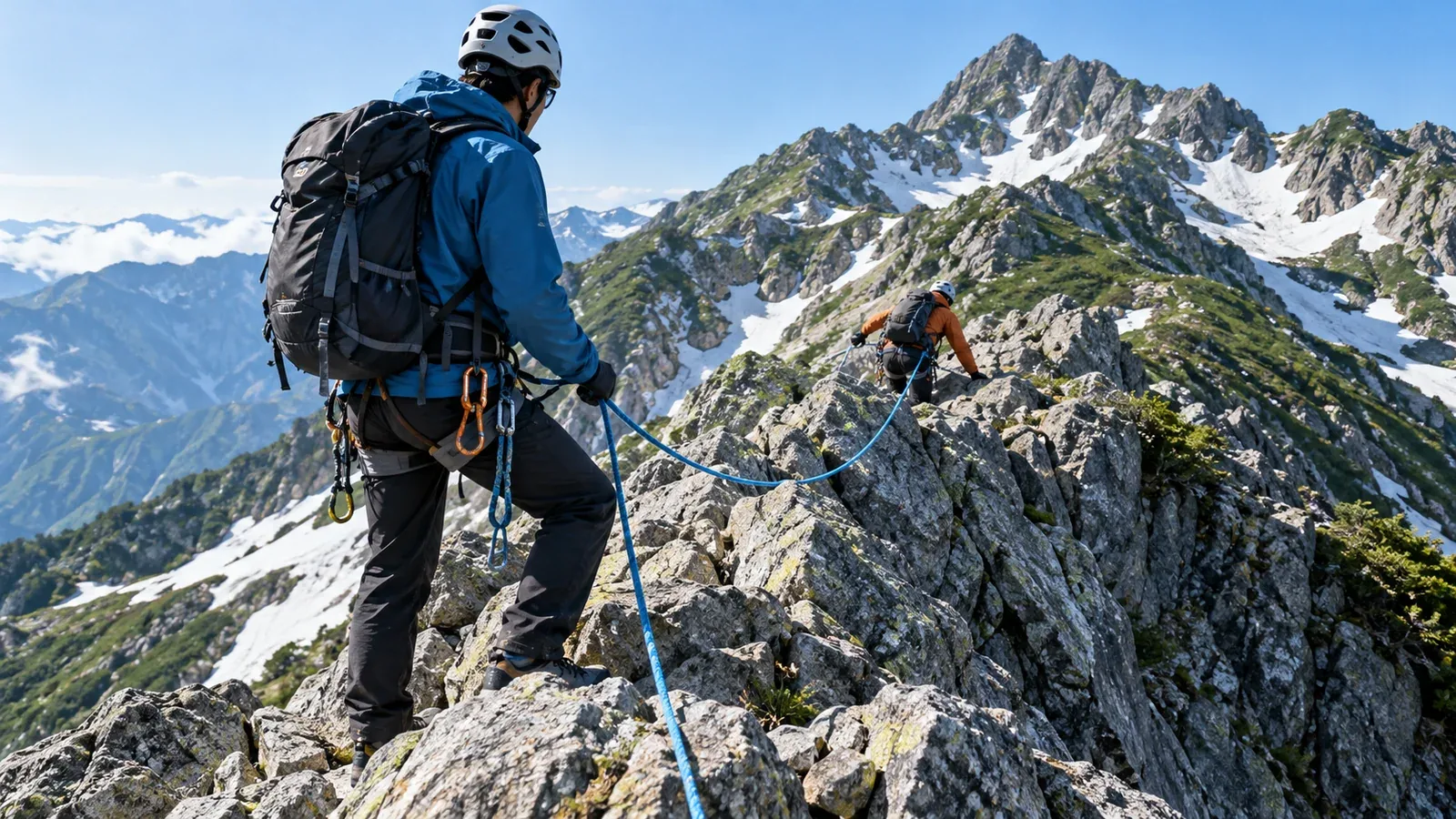
Some rocky ridges, snow routes and difficult traverses require skills beyond ordinary hiking. Find out before departure whether the route calls for a rope system, who can use it and what alternatives exist.
Use this guide to assess the route and identify the training you need. Practise any life-critical system in person with a qualified instructor before relying on it in the mountains.
Planning to carry a rope and deciding to use it
Make the equipment decision while planning the route. Decide whether to proceed from stable ground after checking the actual terrain and conditions.
Trail chains and fixed ropes can help with movement where they are sound. Their presence does not establish an anchor or a fall-arrest system. Choose another route if you cannot move safely without protection or cannot verify and manage the required system.
- An exposed rock or snow ridge where a fall would have serious consequences.
- Glacier travel with crevasses or steep snow where the team has specific training for that terrain.
- An unexpected exposed section, where the first options are to stop, reassess and retreat safely.
- An injury or a party unable to continue or retreat, where technical lowering or rescue requires trained personnel. In Japan, call 119 or 110 from a secure position when possible.
Plan around the section that the group can safely manage. Carrying equipment does not make an unfamiliar system usable. If the route requires skills the group lacks, choose another route or arrange qualified instruction or guidance in advance.
What a harness does
A harness connects you to a rope system at the points specified by its manufacturer and distributes load. A backpack, a gear loop or a rope around the body is not a substitute for a harness and the appropriate equipment.
Choose the harness for its intended activity and fit. Check the size, tie-in points, buckles and compatibility with clothing and the rest of the system. Follow the maker’s inspection and retirement instructions.
A harness only works as part of a suitable system. Learn how to check fit, connections, anchors and the consequences of a fall under instruction before taking the equipment on a route that requires it.
Personal attachment and belaying a partner
These two uses have different equipment and training requirements.
Personal attachment at a verified anchor
A personal tether may be used for positioning at a verified anchor in a system you have been trained to use. Stay on stable terrain while assessing your options. A trail chain, chain fixing, tree or rock is not a verified anchor simply because it is present.
Use the equipment and method specified for that purpose. An ordinary sling or positioning tether is not designed to arrest a free fall. Do not improvise an attachment or clip a trekking chain to cross exposed terrain. A designated via ferrata has its own rules, system and equipment.
Belaying a partner
In a conventional belay, a trained person manages the rope using a suitable system to protect a partner on a defined section. The anchor, device, rope, terrain and position have to work together. Rock and snow may require different methods and training.
Learn in person with a qualified instructor. Check the equipment and roles with your partner before the section and follow the device maker’s instructions. A photograph, article or video cannot verify that your setup is safe.
Rope types and compatibility
Dynamic climbing ropes can carry single, half or twin markings, sometimes in combination. Read the model’s intended use. The required system depends on the route and activity.
Diameter and length. Select a rope long enough for the planned system and any retreat that system requires. Check compatibility with every device. Do not choose a diameter or length from a general rule for hiking. Ask an instructor who knows the activity and route.
Stretch and intended use. Dynamic climbing ropes absorb energy during certain falls. Low-stretch ropes, static ropes and accessory cord have other specified uses. Use each only within the complete system and purpose covered by the equipment and your training.
Standards and markings. Check the manufacturer’s documentation and declared standards. Common examples include EN 892 or UIAA 101 for dynamic climbing ropes and EN 12277 or UIAA 105 for harnesses. CE marking concerns conformity with applicable EU requirements. A standard does not establish that every combination or use is suitable.
How to decide before leaving
Ask these questions before committing to a route.
- What is the terrain? Find the exposed sections, local rules and planned retreat on the map and in the route operator’s information. Confirm whether technical protection is expected.
- What can everyone in the group do? Assess each person’s skills, fitness and experience. If anyone cannot safely manage the planned route, select a route the whole group can handle or organise qualified guidance.
- How could weather change the route? Check current forecasts, access and surface conditions, including snow and ice. Agree when to turn back or use an established alternative.
- Who can use and check the system? Identify the person or people trained for the specific terrain and system. Practise under instruction beforehand and check every component’s compatibility and condition.
If an essential answer is unclear, resolve it before departure or choose a route the group can safely manage. Do not rely on equipment to compensate for missing training.
Before you plan a technical route
Ask a qualified instructor or mountain guide about the skills and equipment needed for your specific activity. Practise fitting the harness, verifying anchors and checking the rope system in a controlled setting. Confirm the equipment requirements before buying or carrying gear for the trip.
Further reading
- Japan Mountaineering and Sport Climbing Association safe hiking resources
- UIAA equipment standards
- National Police Agency mountain incident reports
- Japan Meteorological Agency weather warnings and advisories
References and sources
- Japan Mountaineering and Sport Climbing Association · Safety resources
- UIAA · Climbing and mountaineering equipment standards
- National Police Agency · Mountain incident reports
- Japan Meteorological Agency · Warnings and advisories
- Petzl · Common rope hazards and mutual checks
- UIAA · Static attachments and fall loads
- Mountaineering Scotland · Equipment for outdoor climbing
- Mountaineering Scotland · Winter skills and training
- European Commission · CE marking and declaration of conformity
- Japan National Tourism Organization · Emergency numbers