
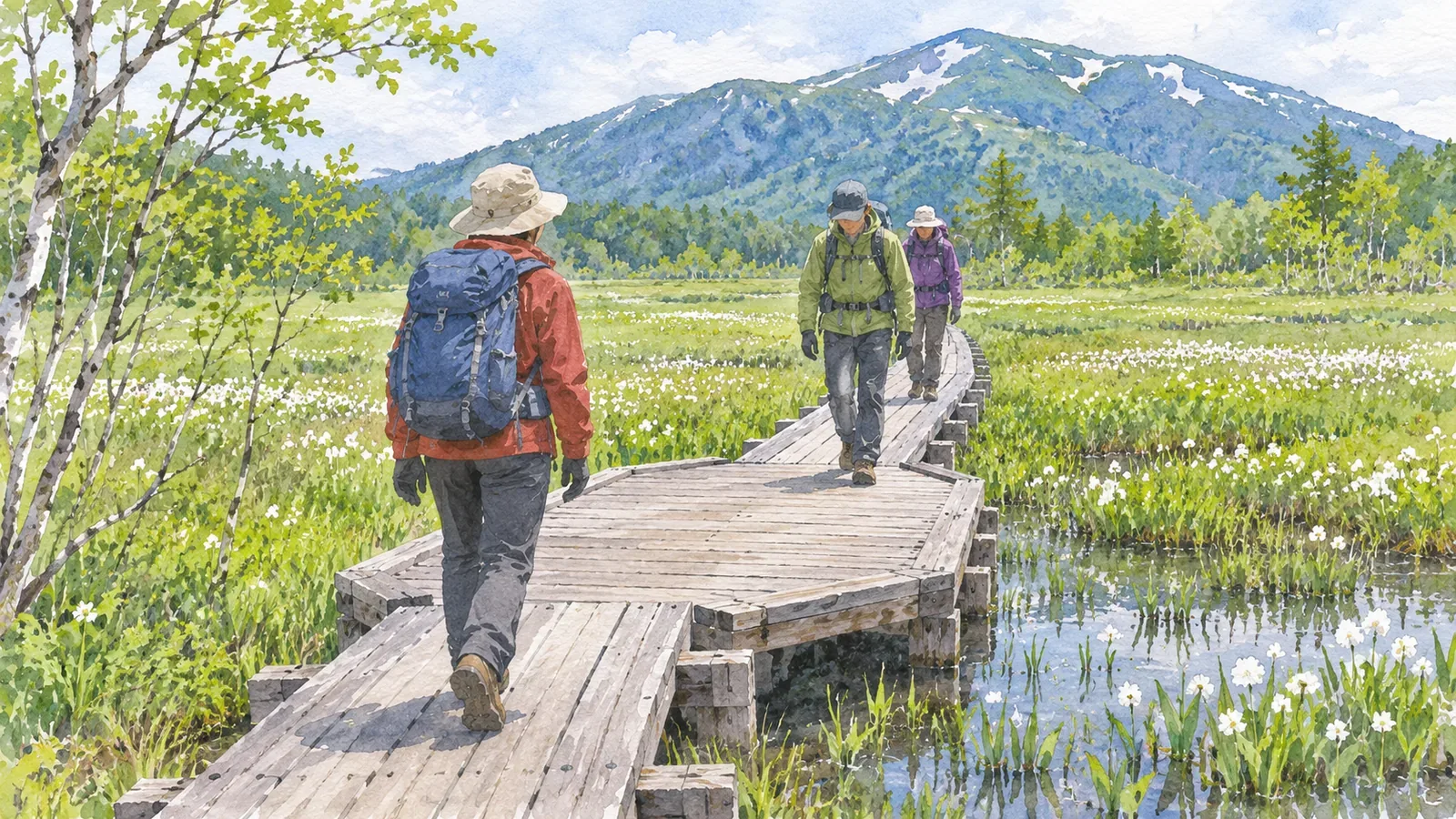
When meeting someone on a boardwalk, look ahead for a place where you can give way without stepping into the wetland. Oze asks visitors to keep right, give uphill walkers priority and stay on the boards. In narrow places, check one another’s footing and speak up about who can wait safely. In other areas, follow local rules and instructions.
Give Way Without Leaving the Boards
According to Fukushima and Gunma prefectures, Oze’s boardwalks began as logs laid across muddy ground to make walking easier. From the mid-1950s into the mid-1960s, more people stepped into the wetlands. Plants died, the ground became compacted and dried out, and peat cracked or washed away in places. Boardwalks were later built to protect the wetland.
Peat builds up at only about 1 mm a year. Fukushima Prefecture explains how a wetland formed over thousands of years was degraded in just a few years. Japan’s Ministry of the Environment asks visitors to stay on the boards to protect the fragile wetland ecosystem. The Oze Preservation Foundation also asks people who sit on the boardwalk or in a rest area to keep their feet out of the wetland. Keep your feet and gear on the boards when giving way. Before the other person gets close, look for a spot to stop on the boardwalk. Choosing early gives you time to watch your footing and wait calmly.
Keep Right and Give Uphill Walkers Room
The Oze Preservation Foundation asks visitors to keep right and give uphill walkers priority. If the boards are too narrow to pass, check where you can both stand and talk to each other. Fukushima Prefecture also describes how restrictions on private cars introduced in 1974 eased congestion on the boardwalks.
On the way down, look ahead for people coming uphill. When going up, check whether the person coming down can wait safely. Even on level ground, speak to each other and decide who will wait. In a group, agree on where to wait and the signal to move, so people at the back won’t have to hurry to catch the leader. Look for a spot with room to pass without twisting suddenly or stepping backward.
Four Things to Look For in a Place to Wait
Check the following before choosing where to wait. First, keep your body, pack and pole tips within the boards. The foundation asks walkers to use protective caps and keep the tips inside the trail. While waiting, keep your poles from swinging into the wetland or toward the other person. Second, check that the boards are stable. The Ozenuma Visitor Centre’s repair report from August 6, 2024 warns about split or tilted boards. The Oze Trekking Guide also mentions injuries from fittings and splinters. Avoid waiting on visibly damaged boards.
Third, avoid slippery surfaces. The guide explains that wet boards can be slippery. Even boards that look dry or pale may be slick. If you’re unsure you can stand securely, wait somewhere else. Fourth, look for a clear view of people approaching so you can talk before anyone has to move suddenly. Fukushima Prefecture describes how Oze’s boardwalks changed from logs to planks, from single to double tracks, and in some places to raised boards that interfere less with water flow. Check the boards’ condition, the room for your feet and how people are moving before choosing where to wait.
The Oze Trekking Guide records 96 incidents in the 1997–2002 seasons, mostly on the Gunma side. Of these, 61 were injuries while walking. The guide mentions that fatigue can make it harder to balance and recommends shorter steps and watching where you place your feet. If you’re tired, look ahead for a place where you won’t have to stop abruptly or sidestep.
Plan Ahead and Decide What to Do on the Boards
Before leaving, use the map to see which sections are uphill or downhill. Picture where you could stop on solid footing when someone approaches. Agree on short signals such as “I’ll keep right” or “Go ahead” and decide who leads and who walks at the back. Check the manager’s latest notices for access restrictions and boardwalk conditions.
Check the map or use a device only after stopping on stable footing where people can pass. If there’s nowhere suitable, do it later. Save notes, photos and screen use for when you’re stopped. At home, jot down whether you were going up or down, where you waited and what the boards were like to help you choose next time.
Plan Where to Give Way and Stay on the Boards
In Oze, keep right, give uphill walkers priority and stay on the boardwalk while making room for each other. Look early for enough room for your body and pack, sound boards, secure footing and a clear view of people approaching. If there’s nowhere safe to wait, take time to talk rather than crowding the edge. Agree on signals beforehand and use them on the trail.
References and sources
- Oze Preservation Foundation: Rules and Etiquette
- Japan’s Ministry of the Environment: Etiquette in Oze National Park
- Oze Preservation Foundation, Ozenuma Visitor Centre: Repairing the Boardwalk (August 6, 2024)
- Fukushima Prefecture: The History of Conservation in Oze, Part 2 — Managing Overuse
- Gunma Prefecture: Oze Boardwalks and Vegetation Recovery, pp. 26–33
- Oze Preservation Foundation: Oze Trekking Guide