
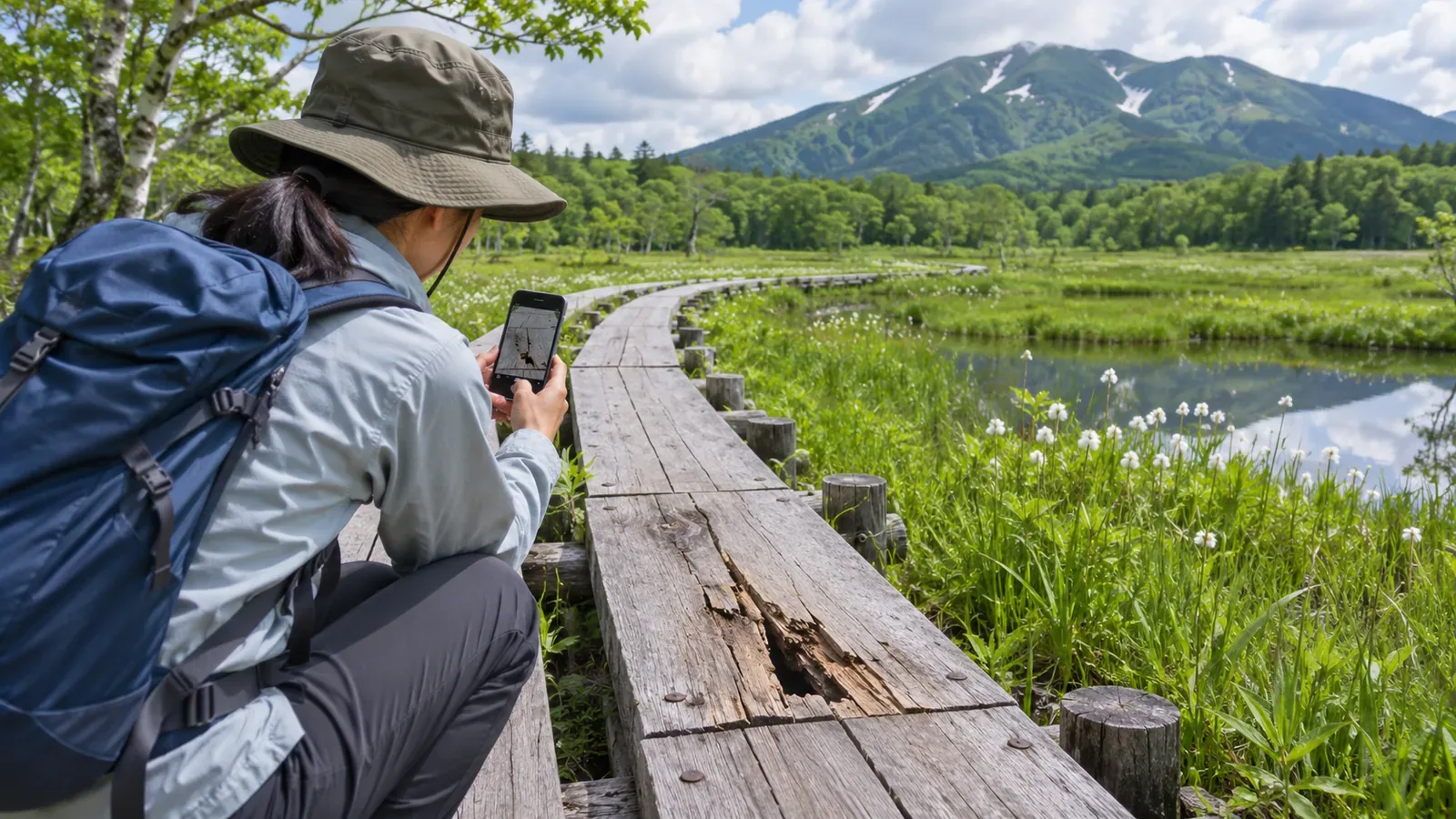
If you see a damaged plank, stop on secure footing before you reach it. Leave the plank alone. If you can’t tell whether it’s safe to cross, turn back without stepping into the wetland. Here’s how to report what you can see on Oze’s boardwalks. Check official notices or signs for the correct contact and how to report it.
Why Planks Deteriorate and What to Look For
Gunma Prefecture’s booklet explains that wetland boardwalks can rot or break in seven to ten years. Large machinery cannot get to the work site, so materials are flown in by helicopter and the work is done by hand. Fukushima Prefecture also describes the work involved in upkeep and the difficulty of finding workers.
A 2024 repair report from the Ozenuma Visitor Centre calls for caution around older boards that have split or tilted. Check what you can see from a safe spot and take the condition of the boards into account as well as the installation date.
When you report damage, give specific landmarks and your direction of travel so someone else can find it. Record what you saw and let the manager decide how to repair the plank and whether to keep the path open.
Keep Out of the Wetland Even When a Plank Is Damaged
The Oze Trekking Guide describes slips on wet boards and hand injuries from metal fittings or splinters. If you see a crack, a tilted board or an exposed fitting, stop on stable footing before you reach it. Avoid stretching out to test it with a hand or foot.
When you find a damaged plank, stay on the boardwalk and keep out of the wetland. Japan’s Ministry of the Environment asks visitors to stay on the boards. Fukushima Prefecture says peat accumulates at only about 1 mm a year. Gunma Prefecture explains that repeatedly trampling a spot kills plants and compacts and dries the ground. Peat can then crack or wash away in rain. If you’re unsure whether you can cross, turn back and follow the manager’s instructions and any closure signs.
Leave the plank where it is. To report it, you can describe what you see without stepping on it, shaking it or lifting it. Leave repairs and clearing to the manager. To avoid wearing the boards faster, the Oze Preservation Foundation asks visitors to fit trekking pole caps, keep the tips inside the path and take off crampons on snow-free ground.
Three Details to Include in a Report
A good report helps someone else find the same plank. Gather these three details if you can stop on stable ground. Keep your distance from the damaged board.
First, note the location. Name a nearby junction, rest area or wetland that can be found on a map, and say which way you were walking. Oze asks people to keep right, so say whether the plank was on the right or left in your direction of travel. A phrase like “just before the junction” or “just past the rest area” is enough.
Second, include the burned-in mark if you can read it safely. A June 2025 report by the Yamanohana Visitor Centre shows marks on the section from Hatomachi Pass to Yamanohana that identify the installer and year. Copy what you can read. If you would have to lean, move to the edge or approach the damaged board, write “not checked.”
Third, describe the damage you can see. Say that a plank is split, there’s a step between two boards or a fitting is exposed. Add the date, time and approximate weather. Even without a photo, a short description of the location and condition can help.
Keep what you saw separate from what you think might happen. For example, “Just after the junction, the board at the right edge in my direction of travel was split and a fitting was visible. It was wet from rain.” If you include a guess, label it separately.
Where to Stop and What to Prepare Before Leaving
Take notes only after stopping on stable footing without blocking the path, such as a safe place before the damage. Stay on your side of the damaged board and out of the wetland. The Oze Preservation Foundation also asks visitors to keep feet and tripods out of the wetland. If you can’t stop safely, wait until you’re somewhere safe and report what you remember. A photo is optional, and you can leave uncertain details unknown.
Before leaving, make a simple note with spaces for location, the mark, visible damage, date and weather. Pick a few junctions or rest areas on a map and practise describing them in one line, such as “before the junction, on the right in my direction of travel.” Then practise describing a crack or a step between boards as if you were stopped. If you’re writing after the hike, list the landmarks in the order you passed them to narrow down the spot.
Before leaving, check the manager’s official guidance for whom to contact and how to send a report. Follow any contact instructions posted on site.
Stay Safe on the Boards and Bring Back Details the Manager Can Use
Keep away from the damaged plank and record the location, any mark and the visible damage from safe footing. The boardwalk protects the wetland from foot traffic. Turn back if you’re unsure you can cross and keep off the wetland. Look up the reporting contact in advance and be ready to give a short description of the place and condition.
References and sources
- Oze Preservation Foundation, Yamanohana Visitor Centre: Hatomachi Pass to Yamanohana (June 24, 2025)
- Gunma Prefecture: Oze Boardwalks and Vegetation Recovery, pp. 26–33
- Fukushima Prefecture: The History of Conservation in Oze, Part 2 — Managing Overuse
- Oze Preservation Foundation: Oze Trekking Guide
- Japan’s Ministry of the Environment: Etiquette in Oze National Park
- Oze Preservation Foundation: Rules and Etiquette
- Oze Preservation Foundation, Ozenuma Visitor Centre: Repairing the Boardwalk (August 6, 2024)