
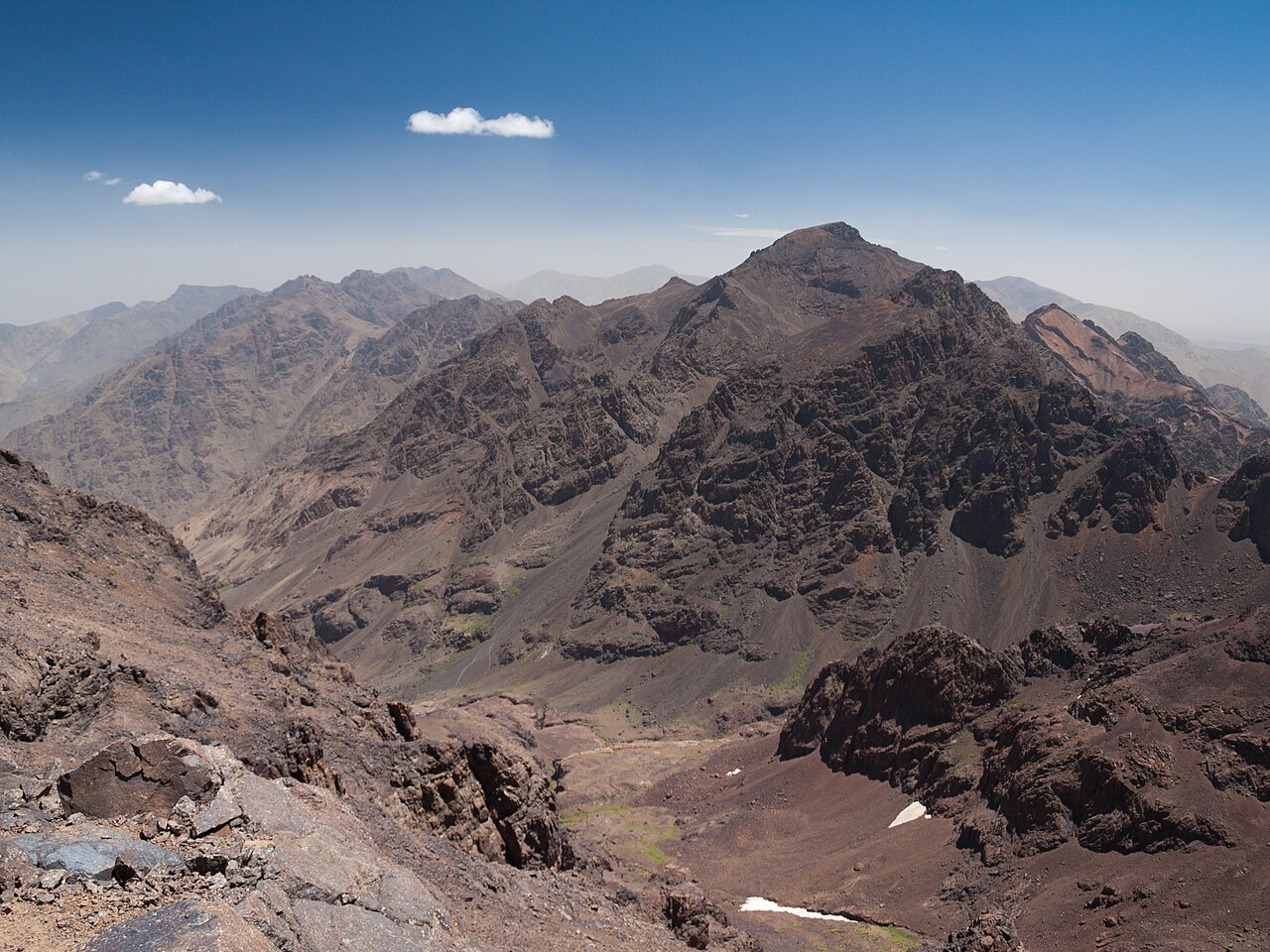
A Summit in National Park Country
Toubkal National Park was formally established on 19 January 1942, encompassing an altitudinal gradient from forest zones dominated by Quercus rotundifolia and Juniperus thurifera up through open alpine terrain. The park landscape includes irrigated farming and livestock grazing, reflecting long-standing human use of the mountain environment. The Key Biodiversity Areas factsheet notes that vegetation and trails within the park face ongoing pressure.
The 1923 Recorded Ascent
The alpine club archive maintained by the Refuge du Toubkal records an ascent of the peak in 1923, attributed to the Marquis de Segonzac, Vincent Berger, and Hubert Dobeau.
The Refuge and the Name It Carried
A hut was built in the summer of 1938 beside the Assif n'Ait Mizane river, at the foot of Ighibi-Sud at 3,207 metres. Its original Amazigh name, Issougan n'ouagouns, referred to the local azibs — the seasonal high-mountain shelters that herders had long used in the area. The hut later took the name of Louis Neltner, a geologist and alpinist tasked with mapping Moroccan massifs whose support was recognised in the naming. The 1938 date marks the construction of that original structure; the present building is a later replacement.
In 1987 the CAF Casablanca section renamed the refuge the Refuge du Toubkal, the name it carries today. The hut's layered nomenclature — Amazigh pastoral term, French geologist's name, modern club designation — reflects successive phases of the Atlas's documented history: indigenous land use, scientific survey, and alpine-club organisation, deposited one over another in a place that remains central to any approach to the summit from the Mizane valley.