
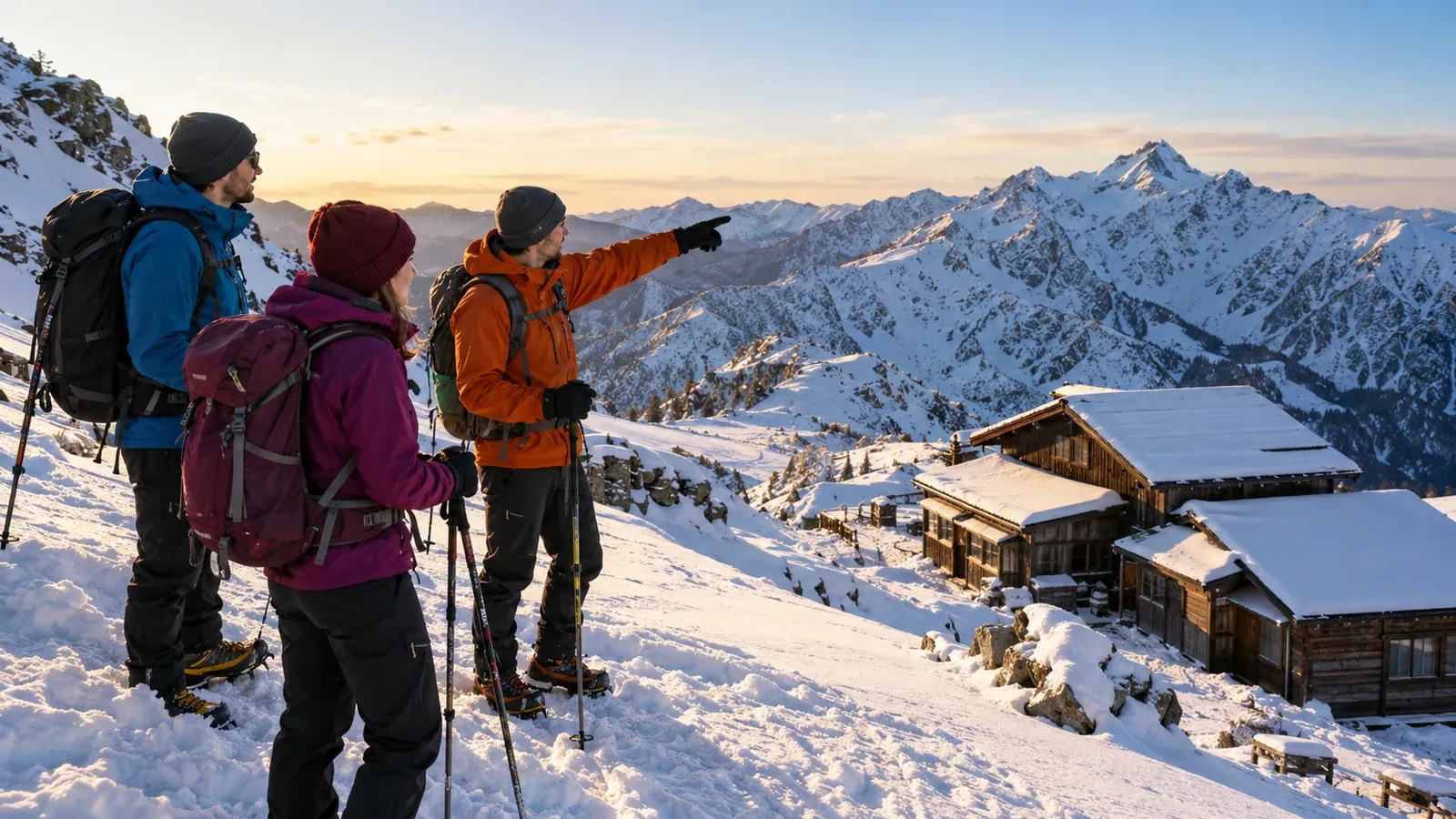
Japan's winter mountains have a distinct appeal for visitors. Deep snow, an established hut culture and places such as the Northern Japanese Alps and Mount Fuji have become well known online. Normal access to Mount Fuji closes in winter. If you're showing someone around or planning to climb with a visitor, find out what each person needs to know and what to check together first.
This guide is for local hikers, aspiring guides, hut staff and anyone planning a winter climb with companions visiting from abroad. It covers preparation and communication specific to snow-covered mountains.
Why Japan's winter mountains draw overseas interest
As Hokkaido, Nagano and Niigata have become known for skiing, information about their mountaineering routes has spread as well. Blogs and social media carry trail reports in English, Chinese and Korean. There is enough informal information for visitors from Europe, North America, Taiwan and South Korea to start planning trips to the Japanese Alps or Yatsugatake.
Official information on closures, plan filing and emergency contacts is often easiest to find in Japanese. Local companions and staff can help visitors find the guidance that applies to their route.
What to explain first when sharing winter information
Cover four things with your companions: weather, gear, local rules and emergency calls.
Weather. Official Japan Meteorological Agency forecasts and warnings are a starting point. If the mountain information is in Japanese, explain it and use services such as Mountain Forecast or Windy as supplements. Agree on what you will do if visibility falls or avalanche conditions change.
Gear. Experience with crampons and an ice axe abroad helps, but snow and terrain differ from route to route. A firm surface can hide weaker snow underneath. Be clear from the start whether the route calls for 12-point crampons and an ice axe, and whether everyone can use them.
Local rules. Winter closures, access restrictions and mandatory plan filing vary by area. Check the relevant authority's accepted filing methods, such as Compass where available, and whether they support the group's languages. If someone needs help, agree who will assist with the required information and submission.
Emergency calls. In Japan, call 110 for the police or 119 for fire and emergency medical services. Explain that you need mountain rescue and give your location. Some rescue arrangements can involve costs, so check whether your insurance covers the planned winter activity and rescue. Visitors may be familiar with a different system at home.
Ways to communicate across a language barrier
Use straightforward English alongside a map or diagram. Clarifying a Japanese-only sign or hut rule on the spot can affect the whole group's safety.
Prepare a few things beforehand.
- Annotate a topographic map. Mark the route, turnaround points and emergency shelters in advance.
- Agree on measurable weather limits. You might agree on a wind speed in meters per second at which you'll turn back. Set the limit based on the route, actual conditions and participants' experience.
- Share the hut's rules ahead of time. Check arrival time, lights-out, meals and where to remove or store crampons. Some huts close in winter or take guests only by reservation, so confirm with the hut.
- Carry a Japanese emergency phrase card. Useful examples are “Tasukete kudasai” (please help), “Katsuraku shimashita” (someone fell down a slope) and “Teitaion-shō no utagai ga arimasu” (suspected hypothermia).
How to check winter experience
Experience can mean many things, from climbing in the Alps to ice climbing or backcountry skiing. A winter ridge in Japan takes specific skills and stamina. Ask about the kind of terrain and weather each person has actually dealt with.
Ask about experience with the following.
- Fitting and using crampons and an ice axe.
- Traveling in temperatures of −10°C or below.
- Navigating in a whiteout.
- Recognizing basic avalanche hazards, including slope angle and snow conditions.
- Recognizing and responding to hypothermia.
Share the list before the trip and ask each person to fill it out. That makes it easier to spot different expectations. Provide an English version where needed or ask a certified guide through Nordwand.
Explain the reasons behind hut and mountain rules
Japanese huts may handle footwear, quiet spaces, meals and campsite bookings differently from huts abroad. Explain the rules before people arrive.
Give the reason for each practice. Keeping shared spaces quiet or putting equipment in its designated place helps people rest and move around safely. That context can make a rule easier to remember and follow.
Winter hut operations are often more limited than in summer. Opening dates, capacity and meal service can vary by season. Check with the hut or the local authority or mountaineering association.
What to do next
If you're planning a winter outing with visiting companions, start with the local authority's access and plan-filing guidance. Discuss everyone's experience and agree on when to turn back. Nordwand's Base Camp and certified guide features can help you find companions or a guide. Check the official site for details.
Further reading
- Japan Meteorological Agency, mountain weather information.
- National Police Agency, annual mountain incident overviews.
- Ministry of Land, Infrastructure, Transport and Tourism and Japan Tourism Agency, information for welcoming international hikers.
- Official guidance from prefectural mountain rescue teams.