
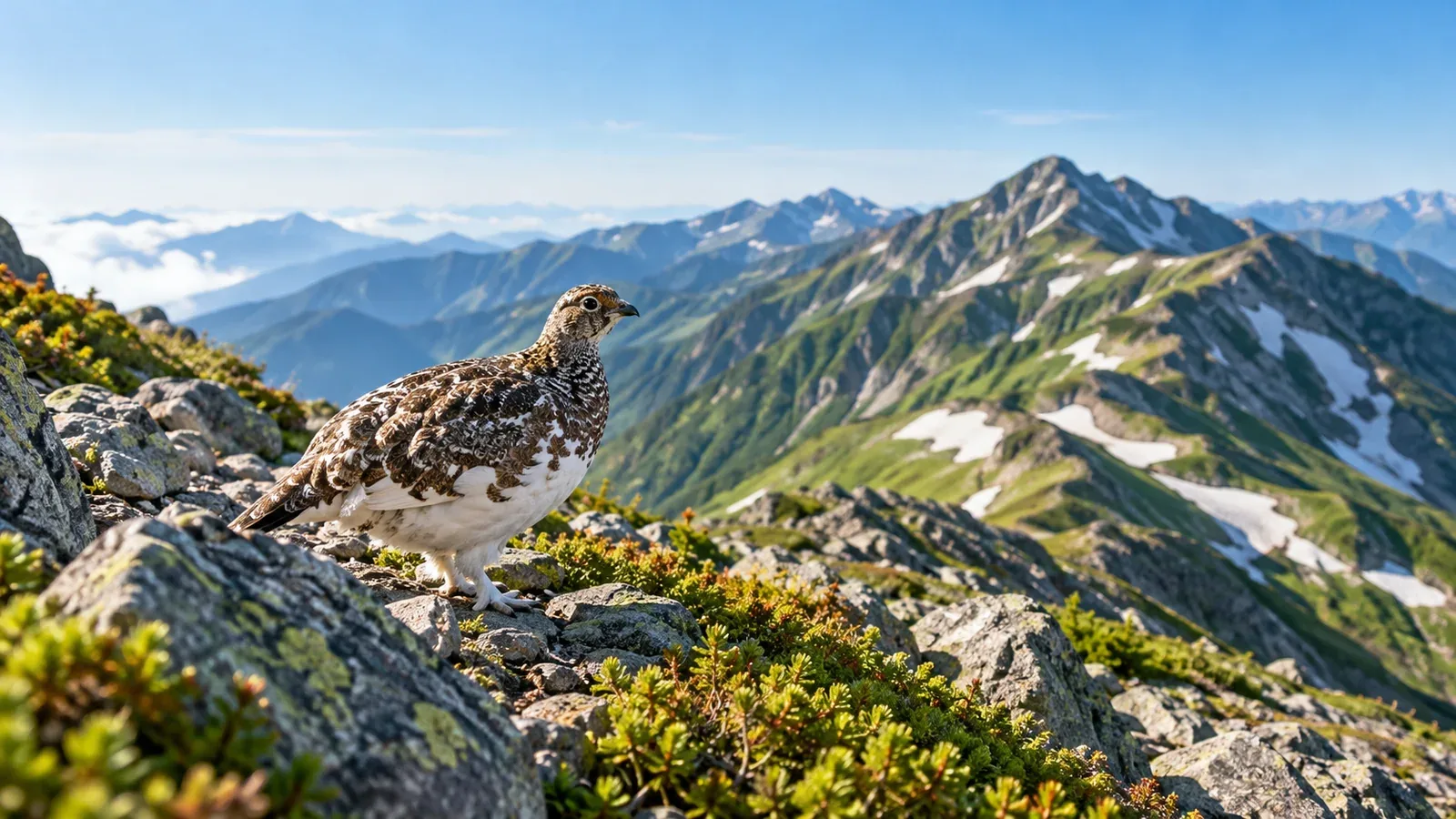
On a ridge in the Japanese Alps, you may notice a round bird walking among the rocks and grass. It is a rock ptarmigan. In winter its white plumage blends into the snow. What it eats and where it spends its time change with the seasons too.
The rock ptarmigan (Lagopus muta) occurs at high latitudes across the Northern Hemisphere and in some alpine areas. Japan’s subspecies (Lagopus muta japonica) lives in isolation in the mountains of central Honshu. Its features and history help explain how it remained in Japan.
Feathers and feet suited to alpine seasons
The colors that blend into exposed rock and grass are different from those that blend into snow. Rock ptarmigan molt with the seasons.
Japanese rock ptarmigan molt three times a year, developing winter, breeding and autumn plumage. Much of the body is white in winter. When the snow recedes, brown and dark brown markings blend in with rocks and vegetation.
Their legs are feathered right down to the toes. If you see a ptarmigan on snow, look for those feathered feet as well as the bird’s round body.
From spring into summer, the birds use habitats with low shrubs for nesting and alpine plants for food. In winter, some move near the treeline or into the subalpine zone.
How the birds remained in central Honshu after the Ice Age
To understand why the birds live high in Japan’s mountains, look back to a colder period.
A 2026 study of mitochondrial DNA from museum specimens estimated that the Japanese lineage split from other lineages before the Last Glacial Maximum. The birds are thought to have extended their range into Japan during a cold period and remained in cool mountains as the climate warmed.
Populations left in isolated places after a cold-period expansion are known as Ice Age relicts. In central Honshu, the habitats are separated by mountain range, and researchers have reported genetic differences between populations including those in the Northern and Southern Alps.
Japan’s sites lie at the southern edge of the species’ East Asian range. The birds live in central Honshu, separated from habitats farther north.
Food, breeding and predators
From spring to autumn, they eat leaves, buds, flowers and fruits of alpine plants such as crowberry. For birds that spend snowy winters near the treeline, Erman’s birch buds protruding above the snow are an important food.
Males hold territories during the spring and summer breeding season. Around June, the female builds a nest beneath a low shrub such as dwarf pine and lays about six eggs. The chicks follow the adult after hatching.
Foxes, martens and crows are among the predators that affect eggs, chicks and adults. Which animals move into alpine habitat and what impact they have vary by area. Conservation teams use field surveys to decide how to respond.
Conservation status and local challenges
Japan lists the rock ptarmigan as a national Special Natural Monument. The Ministry of the Environment’s fifth Red List classifies the Japanese subspecies as Endangered (EN). Its fifth Red Data Book estimates about 2,000 birds across Japan.
Conservation challenges differ by population. Surveys look at the effects of climate, predators and vegetation.
As warming changes the timing of snowmelt and alpine vegetation, it also changes places the birds can use for feeding and breeding. Because their habitats are separated, researchers track the effects by mountain area.
Where predation is a concern, conservation teams survey and manage predators and monitor nests and chick survival.
When alpine plants decline, the places where birds can feed change. On Mount Hiuchi, the Ministry of the Environment and its partners reported signs of alpine vegetation recovering in plots where they removed grasses.
In the Central Alps, releases and predator management are helping rebuild the population. Japan’s 2026 environmental white paper reports an estimate of about 300 birds in July 2025.
Watch quietly from the trail
If you see a rock ptarmigan, stay far enough back for it to keep feeding or moving.
Do not approach or follow it. If it comes onto the trail, stop and wait for it to move away.
Do not feed it. Keep your food to yourself and watch the bird forage.
Stay out of dwarf pine scrub. Nests and chicks may be hidden. Take photos from the trail.
Pack out rubbish and leftovers. Keep food from attracting animals to the area.
For photos, keep your distance, use a zoom or long lens, and switch off the flash. Leave the adults and chicks a clear way through.
What to check before a hike
Check opening dates, trail access and wildlife-watching rules for your destination. The Ministry of the Environment’s conservation reports explain how work differs by mountain area and which habitats the birds use.
Sources for further reading
- Ministry of the Environment conservation program, environmental white paper and fifth Red Data Book.
- Museum specimen genetic research and the Japanese Journal of Ornithology study on seasonal diet.
- Agency for Cultural Affairs listing of the rock ptarmigan as a Special Natural Monument.
- Nagano Prefecture guidance on watching rock ptarmigan.
References and sources
- Ministry of the Environment: rock ptarmigan conservation and recovery
- Ministry of the Environment: fifth Red Data Book, birds
- Chūbu Regional Environment Office: rock ptarmigan talk and field observation
- Nagata and colleagues: genetic diversity of Japanese rock ptarmigan from museum specimen mitochondrial genomes
- Japanese Journal of Ornithology: seasonal changes in the diet of Japanese rock ptarmigan
- Agency for Cultural Affairs: national cultural property listing for rock ptarmigan
- Ministry of the Environment: 2026 environmental white paper, wildlife conservation and management
- Shin’etsu Nature Conservation Office: third implementation plan for rock ptarmigan conservation
- Shin’etsu Nature Conservation Office: improving rock ptarmigan habitat on Mount Hiuchi
- Nagano Prefecture: watching rock ptarmigan responsibly