
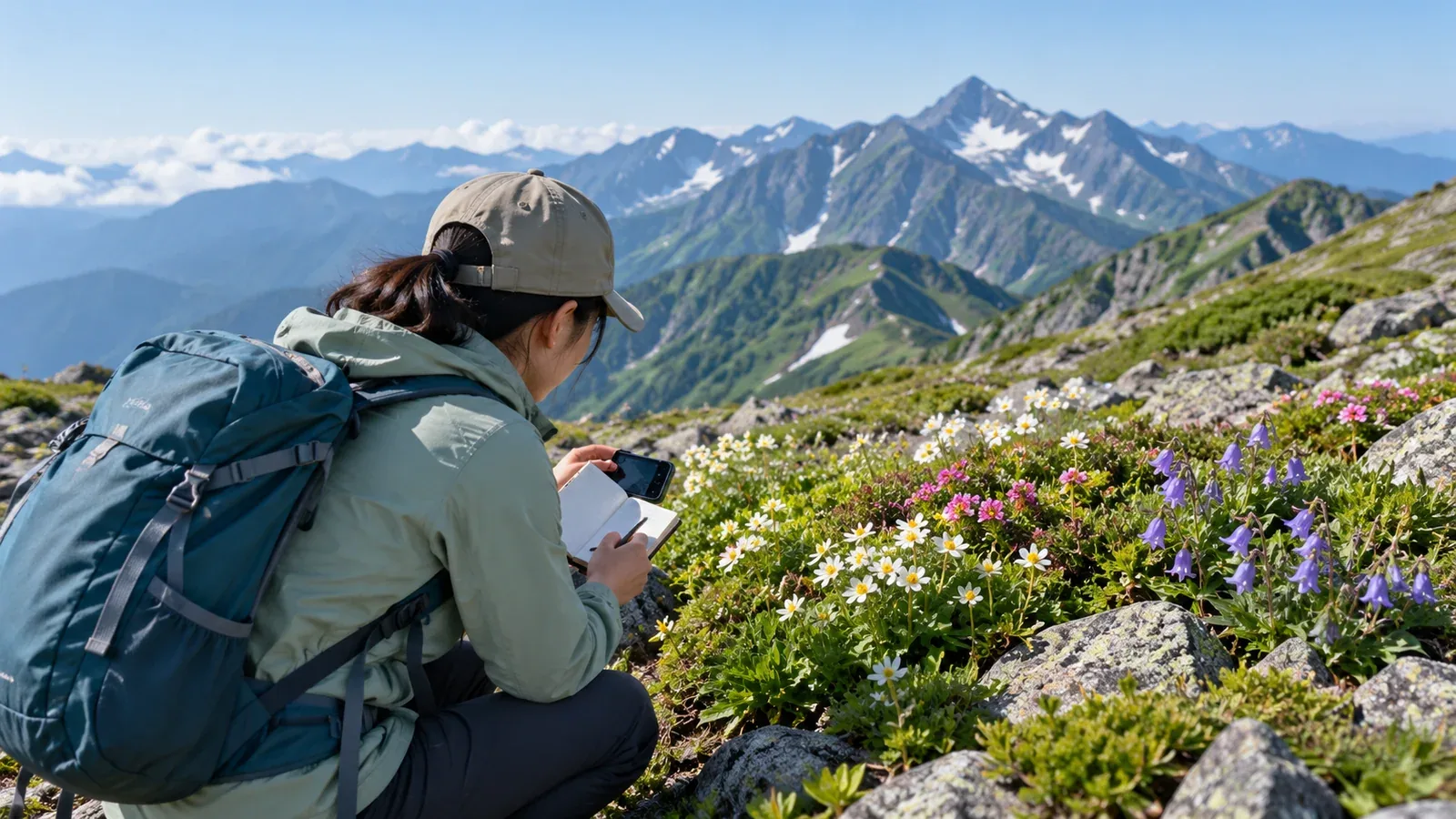
Look up a trailside flower after a hike and you may find several that look alike. Along with its color, record the leaves, the whole plant and where it grew so you can compare those features later.
Start with flower color, then check shape. Look at the cuts in the leaves, how the stems grow and the habitat to tell similar plants apart.
Even when you cannot recall a name, following the same order gives you clues to use with your photos or field guide.
Start with color and shape
Color is easy to see even at a distance. With flowers of the same color, look at the number of petal-like parts, whether they join into a tube or bell, or whether many tiny flowers form a cluster.
Use a field guide’s color index or floral illustrations to find candidates. If you use a plant identification app, compare its suggestions with leaves, flowers and geographic ranges in a field guide or park material.
1. Record the flower color
Color is a starting point. If the center and edge are different colors, note both.
Yellow or orange. Usagigiku, an arnica in the daisy family, has petal-like ray florets outside and small tubular disk florets in the center. Yellow miyama-kinbai, a cinquefoil in the rose family, has a different flower structure.
White or cream. In Hakusan-ichige, the white sepals look like petals. For other white flowers, check the center and the leaves as well.
Pink, purple or violet-blue. Record a shape as well as the color, such as rounded petals on Hakusan-fūro geranium or the bell of iwa-gikyō.
Red or deep reddish purple. Komakusa has pink flowers and grows on gravelly ground. Kuroyuri, a fritillary, can have dark reddish-purple downward-facing flowers. Fine spots are another clue.
Green, brown or past flowering. When bright flowers are absent, look at leaves and fruit. After flowering, chinguruma develops conspicuous feathery fruit heads.
2. Compare flower shapes
Next look at the flower from the front and side to see the number of petal-like parts and how they connect.
Separate petals. Hakusan-fūro geranium has five petals. In some flowers, such as the white Hakusan-ichige, sepals look like petals.
Petals joined into a tube or bell. Compare the bell of iwa-gikyō with the tube of Hakusan-kozakura primrose, which flares at the tip.
Different shapes above and below or to either side. View the pea-family plant oyama-no-endō from the side to see how differently shaped petals fit together.
Clusters of tiny flowers. What looks like one flower on an arnica is a cluster of small florets. On yamahahako, a pearly everlasting, the white bracts around the florets resemble petals.
Tiny flowers along a spike. On alpine bistort, small white flowers line the top of the spike, and reddish bulbils can form below them.
3. Check leaves, stems and habitat
When flowers look similar, compare the shape of the leaves, stem height and where the plants grew.
Leaf shape and cuts. The basal leaves of Hakusan-ichige have narrow, deeply cut lobes. Hakusan-fūro also has divided leaves, so check the full leaf shape alongside the flower.
Stem growth and height. Look for leaves grouped near the ground or spaced up the stem. Note how high the plant looks, such as “ankle-high” or “upright stem, about knee height.”
Habitat. The gravelly ground where komakusa grows and damp grass after snowmelt where Hakusan-kozakura can be seen differ in soil surface and surrounding plants. Write down details such as “rock crevice” or “hollow with lingering snow.”
How to take notes and photos
Record these three things briefly from where you can see the plant on the trail.
- Color. For example, “white with a yellow center” or “violet-blue with a pale edge.”
- Flower shape. For example, “bell that flares at the tip” or “cluster of small flowers.”
- Habitat and height. For example, “ankle-high on gravel” or “damp grass near snow.”
Photograph the front and side of the flower, the leaves, the whole plant and the ground around it. Stay on the trail and leave the flowers in place.
On one outing, try comparing the leaves and shapes of just two white flowers. The same plant can look different in bud, in flower and in fruit.
Try it on your next hike
Pick a flower to observe. Record its color, shape, leaves and habitat in that order. At home, compare it with a regional guide or park material. Keep a note of the possible species if you cannot tell which it is.
Sources for further reading
- Ministry of the Environment materials on plants at Norikura and Senjō, and observation etiquette at Hakusan National Park.
- Hakusan Nature Conservation Center and university materials on flower structure and species features.
- Local national park and trail manager guidance on vegetation protection and collecting.
References and sources
- Ministry of the Environment: alpine plants on Mount Norikura
- Chūbu Regional Environment Office: flowers in bloom at Norikura Tatamidaira
- Toho University Medicinal Plant Garden: Hakusan-ichige anemone
- Ishikawa Prefecture Hakusan Nature Conservation Center: alpine meadow flowers
- Ishikawa Prefecture: the local flower kuroyuri
- Ishikawa Prefecture: chinguruma
- University Museum, University of Tokyo: plants of the genus Potentilla
- University of Tsukuba: floral formulas and diagrams
- Yamanashi Prefectural University website: alpine plants of Yatsugatake
- Okayama University of Science: yamahahako
- Kantō Regional Environment Office: plants on Mount Senjō in July
- Ministry of the Environment: hiking and etiquette in Hakusan National Park