
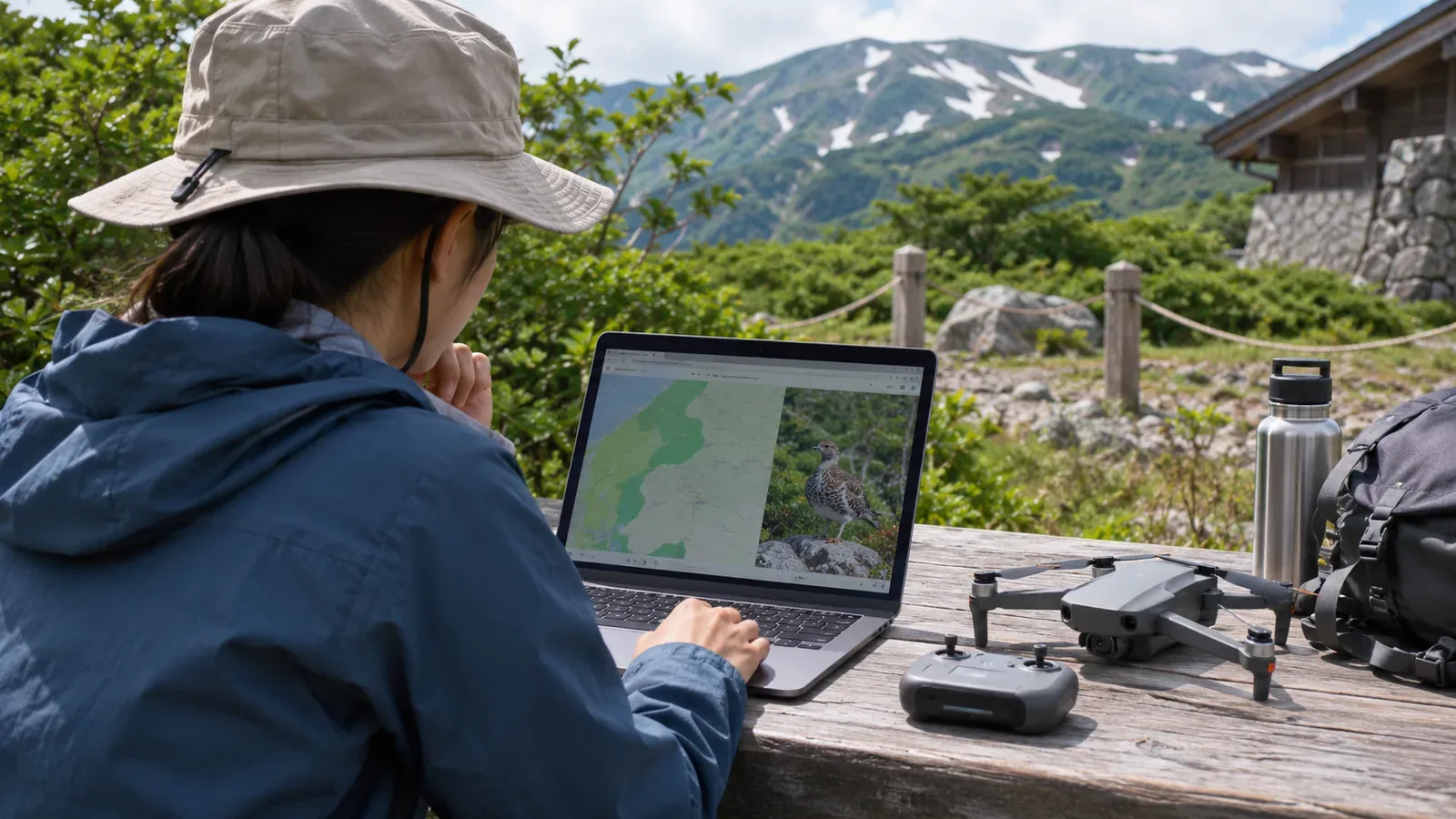
Before flying a drone in a national park, check any work the flight requires, site rules, impacts on wildlife and visitors, and aviation requirements. The environment ministry’s Kanto office explains what to look into before choosing a takeoff and landing site.
Check procedures for flying and related work
The Kanto office explains that flying, taking off or landing a drone in a national park does not in itself require a permit or notification under the Natural Parks Act. If the flight involves installing structures or cutting trees or bamboo, check what procedures those activities require.
Flights are also subject to rules from land and facility managers and other laws, including the Civil Aeronautics Act. Check the guidance for the specific national park. For a quasi-national or prefectural natural park, ask its governing authority.
Four things to check before leaving
Mark your proposed flight path and takeoff and landing sites on a map. Then work through the following four checks.
First, check Natural Parks Act procedures. If you plan to install a structure or cut trees or bamboo, look up the zone and activity in the ministry’s list. Ask its local office in advance if the land is managed by the ministry or if planned work requires an application.
Second, check the land or facility owner’s and manager’s rules. Flying over shrines, temples or park facilities may be prohibited. Give the manager your proposed sites and flight path.
Third, consider wildlife and other visitors. The Kanto office asks operators to avoid flying in habitats and to keep the drone grounded when wildlife is nearby. Stay away from busy trails and rest areas, and from places where privacy is at risk, such as accommodation and outdoor baths. Avoid unnecessary low flying, high-pitched noise and abrupt descents.
Fourth, check aviation law and other regulations. Rivers, lakes and waterfalls may be subject to rules set by managers or local authorities. Flying in a national forest requires a forest entry notification. Check management rules for state land under the environment ministry, and consult the transport ministry for airspace and flight rules.
The Kanto office warns that seriously disturbing visitors, harming wildlife through a crash or collision, or leaving a downed drone behind may violate laws and lead to penalties or restoration orders. When planning the flight path, consider the impact on people and wildlife and what you would do if something went wrong.
Plan takeoff, landing and crash response
Choose a site the pilot can legally enter and where equipment can be brought in. The environment ministry lists entry into designated areas and the use of vehicles or horses in designated places among regulated activities. Compare the zoning map with local access and passage rules.
Give the manager the exact location and planned work and ask about access and equipment transport. For land the environment ministry manages, also ask its local office in advance. Near trails, rest areas and accommodation, consider when people gather and where privacy may be affected.
If the drone falls, determine whether it can be recovered safely. Stay off dangerous slopes and out of restricted areas. If safe recovery is not possible, record the position and ask the site manager or another responsible authority what to do. Avoid flight paths where recovery would be difficult.
The transport ministry requires operators to check for designated emergency response airspace before flying. Drone flights are generally prohibited in these areas to protect search and rescue and other emergency aircraft. Permission to fly in another type of restricted airspace does not cover emergency response airspace. Check the latest designations just before takeoff.
Record what you have verified before leaving
Record takeoff and landing sites, the flight path, owners or managers, any tree cutting or installation, nearby habitats and busy facilities, and your checks on aviation law and procedures for rivers or national forests. Note who confirmed each point and when.
For questions that remain, note whom to ask and what you need to know. Keep the drone grounded at any site with unresolved conditions.
Find the responsible office in the ministry’s national park directory. When asking about Natural Parks Act procedures, describe the proposed location and work to the ministry’s local office or prefectural department and ask where to file. Contact the authorities responsible for other laws separately.
When checking a map or notice on site, stop on stable ground where you will not block the way.
Fly where you have confirmed the requirements
Ask the site manager and check procedures for associated work, impacts on wildlife and visitors, aviation rules and local conditions. Record your findings before leaving and recheck the airspace and local conditions just before flying. Call off the flight if conditions remain unclear or you cannot avoid disturbing people or wildlife.
References and sources
- Japan Ministry of the Environment, Kanto Regional Environment Office: Using drones in national parks
- Japan Ministry of the Environment: National park notifications and permit applications
- Japan Ministry of the Environment: Activities requiring permits or notices in national parks and the relevant forms
- Japan Ministry of Land, Infrastructure, Transport and Tourism: Rules for flying unmanned aircraft
- Japan Ministry of Land, Infrastructure, Transport and Tourism: Restricted airspace and flight methods for unmanned aircraft
- Japan Ministry of the Environment: National park office directory