
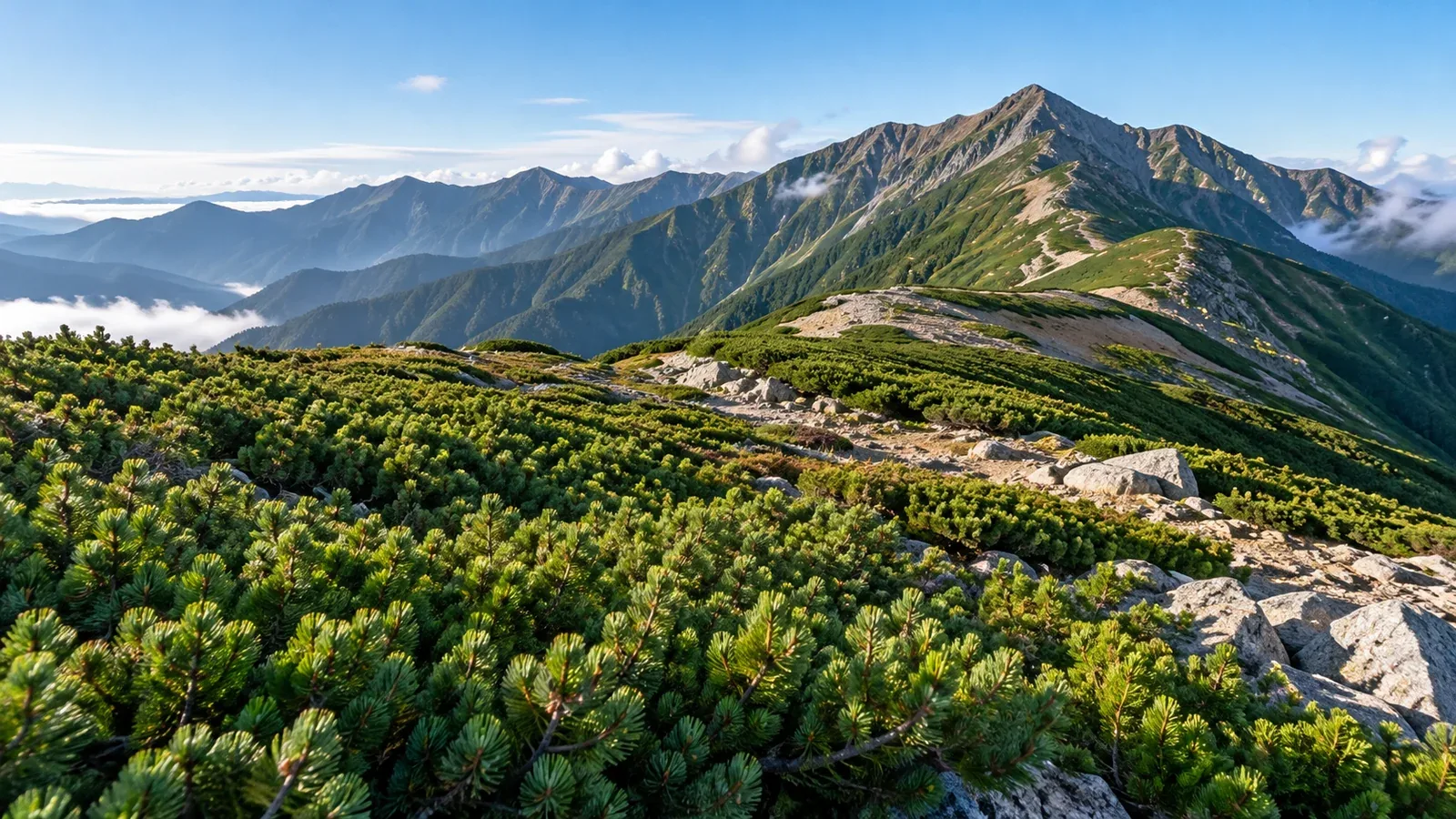
Above the treeline, dark green shrubs spread across the ground. These are dwarf pines. Their shoots grow during the short summer, and in some places the plants spend winter under snow.
Compare the height and spread of the branches and you can see how wind and snow vary even along the same ridge. Look for cones and birds, too.
What is dwarf pine?
Siberian dwarf pine (Pinus pumila) is an evergreen shrub in the pine family. In Japan it occurs in the mountains of Hokkaido and from central Honshu northward. Its stems and branches grow along the ground, and many plants are shorter than a person.
On some mountains, dwarf pine scrub grows above forests of tall conifers and Erman’s birch. In Daisetsuzan and the Japanese Alps it grows among grasslands, rocky ground and areas where snow lingers.
Eurasian nutcrackers remove seeds from the cones and bury them for later. Seeds that are left behind can germinate away from the parent plant. Mature shrubs can also spread when branches in contact with the ground take root.
Low branches and a winter under snow
Strong winter winds carry snow and ice particles across ridges. Branches and needles that extend above the snow can dry out or be damaged by the wind.
Branches close to the ground are less exposed to wind when covered by snow. Snow also buffers sudden changes in air temperature. Where the wind sweeps the snow away, even low branches can remain exposed.
Evergreen needles survive the winter and can resume photosynthesis once snow melts and conditions allow. A cuticle on the needles limits water loss.
Shoot growth varies from year to year and place to place. Japan’s alpine monitoring program measures how much shoots grow in a year and compares that with local temperatures, snow cover and vegetation.
Plants and animals that use dwarf pine scrub
Ground covered by branches sits next to open grass and rock. Different plants and animals make use of these neighboring habitats.
Rock ptarmigan. Rock ptarmigan nest in places such as the shelter of low dwarf pines. They feed on alpine plants on exposed slopes and where snow lingers. Some move near the treeline in winter and feed on buds of Erman’s birch and other plants.
In and around the scrub, leaf litter collects between branches, and light and soil moisture can differ from nearby open areas. From the trail, look for mosses near the pines and lichens on exposed rocks.
On ridges where wind scours away snow and on slopes where snow collects, bare ground appears at different times in spring. Compare the arrangement of pines, grass and rock with the snow that remains.
What to keep in mind when hiking
Watch dwarf pine from the trail. In snow season, assess avalanche terrain separately from the vegetation you see.
Stay out of the scrub
Tangled branches can hide rocks and holes and catch your feet. Keep to the trail even in mud or crowds to avoid damaging the branches and nearby plants.
Check avalanche terrain in snow season
Visible dwarf pine can lie below an avalanche starting zone or along an avalanche path. Check avalanche information, slope angle, wind-loaded areas and the terrain above and below. Turn back if you cannot assess whether you can pass safely.
Tracking a changing climate
Changes in temperature and snowmelt can affect shoot growth and the boundary with neighboring plants. Japan’s Ministry of the Environment monitors temperature, vegetation and dwarf pine shoot growth at multiple mountains.
Four things to look for from the trail
Stop at a spot with a good view and compare branches, terrain, snow and bird activity.
- Edges of the scrub. Compare where tall trees, dwarf pine and grass appear along the ridge and down the slope.
- Remaining snow. Compare the pattern of plants in hollows where snow lingers with places where it melted earlier.
- Cones and birds. As cones mature, you may see nutcrackers extracting seeds.
- Branch height. Compare how high the branches grow and which way they extend on an exposed ridge and on the slope just below.
What to check before the hike
Check local trail and vegetation protection guidance, and look at maps or trail photos to find where your route enters dwarf pine scrub. From the trail, compare the spread of the shrubs, the slope’s direction and the patches of remaining snow.
Sources for further reading
- Japan’s alpine monitoring program and Takuya Kajimoto’s research on dwarf pine ecology.
- Mitsuhiro Hayashida’s research on seed dispersal by Eurasian nutcrackers.
- Ministry of the Environment materials on rock ptarmigan conservation and national parks.
- Japan Avalanche Network’s guide to avalanche terrain.
References and sources
- Ministry of the Environment: Monitoring Sites 1000, second alpine survey report
- Takuya Kajimoto: ecology, growth and regeneration of dwarf pine
- Mitsuhiro Hayashida: seed dispersal of dwarf pine by the Eurasian nutcracker
- Ministry of the Environment: rock ptarmigan conservation and recovery
- Ministry of the Environment: fifth Red Data Book, birds
- Ministry of the Environment: features of Minami Alps National Park
- Shin’etsu Nature Conservation Office: advice for winter visitors to Tateyama Murodō
- Ministry of the Environment: trail management in Daisetsuzan National Park
- Japan Avalanche Network: what makes terrain exposed to avalanches?