
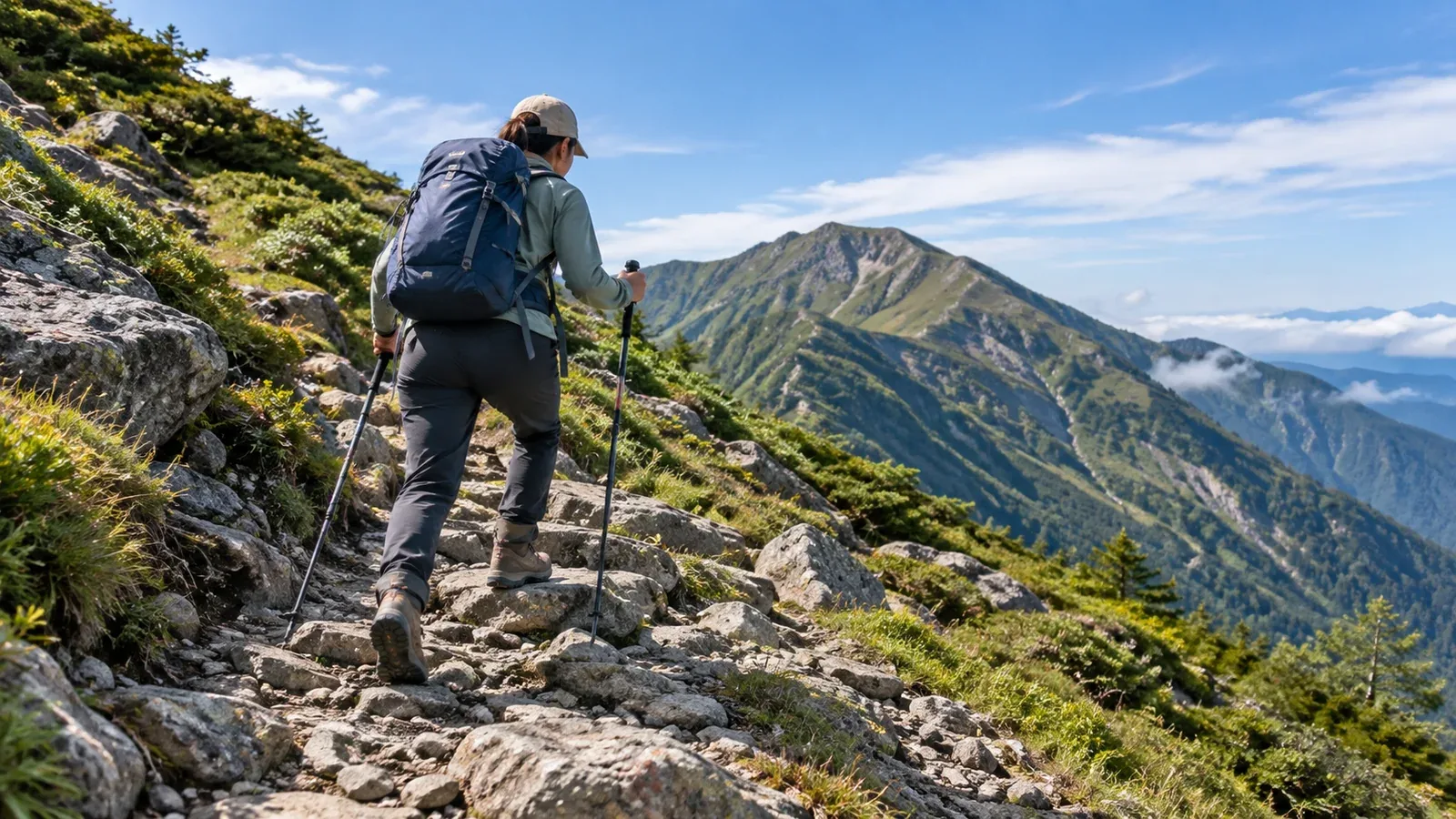
Even on the same trail, a change in slope or surface can call for a different stride and different footholds. Descents can bring on fatigue, so slow down and check each step.
Here are three things to pay attention to on a trail: your footholds, your upper body, and your shoulders and arms.
Why the slope and surface change how you walk
Rocks, roots, mud and steps can follow one another on a mountain trail. When there is little room to place your feet or the surface is slippery, it is hard to use the same stride and pace as on level ground.
A shifting pack or tired legs that are hard to lift make it harder to balance. Slow to a speed at which you can stop before reaching a change in the terrain.
Three points to check as you walk
Where you place your feet
On a climb, look for a step or surface where you can place your foot securely. Take shorter steps and transfer your weight once the next foot is steady.
On a descent, reaching far ahead in a hurry makes it harder to stop. Look at the next foothold first, take a short step and transfer weight to it gradually.
Upper body and where you look
Your upper body changes angle as the slope changes. If you find yourself leaning a long way forward or back, reconsider your stride and where you put your feet.
Look between the next foothold and the terrain a little further ahead. Stop somewhere safe if you want to read a sign or take in the view.
Shoulders and arms
If your shoulders stay tense or your pack sways from side to side, stop and check how the load is distributed and how the straps fit.
If you use trekking poles, practise on easy ground first and place the tips where they are unlikely to slip. On rock or chain-assisted sections where you need your hands, stow the poles to keep both hands free.
What to change uphill and downhill
Foot placement and speed change between uphill and downhill walking. In both directions, go at a pace that lets you stop when needed.
Uphill, take short steps and look for a surface where your foot can sit securely. If a steep slope leaves you out of breath, slow down or rest somewhere safe.
Downhill, keep taking short steps as you tire. On wet rocks or leaves, check the foothold before transferring your weight and avoid running downhill.
Take a break when fatigue shows
If your walking starts to change, stop where others can pass safely and where there is little risk from falling rock.
- You trip over roots or steps more often
- You struggle to lift your feet and start to drag them
- Your pack sways and pulls to one side
- You have trouble stopping where you want to
- Leg or back pain changes how you walk
Take a break, have something to eat and drink, and check how you feel and what remains of the route. If your footing stays unsteady, work out a shorter, safer way back with your companions.
Practising on nearby hills
On a short, maintained path, you can try one adjustment at a time on gentle climbs and descents. Avoid practising on wet, steep slopes or where footholds are narrow.
Walk a short stretch with smaller steps than usual and notice where you can place your feet to stop easily. Change one thing at a time, then think about what felt easier when you are back.
If knee or back pain is severe or persists, seek medical advice before increasing your effort.
Try a short descent
Find a brief downhill stretch on a maintained path nearby. Look ahead to your next foothold, shorten your stride and go slowly enough to stop easily. You can find walking partners through the Nordwand community.