
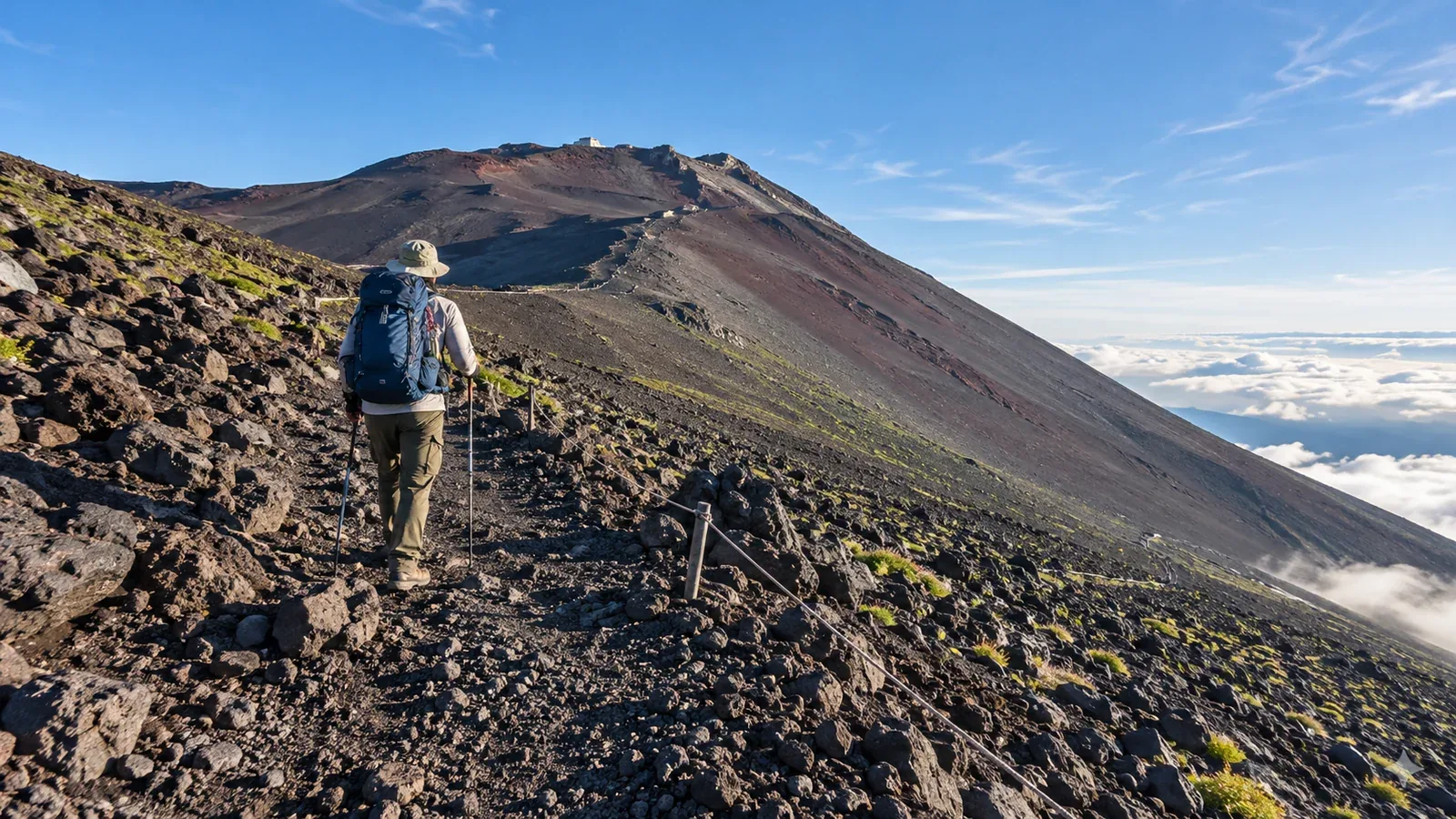
Gotemba’s wide volcanic slopes can feel quieter than the busiest parts of Mount Fuji. This route also starts lower than the others and demands the longest climb. Decide whether its length, sparse services and open terrain suit your group before choosing it for the quieter trail.
Look at the ascent, descent and ways to get back from the New 5th Station. Plan for enough daylight, food, water and time to turn back if the group slows or conditions change.
Why the ascent is long
The official guide puts Gotemba’s New 5th Station at 1,440 m, well below the Fuji-Subaru Line 5th Station at 2,305 m and the Fujinomiya 5th Station at 2,400 m.
Gotemba gains about 2,300 m to the summit area. The official figures are 10.5 km and about 8 hours 40 minutes uphill and 8.4 km and about 3 hours 30 minutes downhill, excluding breaks and any crater-rim detour. Confirm the seasonal bus from Gotemba Station or the road to the New 5th Station.
There are few huts and no first-aid center listed for this route. You may spend long stretches without shelter or other hikers nearby. Know how to locate yourself and call for help.
Terrain and weather on Gotemba
The lower ascent crosses broad volcanic gravel with few landmarks. The slope becomes steeper above the 6th Station and rougher and rockier higher up. The signed descent uses the Ōsunabashiri lower down.
The open slope offers little shade or wind protection. Sun, wind, low cloud and lightning can change the difficulty quickly. Check the forecast and local notices, and stop where it’s safe to reassess if visibility deteriorates.
The Ōsunabashiri is about 5 km of volcanic gravel according to the official guide. Use short, controlled steps and keep space between people. Gaiters and eye protection can help with grit. Stop in a stable place to clear gravel from your boots.
What to consider before choosing Gotemba
This route combines a long climb, high altitude, open ground and few services. Use your recent experience to judge how your group will handle those conditions.
Experience that helps
- You have completed long climbs and sustained descents on comparable terrain with energy in reserve.
- You know how you respond to hours of movement with a pack and what you need to eat and drink along the way.
- You can follow a marked route in poor visibility, identify when to turn back and account for relevant joint or health concerns.
Choose a shorter route or gain experience on other mountains if Gotemba is beyond your group’s recent outings. If choosing Gotemba, a hut stay and an experienced companion or guide can give you more options. Confirm bookings and the distance you can safely cover.
Plan around gaps between huts: There is no hut at the New 5th Station itself. Oishi-Chaya is a short walk above it, and the official directory lists a long gap before the New 6th Station. Verify availability directly, carry sufficient food and water and avoid counting on unconfirmed supplies.
Season, entry and crowds
The 2026 Gotemba season ran from July 10 at 09:00 to September 10 at 17:00. The official outlook for 2027 is early July to early September, with exact dates to be announced. Summit trails close outside the season. Check Gotemba’s trail notices and the crater rim separately.
Crowds and bus availability vary with the date and conditions. In 2026 the Gotemba access road had no seasonal private-car restriction. Weather and road closures can still prevent access. Check the latest road and bus information both ways.
In 2026 Shizuoka charged ¥4,000 per climber and required safety training and entry procedures. A hut booking was required for entry from 14:00 to 03:00. FUJI NAVI offered advance registration, and people without smartphones could complete the procedure at the trailhead. Check the current season’s rules.
Equipment and planning for the distance
Base your plan on the actual hours, terrain and distance between services, and leave room to return early.
Pace: Begin slowly and schedule enough time to rest, navigate and descend. Use the slowest person’s pace and an agreed turnaround time. Stop ascending if altitude symptoms develop.
Food and water: Carry enough for the weather, planned time and delays. Check the services and opening hours for any hut you intend to use. Bring food you can eat easily during a short break.
Clothing: Bring dry insulation, waterproof and windproof outerwear, gloves and a hat. Keep sun protection, a headlamp and a spare light accessible.
Route and exit options: Follow the green Gotemba signs. Near the 6th Station on descent, the Mount Hōei branch can take you toward Fujinomiya, a different trailhead with different transport. Check whether the branch is open and suitable before relying on it. Keep an offline map and a backup.
Before you go
Confirm trail opening, Shizuoka’s entry rules and the last return transport. Compare the climb and descent with your recent hikes and choose a turnaround point. Nordwand can help you find a guide familiar with the route.
Sources
- Official Mount Fuji climbing website: Gotemba route and huts
- Shizuoka Prefecture: entry and road conditions
- Japan Meteorological Agency: forecasts and warnings
References and sources
- Official Mount Fuji climbing website — Trail comparison and access
- Official Mount Fuji climbing website — Current season outlook
- Official Mount Fuji climbing website — Trail openings and facilities
- Shizuoka Prefecture — Entry requirements
- Official Mount Fuji climbing website — Signs and junctions
- Japan Meteorological Agency — Weather forecasts
- Official Mount Fuji climbing website — Gotemba huts
- Shizuoka Prefecture — Roads around Mount Fuji