
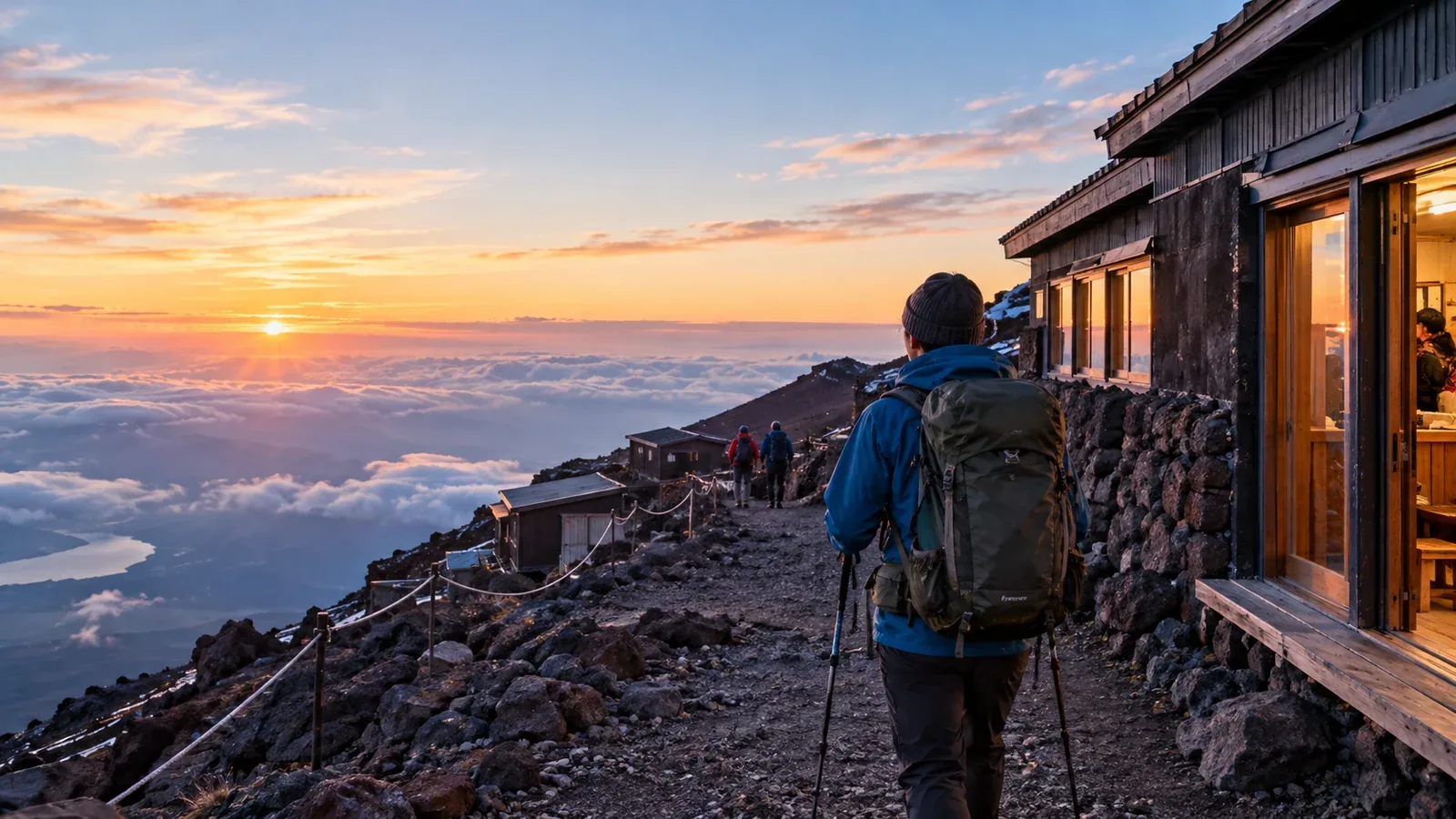
Once you’ve chosen a Mount Fuji route, the next decision is where to stop for the night. Booking dates, prices and meal options differ by hut. The elevation and location of your hut shape how long you’ll hike on both days.
Start checking your preferred huts before the climbing season. Popular dates can fill quickly once bookings open. Compare the huts along the route, how far your group can comfortably walk and what’s included in each booking.
Use the hut’s official page or booking service for current prices, opening dates and availability. The 2026 season has ended, and the official 2027 outlook is early July to early September, with exact dates still to come.
Why split the climb over two days?
Mount Fuji reaches 3,776 m. Walking estimates differ by trail. On Yoshida, for example, the official guide gives about 6 hours 10 minutes up and 3 hours 35 minutes down from the 5th Station, excluding breaks and any extra walking at the crater.
An overnight stay can split the ascent and give you time to rest. Some hikers watch sunrise from the hut and continue in daylight. You are still sleeping at altitude. Stop ascending if symptoms develop and change the plan if conditions worsen.
When to look and book
Huts operate during the climbing season, but each hut opens reservations on its own schedule. Check the listed date and time well before your trip, especially for summer weekends or the Obon holiday period.
Use these steps to keep more options open.
- Before bookings open: Make a short list of huts on your route and keep two or three dates in mind. Note when each one starts taking reservations. Hinodekan, for example, opened its 2026 bookings on April 11 at 09:00 Japan time.
- When a booking window opens: Check the hut’s location, check-in and cancellation conditions before you book.
- If your first choice is full: Look for a weekday, ask about cancellations or adjust the route if another hut suits your pace. Avoid an overnight summit push as a substitute.
Some huts use their own online form, some take phone bookings and others use a booking service. Follow the operator’s instructions and make sure you have a confirmation.
What the price includes
A hut may offer a bed only, one meal or dinner and breakfast. Check the rate for your date and party, including any extras. Huts are basic accommodation with limited water and facilities. In 2026, Fuji-san Hotel on the Yoshida Trail listed rates of ¥9,300–11,800 for lodging only and ¥12,000–14,500 with dinner and breakfast per person, depending on the day. Use the hut’s current rates for your budget.
Compare these details before paying.
- Meals: Check which meals are included and their serving times. Ask in advance about dietary needs and bring suitable food if the hut cannot accommodate them.
- Bedding: Confirm what is provided and what you need to bring.
- Shared rooms: Check the sleeping arrangement and whether private space is available.
- Payment and cancellation: Check accepted payment methods, deposits, deadlines and how the hut handles weather or trail closures.
The hut rate is separate from the trail fee and transport. In 2026 the climbing fee was ¥4,000 per person on each route. Check the current season’s tariff and save room in the budget for transport, drinks and toilet charges where applicable.
How to choose the hut
The four routes have different hut locations. Choose a stop you can reach by check-in time while moving at the group’s pace.
Elevation: A higher hut shortens the remaining ascent but means spending more time at altitude. A lower hut can shorten the first day and leaves more walking for the second. Decide based on pace, altitude experience and safe options if anyone needs to descend.
Route: Check the hut is on your chosen trail and on the side you plan to approach. Yoshida has more huts, mostly on its ascent. Gotemba has longer gaps. Use the official directory for your route and confirm opening dates with the hut.
Booking checklist
- Hut and check-in are on the intended route.
- Elevation and each day’s walking time fit the group.
- Meals, bedding and extra charges are clear.
- Payment, cancellation and contact method are confirmed.
- Confirmation is printed or saved for offline access.
After you book
Put the hut details, transport and trail rules in the same itinerary. Plan an early return option if weather, symptoms or delays make the original plan unsafe.
Check the forecast: Review the Japan Meteorological Agency forecast and official trail notices before travel and again on the day. Factor in wind, lightning, rain and low visibility when deciding whether to go.
Check entry and closures: A hut booking is separate from paying the climbing fee and completing entry procedures. Check the prefectural instructions for your route. Keep proof of the hut reservation available offline if it is needed at the gate.
Tell the hut if your plans change: Follow its cancellation or late-arrival instructions. Update the person who has your hiking plan and any travel companions too.
Before you go
Pick a route and two or three dates, then compare huts you can reach comfortably. Check each operator’s reservation date, rate and conditions before paying. Nordwand’s Base Camp is a place to ask other hikers about their experience on the same route.
Sources
- Official Mount Fuji climbing website: route comparison and hut directories
- Yamanashi Prefecture: Yoshida Trail rules
- Shizuoka Prefecture: climbing regulations
- Japan Meteorological Agency: forecasts and warnings
References and sources
- Official Mount Fuji climbing website — Current season outlook
- Yamanashi Prefecture — Yoshida Trail rules
- Shizuoka Prefecture — Entry requirements
- Japan Meteorological Agency — Weather forecasts
- Official Mount Fuji climbing website — Trail comparison
- Official Mount Fuji climbing website — Yoshida hut directory
- Official Mount Fuji climbing website — Gotemba hut directory
- Hinodekan — 2026 booking opening
- Fuji-san Hotel — 2026 rates