
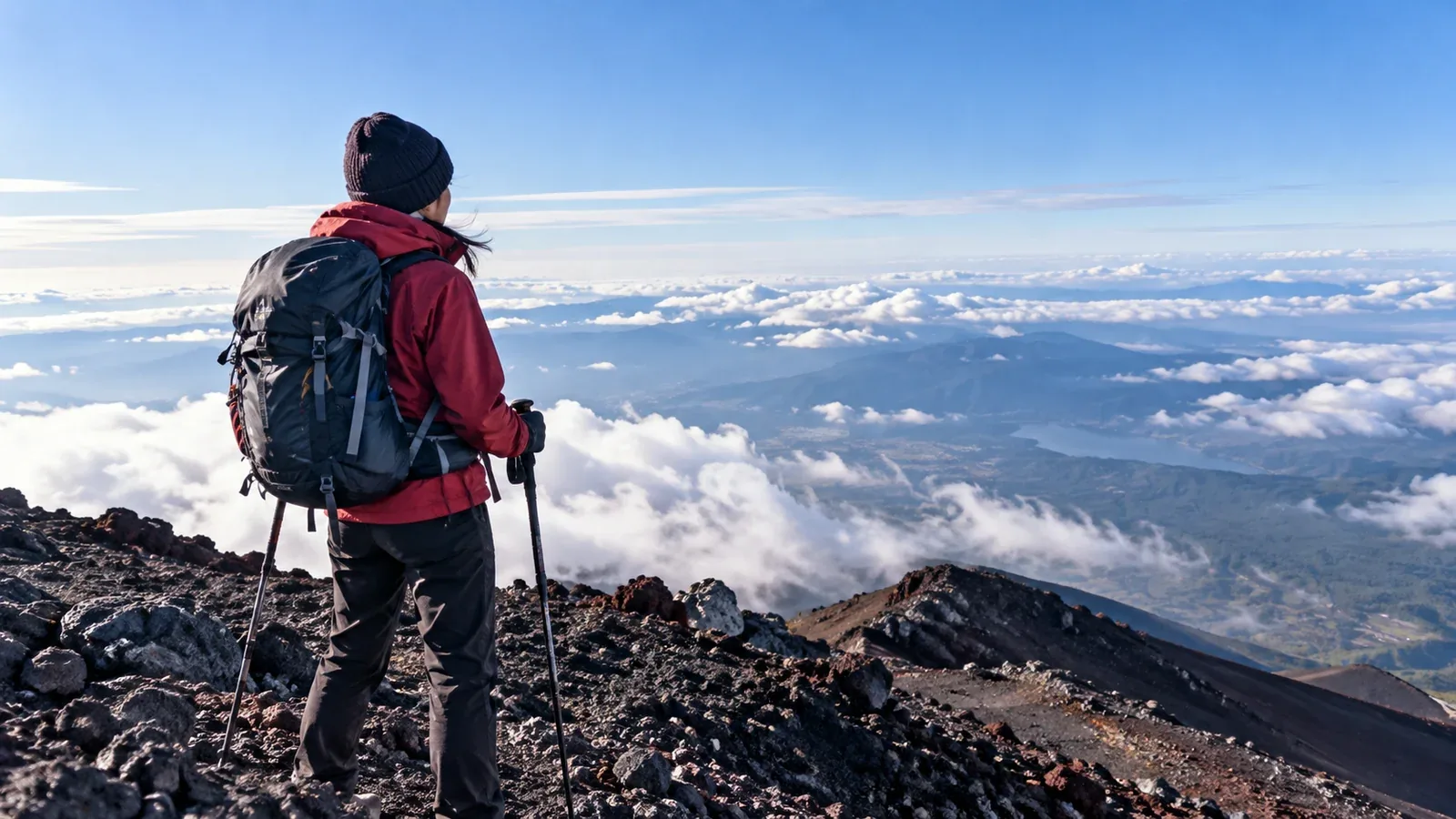
A warm start at the trailhead tells you little about how the upper mountain will feel. On Mount Fuji, the temperature drops with elevation, and wind and rain can chill you quickly, especially when you stop.
The summit reaches 3,776 m and can be near freezing during the summer climbing season. Pack warm layers you can put on quickly, as well as separate waterproof jacket and trousers. Summit trails close outside the summer climbing season.
Choose clothing that can handle a warm climb, an exposed stop and a cold or wet descent. Check the route and summit forecast before deciding how much insulation to carry.
Why it can feel wintry in summer
Mount Fuji’s official site gives a rough temperature decrease of 0.6°C per 100 m of ascent. The Yoshida trailhead is at about 2,305 m, nearly 1,500 m below Kengamine. That rule of thumb suggests a difference of about 9°C. The actual difference varies with weather.
The Japan Meteorological Agency lists an August mean of 6.4°C at the summit station, at 3,775 m. A mean is different from the temperature at a particular hour. Official climbing guidance warns that freezing conditions can occur even in summer.
The mountain is exposed, and wind increases heat loss from your body. Wet clothes can make you cool faster. Wind chill depends on the air temperature and wind speed, so check both and prepare for how long you might be standing still.
Dress in layers you can adjust
Three layers let you manage sweat on the climb, keep warmth at stops and block wind and rain higher up.
What each layer does
Base layer: Choose a quick-drying fabric such as polyester or suitable wool. It moves sweat away from the skin. Cotton stays damp longer and can chill you when you stop.
Insulating layer: A fleece or a lightweight insulated jacket traps warmth. Pack enough insulation for a cold, windy pause. Keep this layer dry and within reach.
Outer layer: A waterproof jacket and trousers block rain and wind. Check that they fit over the warm layers and that you can use the hood and cuffs with gloves on.
What to pack by body area
Upper body
- Base: A quick-drying short- or long-sleeved top.
- Insulation: A fleece or insulated jacket for stops and the upper mountain.
- Shell: A waterproof, windproof hiking jacket that you can wear over the other layers.
If you start in short sleeves, have a long-sleeved layer you can put on quickly for cold, wind or strong sun.
Lower body
Choose hiking trousers that dry readily and let you move freely. Denim is heavy and slow to dry. Waterproof overtrousers also block wind. If you expect a cold start or a long stop, pack a warm layer that fits beneath them.
Hands, head and neck
Bring gloves, a warm hat and a neck gaiter if useful for the summit and exposed sections. Keep them accessible. A brimmed hat can help protect you from the sun lower down.
Footwear and socks
Wear hiking footwear that fits securely and grips rock and loose gravel. Check the soles before leaving and wear socks you’ve tested on a hike. Bring a dry pair in a waterproof bag.
Four common clothing mistakes
1. Leaving rain gear behind when the forecast looks clear. Keep a separate waterproof jacket and trousers in the pack. Weather can change while you’re far from shelter.
2. Waiting until you’re very cold to add insulation. Put on a dry layer before a long stop or when you first begin to chill. If someone becomes confused or has trouble moving in the cold, shelter them and get urgent help.
3. Dressing for the 5th Station alone. Check conditions higher up, including wind, precipitation and the coldest part of the day. Pack for delays as well as continuous movement.
4. Choosing a fabric by its label alone. Check how well it dries and fits with the other layers. Keep a dry change of clothes sealed in the pack.
Before leaving for the trailhead
Check official weather, closures and the current season’s gear rules. In 2026 the Yoshida gate checked for warm clothing, two-piece rainwear and suitable hiking footwear. Confirm the rules for your route and season. Look for the summit forecast as well as updates at the trailhead.
File a hiking plan where applicable and share it with someone who is staying behind. A trail-entry payment and a hiking plan serve different purposes.
Before you go
Try on your layers together, check your footwear and pack the shell and insulation where you can reach them. Review the forecast just before leaving. Nordwand’s Base Camp is a place to ask about recent conditions on your intended route.
Sources
- Japan Meteorological Agency: summit climate normals and weather forecasts
- Official Mount Fuji climbing website: gear and clothing
- Yamanashi Prefecture: 2026 Yoshida equipment check
- Shizuoka Prefecture: entry requirements
References and sources
- Official Mount Fuji climbing website — Equipment and current season
- Yamanashi Prefecture — 2026 Yoshida equipment check
- Japan Meteorological Agency — Forecasts
- Japan Meteorological Agency — Mount Fuji climate normals
- Official Mount Fuji climbing website — Mountain risks
- U.S. National Weather Service — Wind chill
- Shizuoka Prefecture — Entry requirements