
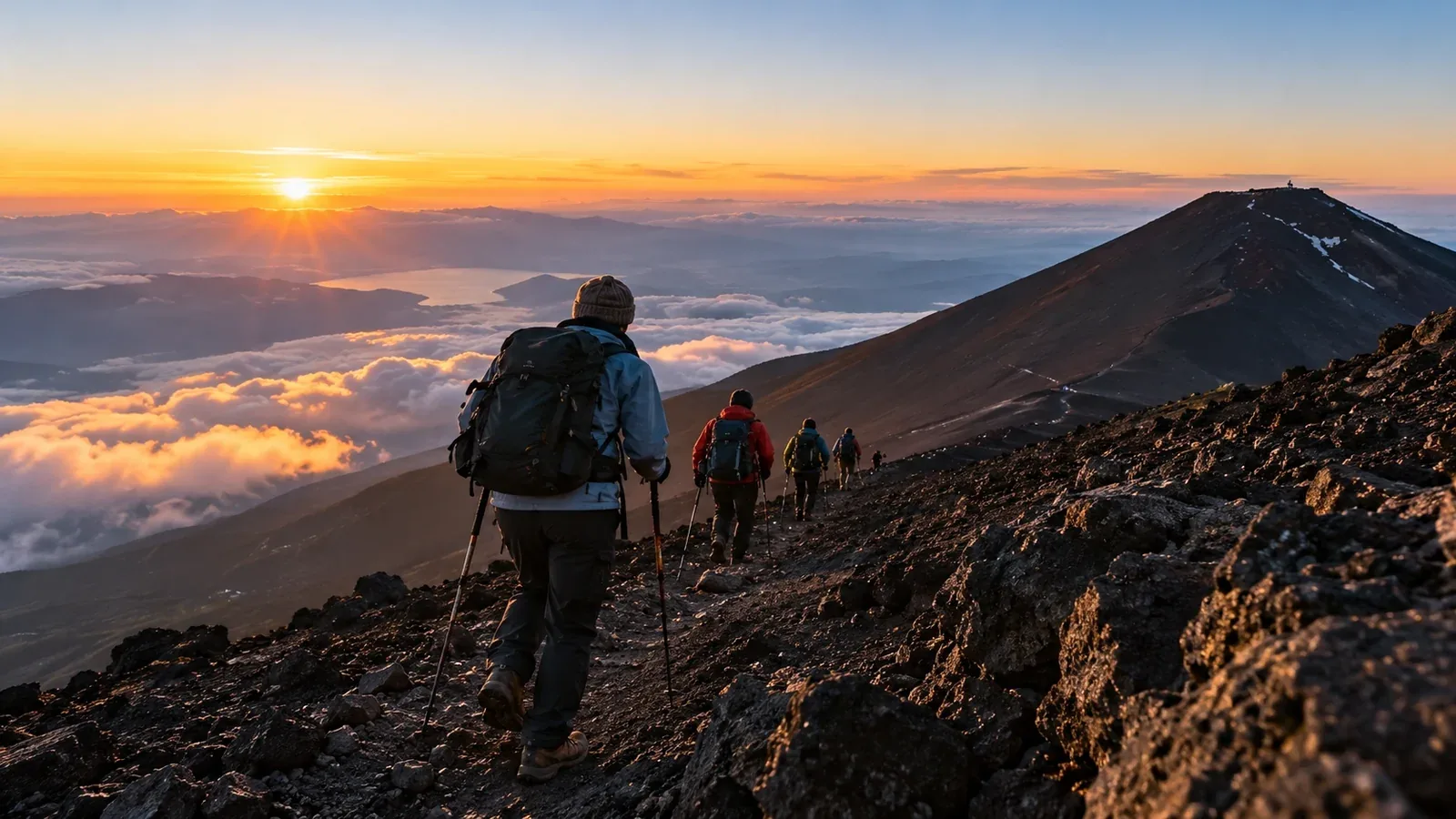
Leaving after work, hiking all night for sunrise and descending the same morning can sound like a way to save a night’s lodging. Mount Fuji’s official guidance calls this an overnight “bullet climb.” The combination of rapid altitude gain, little sleep, darkness and exposure raises the risk of illness and injury.
Plan for time at altitude, sleep and a safe descent. This article explains the risks, describes the 2026 restrictions and gives ways to see the sunrise without trying to reach the summit overnight.
Three risks that can build overnight
Rapid ascent and altitude illness
Mount Fuji’s highest point, Kengamine, is 3,776 m. Air pressure decreases with altitude. The oxygen fraction remains much the same, but less oxygen is available with each breath. Your body needs time to adjust.
The four 5th Stations range from about 1,440 to 2,400 m. Climbing rapidly to the upper mountain can cause headache, nausea, dizziness or unusual fatigue. Fitness alone offers no protection against altitude illness. Stop ascending if symptoms appear. Descend if symptoms worsen, and seek urgent help for confusion, poor coordination or breathlessness at rest.
Little sleep and a long descent
Climbing after a day awake can leave you tired before you start. Rock and loose volcanic gravel demand attention, and a headlamp gives only a partial view of the trail. Fatigue can make it harder to place each foot or notice a fork.
The descent still takes hours. Use the official times for your route, then allow for slower movement, breaks, crowds and any crater-rim walking. Leave enough energy and time to get back to your transport.
Cold and changing weather in the dark
Even in summer, exposed slopes and the summit can be cold. Wind and wet clothing can cool you quickly, especially if you stand in a queue. Pack dry insulation and wind and rain protection that you can put on without unpacking everything.
The weather and footing can be hard to assess in darkness. Huts have their own hours and may have limited capacity. Plan where you can turn back or get help before you leave.
How the entry restrictions worked in 2026
The prefectures introduced rules to address nighttime climbing, crowding, safety and conservation. The 2026 season has ended. The next season is tentatively early July to early September 2027, with exact dates and rules still to be confirmed.
Gate and entry hours
In 2026, the Yoshida 5th Station gate restricted entry from 14:00 to 03:00, with an exception for people staying at a mountain hut. The rule concerned entry. Shizuoka also required a hut stay for entry during those hours on Fujinomiya, Gotemba and Subashiri.
Fees and the daily limit
The fee was ¥4,000 per person on all four trails in 2026. Yoshida had a 4,000-person daily limit with an exception for hut guests. Shizuoka required a safety lesson and entry procedures and had no daily cap. FUJI NAVI offered advance registration, with on-site processing available for people without a smartphone.
Check the current rules for your route before making travel arrangements. An entry slot is separate from a hut booking. Plan around the last bus or shuttle as well as the gate.
An alternative: a hut stay and a two-day itinerary
A hut stay lets you rest and split the climb. It still involves sleeping at altitude. Choose a hut you can reach comfortably and keep your turnaround plan if symptoms, weather or timing change.
Allow time at the 5th Station
The official Mount Fuji guide suggests resting near the 5th Station for about one to two hours before starting. Use the time to eat, drink and check the group. Continue with a gradual pace and watch for symptoms throughout the climb.
Choose a hut your group can reach
Compare the huts on your chosen route, their elevations and check-in times. Book directly. The best stopping point is one the group can reach without rushing. If someone has symptoms of altitude illness, stop ascending and reconsider the booking.
See sunrise from a hut or a suitable lower viewpoint
Check which huts and viewpoints face sunrise on your route. Watching from a hut can let you climb after daylight and avoid some of the busiest upper sections. You can also decide to descend after sunrise if the conditions have changed.
Leave time for descent
Calculate descent time from your route, conditions and group pace. Include food breaks, the last bus and a margin before sunset. If the group falls behind, turn back while a safe descent remains possible.
Equipment and weather checks
Prepare for cold, wind and rain, even if the forecast at the trailhead is mild.
- Dry insulation and weatherproof layers: Bring warmth for stops and exposed sections.
- A headlamp and spare power: Carry a hands-free light even on a daylight plan.
- Rain jacket and trousers: Use them to keep wind and water off. Wear suitable hiking footwear for rock and gravel.
- Water and food: Carry enough for delays and avoid relying on closed or full huts.
- Sun protection: Pack sunscreen and sunglasses for exposed terrain in daylight.
Check the Japan Meteorological Agency forecast and local trail reports the evening before and the day of your climb. Delay or change the plan when wind, lightning, rain or visibility makes the route unsafe.
Before you go
Confirm the dates, entry rules, hut availability and transport for your route. Choose a sunrise viewpoint and a turnaround time before leaving. Nordwand’s Base Camp can help you find people who have experience on the same route.
Sources
- Official Mount Fuji climbing website: bullet climbing and safety
- Yamanashi Prefecture: Yoshida Trail rules
- Shizuoka Prefecture: entry requirements
- Japan Meteorological Agency: forecasts and warnings
References and sources
- Official Mount Fuji climbing website — Current season outlook
- Yamanashi Prefecture — Yoshida Trail rules
- Shizuoka Prefecture — Entry requirements
- Japan Meteorological Agency — Weather forecasts
- Official Mount Fuji climbing website — Mount Fuji health and safety
- Official Mount Fuji climbing website — Yoshida model itineraries
- Official Mount Fuji climbing website — Sunrise options
- CDC Yellow Book — Altitude illness