
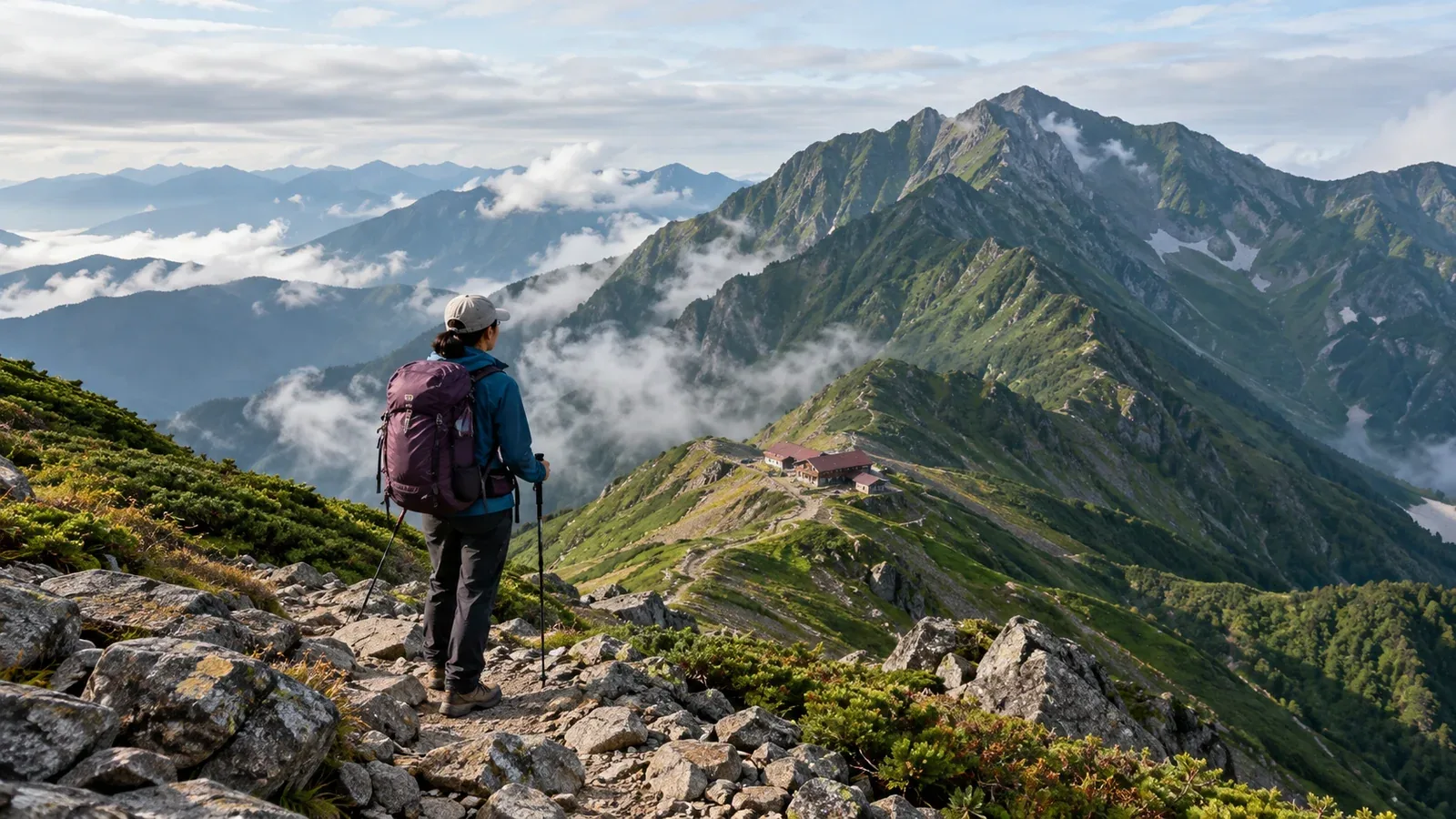
A Japanese hiking plan may have a field for an escape route. It can seem unnecessary when the ordinary descent looks straightforward. If you leave it until you need it, however, you may look for a way off the mountain that does not exist.
An escape route is an alternative way down early and safely when you can no longer follow the planned route. A sudden weather change, feeling unwell, a companion’s injury or falling far behind schedule can all make the planned descent impractical. Turning back can work, but retracing a difficult ridge section may be more dangerous once you are past it. Decide in advance which valley you could descend into or which hut you could go through.
Why plan it before you leave?
Fatigue and bad weather make decisions harder. You may have neither the energy nor the time to spread out a map or look something up on your phone. Choose escape routes at home with a map, while you can consider them calmly.
Planning lets you share the option with companions, family and whoever receives your hiking notification. A route on the plan can help a search. If you write which trailhead you will descend to in bad weather, the person picking you up knows where to go.
How to choose an escape route
Where can you leave the main route?
Look on a topographic map or in a guidebook for other descent paths crossing or near your route. Check the following.
- Where the junction is. A junction before the midpoint may give you an option while you still have energy. If the only branch is much later, consider turning back first.
- Transport at the exit. If there is no bus stop or car park where you come out, plan how you will travel onward. Save a taxi number and check mobile coverage in advance.
- Difficulty. Choose a route of similar or lower difficulty, since you may need it when conditions are poor or people are tired. Avoid technical ridges or long chain-assisted sections as an escape.
- Distance and elevation. A long descent can still leave you racing the sunset. Estimate walking time from the map.
When turning back makes sense
Before planning a separate route, consider whether you can retrace your steps. If the outward journey included a steep descent, climbing back up when tired may be harder than coming down. The proportion of the route you have covered does not settle the decision. Compare the return with an exit ahead, taking into account terrain already crossed, your location, weather, skills, remaining energy and time. Decide early.
How to put it in your plan
- Mark the junctions when drawing your route. Find trails and forest roads that cross the main route and identify possible directions of descent on the map.
- Estimate time from each junction to a trailhead or village. Use guidebook or map timings and write the estimate in the plan.
- Note transport at each exit. Record bus availability and a taxi number you can use from the area. Bus schedules vary by season and day, so check the operator or local tourism office.
- Set a point beyond which returning would be difficult. Identify a place such as the start of a rocky ridge or chain section. When you reach it, use the weather and the group’s energy to decide whether to continue.
- Record, submit and share the plan. Include the escape route in the hiking notification, whether you use a trailhead box, the police or an online system. Tell family or friends too.
Common mistakes and details to check
An escape route may still be difficult. A short line on the map may be a barely visible old path, require a river crossing or pass through dense dwarf bamboo. Even with a major trail, check whether you can safely reach it from your position.
The exit route may be closed. Forest roads can collapse, bridges can wash out and winter closures are common. Check with the local authority or hut when planning.
Insurance and emergency communications are part of the plan. Consider mountain insurance, what it covers for helicopter rescue and how to communicate where phones do not work, for example with a suitable radio or satellite device. This matters if weather or injury leaves you unable to descend. A guide or specialist shop can advise on your needs.
How planning helps you avoid needing the escape route
Thinking through an escape route helps you decide earlier. Rather than continuing until your options disappear, set a decision point in advance: at that junction, if the conditions you agreed on are met, take the descent.
If you are well behind schedule before halfway, the weather is deteriorating earlier than forecast and a companion is slowing noticeably, using the escape route is a sound decision.
What to do next
Open your next hiking plan, find a junction and add the way down and its estimated walking time. If you are unsure how to choose it, ask a certified Nordwand guide. Check where to submit the hiking notification, for example the prefectural police’s online system or the box at the trailhead.
References
- National Police Agency and prefectural police: mountain incident statistics
- Geospatial Information Authority of Japan: GSI Maps
- Prefectural guidance on filing a hiking notification or trip plan