
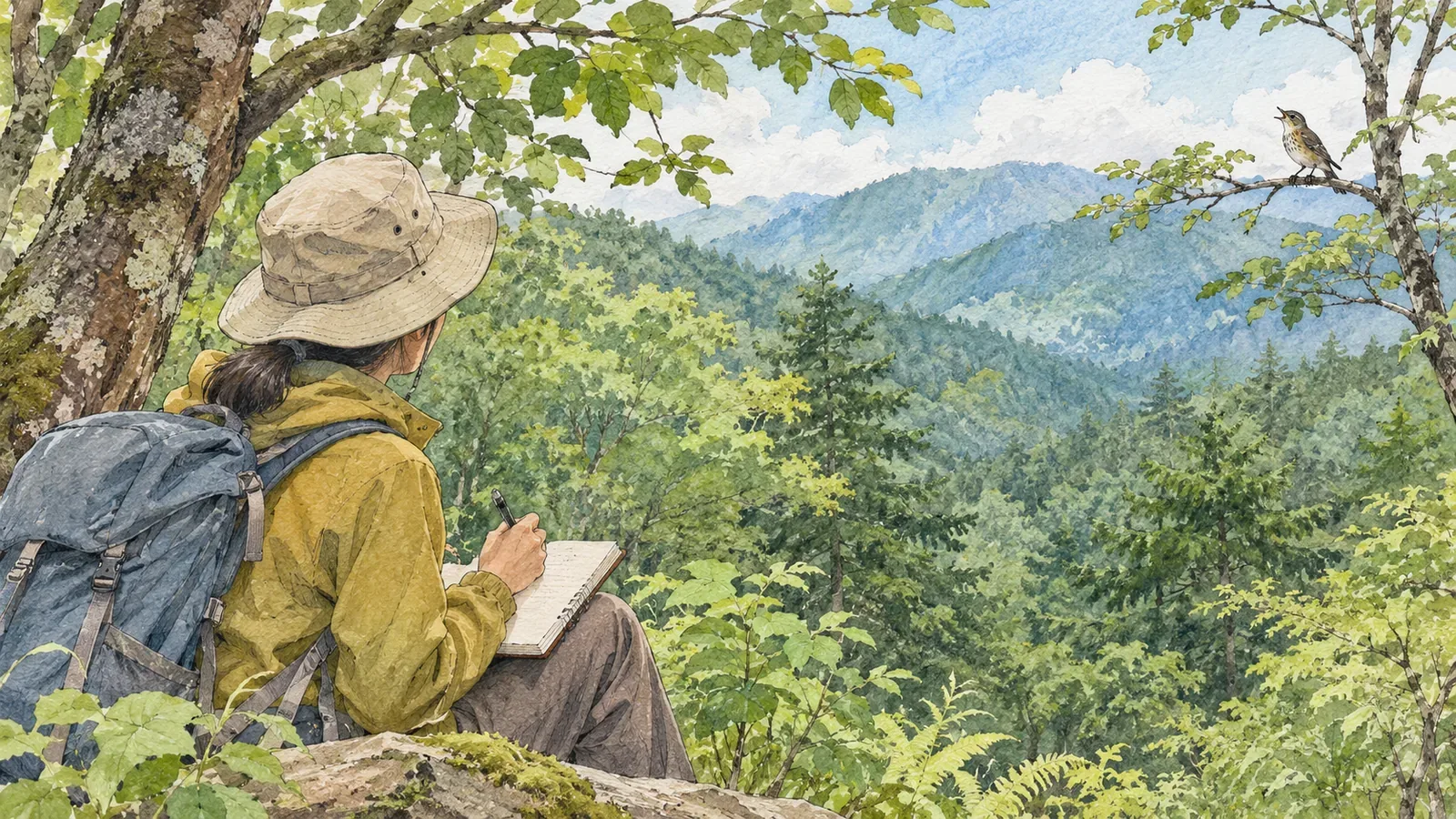
A bird that sounds loud in the woods can seem to be just beside you. Hearing it tells you that a bird called, while its distance may still be unclear. When you can’t see the bird or the surroundings, avoid assuming it’s nearby from volume alone. You can enjoy the sounds of the mountains by stopping somewhere suitable and taking notes without following the call.
Loudness offers only one clue about distance
A call that sounded loud is worth recording in your notes. By ear alone, you may be unable to tell how loudly the bird called, which direction it was facing, or how the terrain and other sounds affected what you heard. Write “sounded loud” and keep the bird’s location separate.
Even in one place, wind, running water, and conversations can change how you hear the call. You can note how it sounds when you turn, together with the other sounds around you. A louder sound after turning slightly gives no precise bearing or distance. If you lack the information, leave the distance unknown.
Equipment settings and playback volume also change how a recording sounds. You can turn up a quiet clip, so loud playback tells you little about how close the bird was. Note the settings if you know them and keep what you heard in the field separate from what you heard on playback.
What the research can tell us
Researchers have studied how birds judge distance from sound. In a laboratory experiment with great tits (Parus major), they used song signals with equal amplitudes and simulated echoes to see how reverberation and frequency-dependent attenuation helped the birds distinguish distances. It tested cues beyond loudness.
The experiment tested birds. It leaves open how accurately people could judge distance from a call in the mountains, where the source and surroundings vary. Take it as an example of other possible cues and leave the number of meters unknown when all you have is sound.
If you see the bird without measuring its distance, write what you can verify, such as “on a branch I could see from the trail.” If you didn’t see it, record that too. If you aren’t sure which species made the sound, label the identification as tentative.
Stay where you are and listen
Find a safe place to stop before listening, without stepping toward the call. Stay on the trail and out of vegetation or closed areas. If you’re blocking the way, look around and let other people pass where there’s room to move safely.
When a call seems close, you can listen without following it. The Macaulay Library suggests noting the date, time, place, weather, and any prominent background birds with the recording. Jot down the number and duration of calls if you can. Notes such as “a few short calls” or “loud stream nearby” help you recall the scene even if the distance is unknown.
If you’re recording, make a short test for wind or clothing noise. Sony describes a feature on compatible recorders that can reduce wind noise and other low sounds. Features and controls vary by model, so check your manual. Keep to your hike schedule while recording.
Reviewing and sharing your notes
At home, a call that seemed to come from one bird may sound like several on a recording, or the other way around. Compare the recording with your notes and write down how it sounded without giving a definite count. When comparing recordings or field guides, treat a similar call as a clue to the species.
Recordings can pick up conversations from your group or other people. Listen to the whole clip before sharing and leave private conversations out unless the speakers want them shared. The Wild Bird Society of Japan advises against publishing exact photography locations. Check local conservation guidance when sharing sound recordings too and limit location details.
Even without finding the bird, what you heard and what you couldn’t tell make a record worth keeping. The same bird may be in a different place or absent on the next visit. Enjoy the sounds of the day in the conditions you find.
Record loudness and distance separately
Keep the distance open even if the bird sounds loud. Record the sound, the background, and whether you saw the bird. Leave uncertain details unknown.
Stay on the trail and listen from a safe place to stop. Before sharing a recording, check for conversations and location information.