
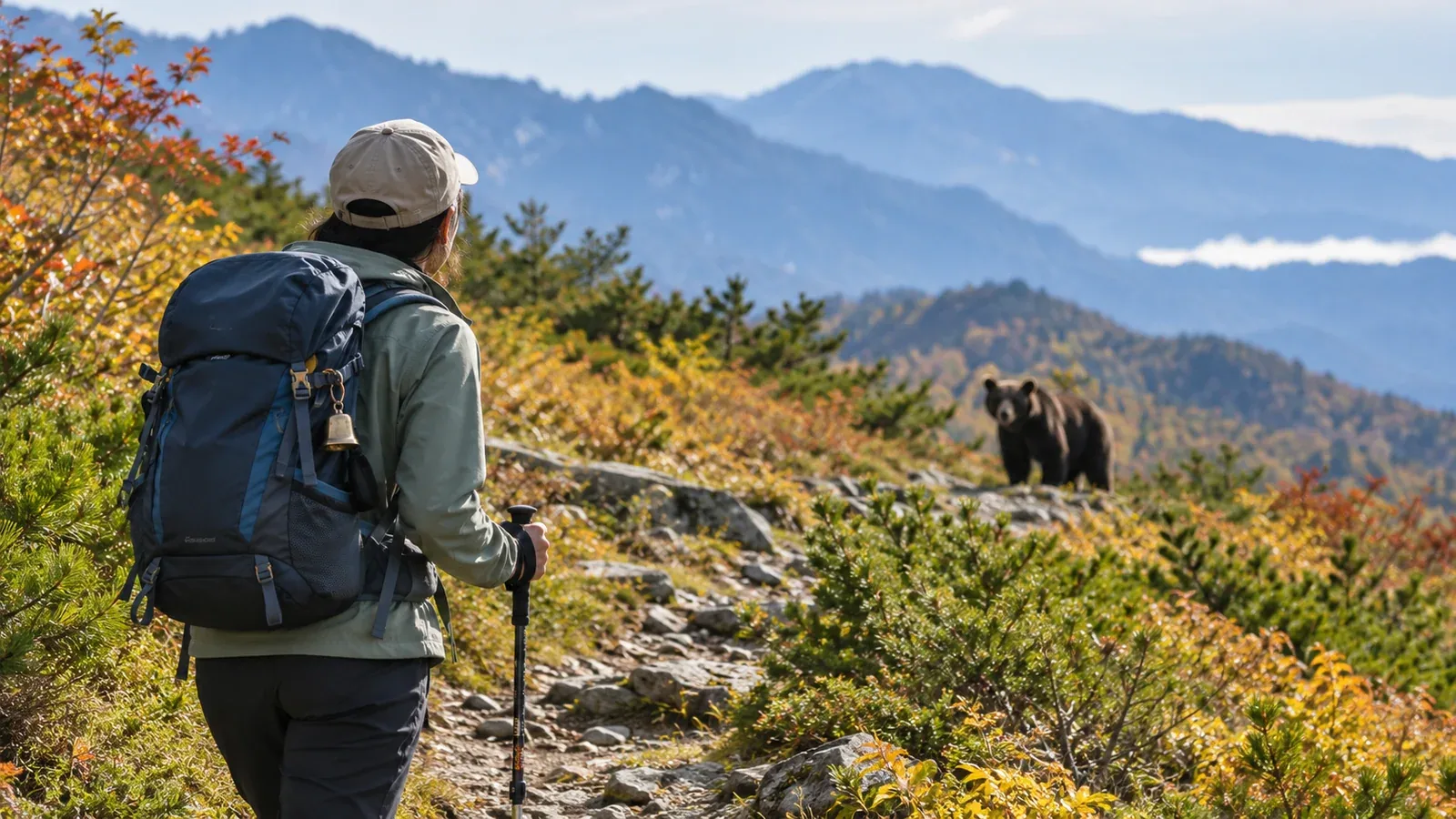
If you see a bear on the trail, keep your distance and avoid startling it. What you do next depends on how close it is, what it is doing and whether you have a safe way to leave. This guide covers preparation and what Japanese authorities advise in different situations.
A surprise encounter can provoke a defensive response, especially around cubs, food or a carcass. Avoid approaching and leave the bear a way to move away.
Bear behavior and sightings vary by area, season and individual. Brown bears live in Hokkaido and Asiatic black bears in parts of Honshu and Shikoku. Before hiking, check prefectural or municipal notices, trail closures and information from the park or hut.
Where to be especially alert
Think about places where you and a bear may not see or hear each other in time.
Pay attention around stream noise, dense vegetation and blind turns. Slow down and make your presence known before entering a stretch with poor visibility. If you see fresh tracks, droppings or a carcass, leave the area without investigating.
Bears can be active during the day as well as around dawn and dusk. Food availability and local conditions change through the seasons. Check recent sightings and closures for the route instead of relying on a time or month.
How to avoid a surprise encounter
Make your presence known before you see a bear
Talking with companions, calling out occasionally or using a bear bell where advised may reduce the chance of surprising a bear. Keep your distance from signs of recent activity.
A bell can be hard to hear beside running water or in strong wind. If hiking alone, use your voice where visibility is limited and follow local guidance. Stay alert even if you are making noise.
Pause before a blind bend or dense cover and look ahead. Avoid moving toward a sound or animal to identify it. If you cannot see or hear clearly and there are signs of a bear nearby, turn back.
Manage food and rubbish
Food, rubbish and scented items can attract bears. Follow the campsite’s rules and use designated lockers or approved containers where provided. Keep food and scented items out of sleeping areas where local instructions require it, pack out wrappers and scraps, and never feed wildlife.
If you see a bear at a distance
Stop and assess where the bear is going. Leave quietly by a safe route, giving it room.
- Do not run.
- Do not shout, throw anything or make sudden movements.
- Move away slowly while keeping track of the bear and your footing.
- Do not approach for a photograph or try to pass close by. Wait or turn back.
There is no fixed distance at which a retreat becomes safe. Give the bear as much space as the trail permits. If it has noticed you or is closer than you expected, stay calm and use the guidance below.
If you meet a bear at close range
Stay calm and leave it room
Keep the bear in view, avoid abrupt movement and look for a safe way to increase the distance. If you cannot move safely, avoid provoking the bear and let it leave.
- Speak quietly if needed to make your presence clear.
- Keep your movements slow and avoid waving your arms or throwing objects.
- Back away slowly while watching the bear and your footing. Do not turn and run.
If a bear charges or attacks
A charge can develop too quickly to know how it will end. Do not try to classify it before responding. Follow the guidance for the area and protect your face, head and neck if an attack is imminent.
If you carry a bear deterrent spray, know the product’s directions, range and safety controls before the hike. Have it accessible and use it only as directed if a bear approaches in a threatening way. Wind can change where the spray goes.
If a sudden attack is unavoidable, Japan’s Ministry of the Environment advises getting face down and protecting the face, head and neck with your arms. Follow local guidance and, when safe, call 119 if anyone is injured.
If you see cubs
Back away quietly. A mother may be nearby even if you cannot see her. Do not approach for photos or get between the animals.
Bear spray and its limits
Bear spray is one option for a threatening close encounter. Distance, wind, access and knowing how to use the product all matter.
Carry it in a holster you can reach, check the expiry date and use a training canister to practice if available. Do not spray food, clothing or a tent as a preventive measure.
Follow the storage and transport instructions, including heat limits. Japan’s Consumer Affairs Agency and Ministry of the Environment say bear spray cannot travel by air in carry-on or checked luggage. Arrange to obtain it after your flight if needed.
Before your next hike
Check local bear notices and closures before leaving. Read the park or municipality’s advice for the species in the area. Report a sighting to the local authority when safe. Nordwand’s Base Camp can help you discuss local conditions with other hikers alongside the official updates.
References
- Japan Ministry of the Environment bear encounter guidance
- Forestry Agency bear safety information
- Prefectural and municipal bear notices
- National Police Agency mountain incident statistics
References and sources
- Japan Ministry of the Environment — Bear safety in national parks
- Japan Ministry of the Environment — Bear injury reports and response, April 2026
- Shiretoko National Park — Brown bear safety
- Kinki Regional Environment Office — Asiatic black bear notices and guidance
- Forestry Agency — Bear safety in the Kanto Forest District
- Japan Consumer Affairs Agency — Bear spray selection, handling and transport
- National Police Agency — Japan’s 2025 mountain incident figures