
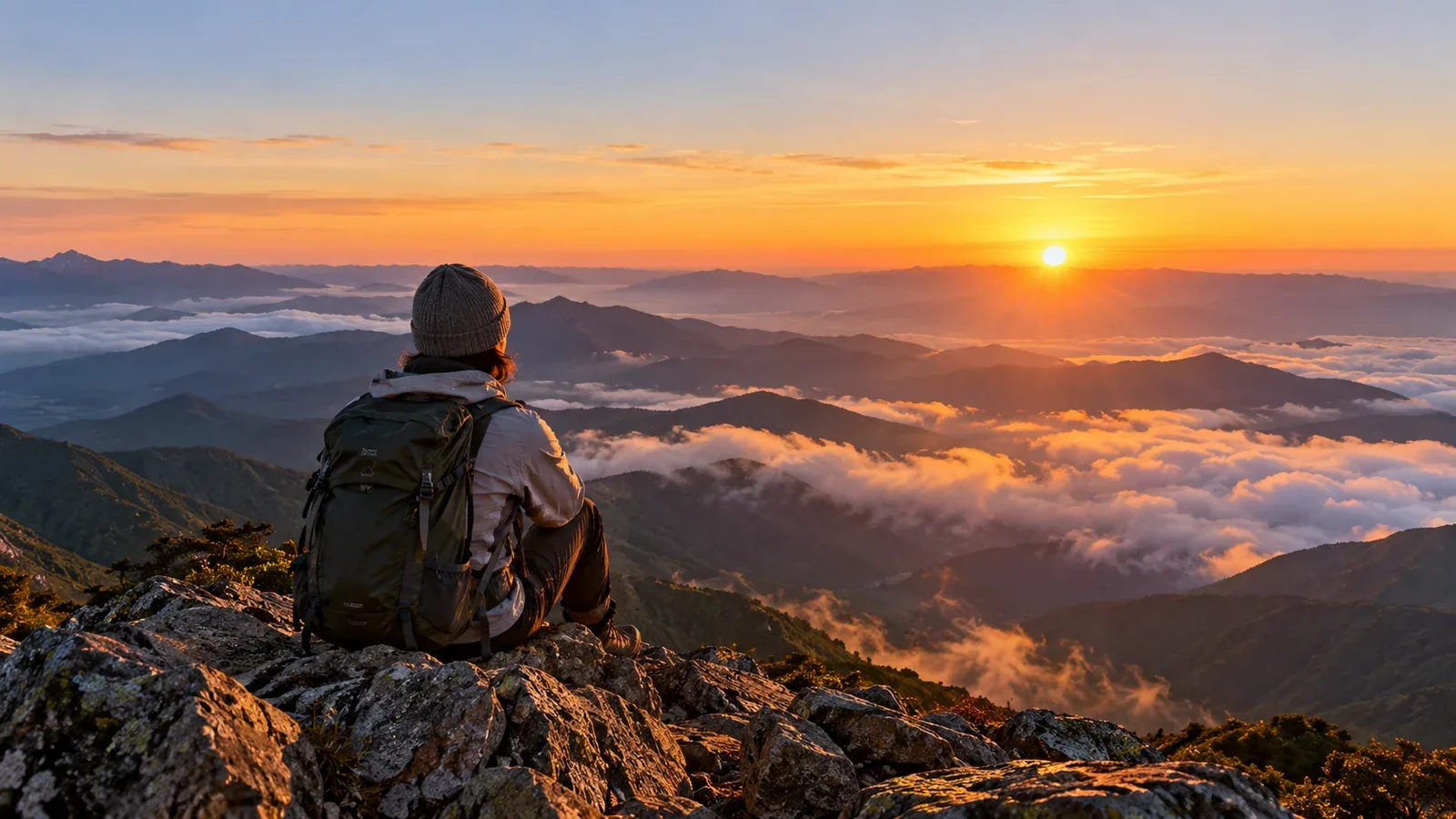
Many people take up hiking because they want to see goraikō, the sunrise from a mountain. Goraikō and hinode describe the same phenomenon, but the words are used differently. Knowing the background also helps you think through a dawn outing.
Hinode is the ordinary Japanese word for sunrise, the astronomical instant when the upper edge of the Sun appears on the horizon. The National Astronomical Observatory of Japan publishes sunrise times. Goraikō comes from Japan’s traditions of mountain worship. It expresses reverence for the sunrise seen from high on a mountain, as if witnessing the arrival of a deity or Buddha. It has long been used on sacred mountains such as Mount Fuji and Mount Ontake. Today it can also describe sunrise from a summit or ridge, or from above a sea of clouds. The word offers a window into Japan’s mountain culture.
This guide helps first-time sunrise hikers choose where to go, prepare for the outing and make decisions along the way.
Why a mountaintop sunrise feels special
You can watch the sunrise at low elevation too. A summit offers a different experience for several reasons.
First, there may be a sea of clouds below you. Moist air at the foot of the mountain can cool overnight and turn to fog or low cloud. From the summit the layer looks like a sea. As the Sun rises over it, the colour of the light plays across the shapes of the clouds. This depends on the weather, including the previous day’s humidity, wind and temperature changes. There is no guarantee you will see it.
An open horizon is farther away, which gives you a longer and clearer view of the Sun rising. A summit or ridge with few obstacles also lets you take in the changing colours of twilight across a wide sky.
At higher elevations there is less atmosphere above you. With less scattering along some lines of sight, the dawn colours can look more vivid, though the weather makes a considerable difference.
Planning a sunrise hike
Choose a mountain and season
If you are new to sunrise hikes, first work out when you can safely reach the summit. Sunrise times vary with season and latitude. Around the summer solstice in late June, the Sun rises early, so you need an earlier start if you plan to watch from the summit. Around the winter solstice in late December, sunrise is later, but winter skills and equipment are needed. Late spring or summer after the trails open, or early autumn, usually makes it easier to balance temperature, weather and daylight.
Look up the time in advance using a service such as the National Astronomical Observatory of Japan’s sunrise calculator. Depending on summit elevation and the horizon, you may see the Sun a few minutes earlier than on the plain. Work back from when you need to be at your viewing spot.
Work backwards from your summit arrival time
Aim to arrive 10 to 15 minutes before sunrise, so you can settle in while the sky brightens. How long it takes depends on the mountain, route and your fitness. Check the trailhead notices, the hut or the local land manager. It is easier to take a wrong turn in the dark. If you are new to dawn hiking, stay in a hut the previous night to shorten any pre-dawn walk, or wait until there is enough light to start.
Check the weather
Visibility depends on whether clouds or fog cover the direction of sunrise. Mountain weather changes quickly, and clouds can hide the summit even when it is clear below. Check several forecasts, including official and commercial mountain forecasts, and look again that morning. The effort of getting there can tempt you to press on. Decide before leaving that you will give up the summit if the weather deteriorates.
What to watch for before dawn
A sharp drop in temperature
Mountain temperatures fall between sunset and dawn. Even in summer, a light fleece or down jacket may be insufficient near a high summit. Waiting motionless for sunrise can make you feel colder still. Bring a windproof outer layer, gloves and a hat. Choose layers for standing still in the cold as well as walking uphill.
A headlamp is essential
Carry a headlamp with spare batteries for hiking at night or before dawn. A phone light drains the battery and occupies one hand. Cold can shorten battery life, so keep spares somewhere warm, such as an inside pocket.
Footing and falls
In dim light it is harder to see uneven ground, rocks and roots. Move carefully, especially if you are new to it. If you carry trekking poles, use them to help with balance where appropriate. On a route with rocky or chain-assisted sections, plan to cross them after daylight.
If you miss the sunrise
Cloud, rain or strong wind may keep you from seeing goraikō. A good way to plan is to enjoy it if conditions allow and count a safe return as a success either way. Even with the Sun hidden, you can see the changing colour on the ridge, light on clouds and the sky fading from blue to pale in the twilight. If being in the mountains at dawn is part of your aim, a cloudy morning can still be worth the outing.
A note that you did not see the sunrise is useful too. It can inform whether you choose a different mountain or season next time, or wait for a clearer forecast.
What to do next
Look up the sunrise time for a place near your chosen mountain with the National Astronomical Observatory of Japan and work backwards to your target arrival and departure times. Then check route times and current trail opening and access information from the hut, land manager or trailhead notices. Nordwand’s Base Camp lets you compare notes with other hikers planning the same mountain.
References
- National Astronomical Observatory of Japan: sunrise and sunset times and bearings
- Japan Meteorological Agency: mountain-weather information
- National Police Agency: overview of mountain incidents, including seasonal and time-of-day trends