
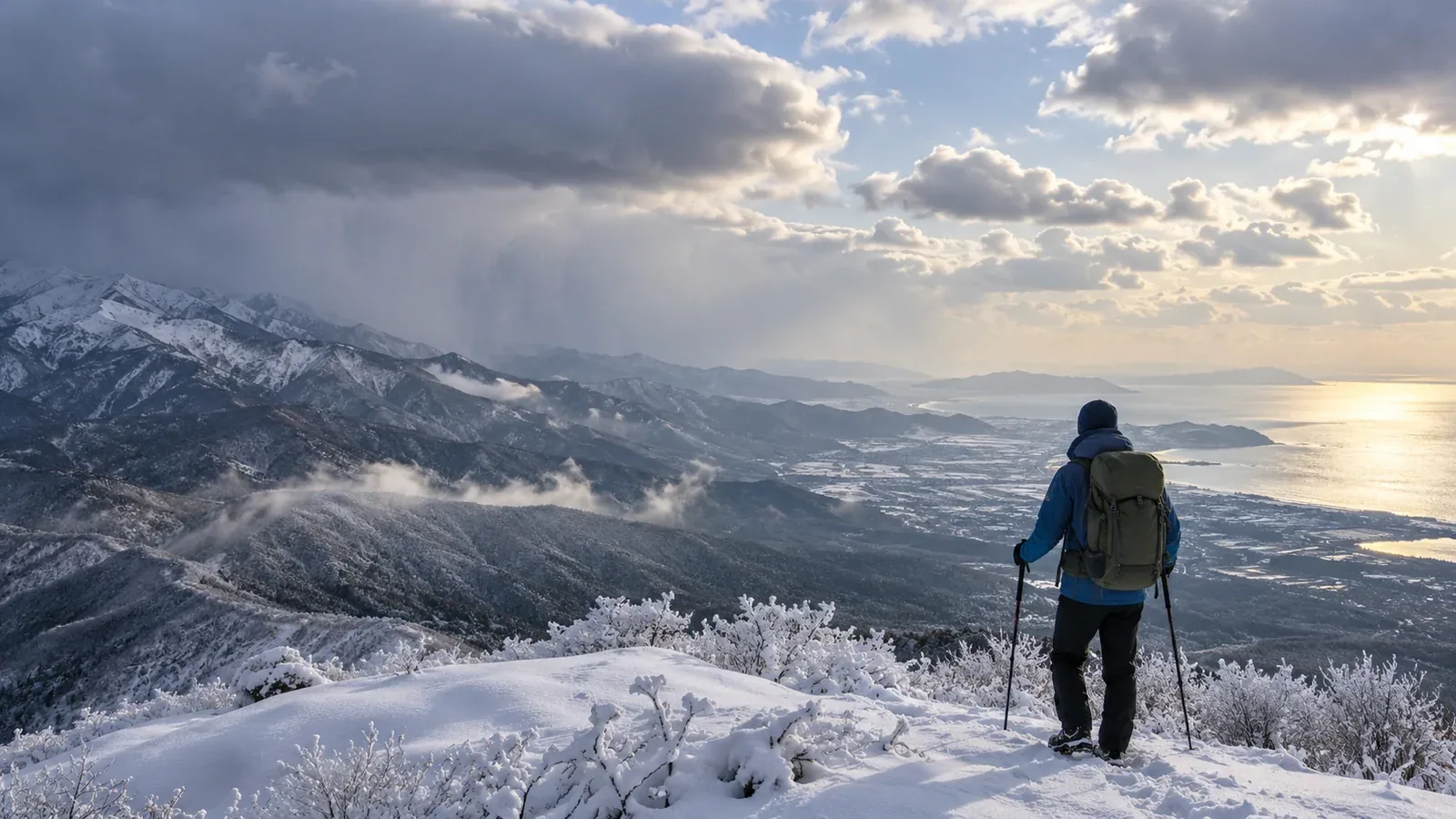
Japanese forecasts often say that the winter pattern is strengthening or that pressure will be high to the west and low to the east. These phrases are routine in the news, but what do they mean for a mountain hike?
Here is what the two terms mean, how they affect mountain weather and what decisions to make when you hear them.
“High west, low east” is a pattern on the weather map
Weather maps have curved lines, called isobars, that join places with equal pressure. “High west, low east” means high pressure west of Japan over the continent and low pressure to the east over the Pacific. This pattern favours northwesterly seasonal winds near Japan.
The arrangement can occur in other seasons but is particularly pronounced in winter. The Siberian High sends cold continental air across the Sea of Japan. The air picks up moisture over the water and produces heavy snow when it reaches the mountains on the Sea of Japan side. Drier air reaches the Pacific side, where skies may be clear even as exposed ridges are windy.
What it means when the winter pattern strengthens
The spacing of isobars gives a rough guide. When they are crowded together, the pressure gradient is steeper and winds tend to be stronger. Forecasts describe this as a strong or strengthening winter pattern.
For hikers it can mean three things.
- Severe winds on ridges. Lowland wind speeds alone do not tell you what to expect on a ridge. With little shelter, winds can strengthen considerably and the wind chill can be severe.
- Whiteout risk. In mountains on the Sea of Japan side, falling and blowing snow can wipe out visibility. On a ridge, you may be unable to distinguish the ground from the sky.
- Rapid changes. A calm morning can deteriorate sharply in the afternoon. Clear skies on their own are a poor guide to winter mountain conditions.
Mountains on the Sea of Japan and Pacific sides differ
Even on the same winter-pattern day, conditions vary greatly by range.
Mountains on the Sea of Japan side, including the Hida and Echigo ranges and the Dewa Mountains, can get heavy snow and strong wind at once. Poor visibility, avalanche risk and the effort of breaking trail through knee- or waist-deep snow can combine. A strong pattern is a reason even experienced hikers may stay away.
Mountains on the Pacific side, such as Okuchichibu, Tanzawa and Yatsugatake, may get less snow, but the wind on ridges can still strengthen. Clear skies can make it easy to underestimate wind chill and the risk of falling. A crosswind on a rocky ridge can knock you off balance and lead to a fall down the slope. Check the expected wind speed.
What to look for in the forecast
If you are new to winter hiking, get used to reading both the forecast wording and the weather map.
- Check Japan Meteorological Agency forecasts and advisories. Look for “winter pressure pattern” and “strong winter pattern”. Check the regional outlook for wind and precipitation, including snow.
- Consult a specialist mountain forecast. Some services cover particular ranges and give more detail than lowland forecasts, such as ridge wind and whether precipitation will fall as rain or snow. Check their official sites for coverage and any charges.
- Check again the evening before and the morning of the hike. The pattern can strengthen earlier than forecast. Use the latest information just before departure to make the final decision.
Making a decision when you hear “winter pattern”
The pattern alone does not close the mountains. Judge the range, elevation and route alongside your skills and equipment.
If it is forecast to strengthen, consider avoiding routes that go onto ridges or switching to a route that stays in the forest. Narrow ridges on low mountains can also be exposed, so look at the terrain in advance.
With little winter experience, a simple rule is to stay off ridges on days when the winter pattern is expected to strengthen. Increase the range of routes you attempt as you gain experience.
What to do next
When you check the weather for your planned area and see “winter pattern” or “high west, low east”, compare the Japan Meteorological Agency’s regional forecast with a specialist mountain forecast. Build that habit before heading out in winter. Nordwand lets you consult trip reports or ask a certified guide when gathering information.
References
- Japan Meteorological Agency: weather forecasts and reading weather maps
- Japan Meteorological Agency: meteorological information for mountains
- National Police Agency and prefectural police: mountain incident statistics